


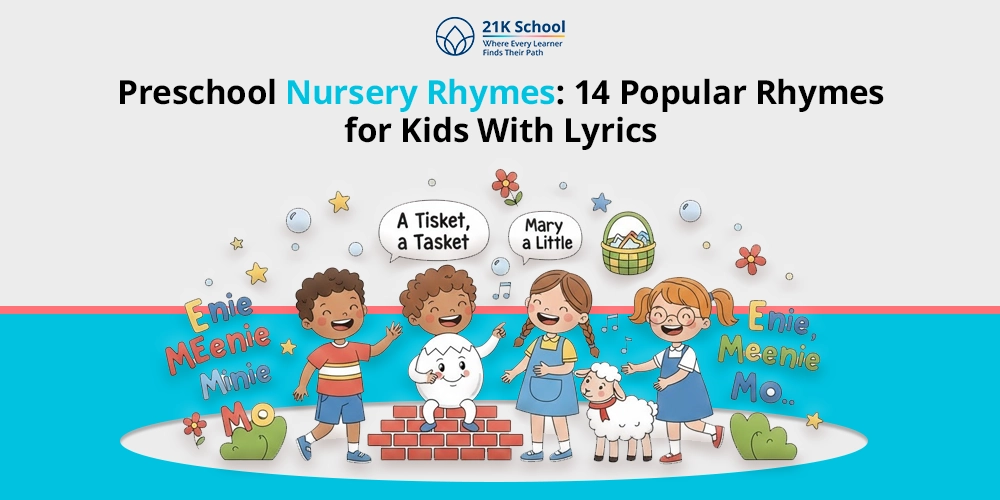
Preschool is a foundational stage for any child aged between 3 to 6. It is the beginning of an educational journey where students learn new things via rhythms, imaginative play etc.
Preschool nursery rhymes are one of the ideal ways of learning and engaging children to develop various skills like listening.
Have you ever tried nursery rhymes at home or school?
To make the experience better we will go through an informative blog to understand popular nursery rhymes, its importance, and how it is beneficial for skill development.
Table of Contents
- What are Preschool Nursery Rhymes?
- 14 Popular Preschool Nursery Rhymes for Children
- 1. Humpty Dumpty
- 2. A Tisket, a Tasket
- 3. Mary Had a Little Lamb
- 4. Eenie, Meenie, Minie, Moe
- 5. Baa, Baa, Black Sheep
- 6. Rock-a-Bye Baby
- 7. Five Little Monkeys
- 8. Jack and Jill
- 9. Twinkle Twinkle Little Star
- 10. Little Miss Muffet
- 11. The Wheels on the Bus
- 12. Itsy Bitsy Spider
- 13. Head, Shoulders, Knees, and Toes
- 14. Here We Go Round the Mulberry Bush
- Why Preschool Nursery Rhymes Are Important for Children? 4 Key Reasons
- 5 Key Benefits of Preschool Nursery Rhymes
- How Preschool Nursery Rhymes Support Early Literacy Skills? 4 Best Ways
- Preschool Nursery Rhymes and NEP 2020
- Conclusion
What are Preschool Nursery Rhymes?
Preschool nursery rhymes are simple and short poems or songs created for children. This helps them to develop listening, reading and imaginative skills through engaging words, repetition, rhyme patterns, and catchy tunes.
It is an ideal way to learn alphabets, numbers, and new words while playing.
14 Popular Preschool Nursery Rhymes for Children
There are a bunch of nursery rhymes parents at home and teachers in preschool can use to engage children.
Explore 14 most liked preschool nursery rhymes for children:
1. Humpty Dumpty
“Humpty Dumpty sat on a wall
Humpty Dumpty had a great fall
All the king’s horses
And all the king’s men
Couldn’t put Humpty together again.”
It is one of the most popular preschool nursery rhymes for children which engage them in a story of Humpty Dumpty.
Children carefully listen and enjoy the playful situation happening in the rhyme.
2. A Tisket, a Tasket
“A-tisket a-tasket
A green and yellow basket.
I wrote a letter to my love,
And on the way I dropped it.
I dropped it, I dropped it,
And on the way I dropped it.
A little boy
He picked it up and put it in his pocket.”
It is an amazing and cheerful rhyme indicating different colors, outdoor environment to engage children. The repetitive lines help in memorising words.
3. Mary Had a Little Lamb
“Mary had a little lamb,
Its fleece was white as snow;
And everywhere that Mary went
The lamb was sure to go.
It followed her to school one day,
That was against the rule;
It made the children laugh and play,
To see a lamb at school.”
A sweet and simple story rhyme about the girl named Mary and her lamb showcase a day in her life. The rhyme helps kids to laugh and learn storytelling sessions.
4. Eenie, Meenie, Minie, Moe
“Eeny, meeny, miny, moe,
Catch a tiger by the toe.
If he hollers, let him go,
Eeny, meeny, miny, moe.”
It is a playful rhythm mostly used as a counting or choosing rhyme. There are various versions of animals, colors, food etc.
5. Baa, Baa, Black Sheep
“Baa, baa, black sheep,
Have you any wool?
Yes, sir, yes, sir,
Three bags full;
One for the master,
And one for the dame,
And one for the little boy who lives down the lane.”
It is an ideal preschool nursery rhyme in which children are introduced to animals and share skills. The rhyme is beneficial for language repetition and social values.
6. Rock-a-Bye Baby
“Rock-a-bye, baby,
In the tree top:
When the wind blows,
The cradle will rock;
When the bough breaks,
The cradle will fall;
Down will come baby,
Cradle and all.”
The rhyme is often used to make children calm and relaxed. Repetiting helps promote positivity, trust, protection.
That’s why it is an ideal rhyme for a nap or quiet time.
7. Five Little Monkeys
“Five little monkeys jumping on the bed,
One fell off and bumped his head.
Mama called the Doctor and the Doctor said,
“No more monkeys jumping on the bed!”
It is an engaging yet joyful preschool nursery rhyme indicating fun and playful behavior of monkeys. It is ideal to introduce math skills and physical coordination.
8. Jack and Jill
“Jack and Jill went up the hill
To fetch a pail of water.
Jack fell down and broke his crown,
And Jill came tumbling after.
Up Jack got and home did trot
As fast as he could caper;
And went to bed to mend his head
With vinegar and brown paper.”
The rhyme shows a storyline in which children learn sequencing and new words like home, bed, paper, water etc.
9. Twinkle Twinkle Little Star
“Twinkle, twinkle, little star,
How I wonder what you are!
Up above the world so high,
Like a diamond in the sky.”
It is one of the most popular preschool nursery rhymes loved by children. The song encourages them to see the sky and imagine the world.
10. Little Miss Muffet
“Little Miss Muffet,
Sat on a tuffet,
Eating some curds and whey:
There came a great spider,
And sat down beside her,
And frightened Miss Muffet away.”
The rhyme indicates a story to engage children in emotions like happiness, fright etc.
11. The Wheels on the Bus
“The wheels on the bus go round and round,
Round and round, round and round.
The wheels on the bus go round and round,
All day long.”
In this rhyme children understand balancing and motor skills. They often mimic to engage in imaginative driving.
12. Itsy Bitsy Spider
“The itsy bitsy spider
Climbed up the water spout.
Down came the rain
And washed the spider out.
Out came the sun
And dried up all the rain,
So the itsy-bitsy spider
Climbed up the spout again!”
The rhyme is an engaging way of learning new words and looking at pictures to identify them.
13. Head, Shoulders, Knees, and Toes
“Head, shoulders, knees and toes,
Knees and toes.
Head, shoulders, knees and toes,
Knees and toes.
And eyes, ears, mouth, and nose.
Head, shoulders, knees and toes,
Knees and toes.”
The rhyme is ideal for students learning which includes basic education about body parts. The repetition helps in memory retention.
14. Here We Go Round the Mulberry Bush
“Here we go round the mulberry bush,
The mulberry bush,
The mulberry bush.
Here we go round the mulberry bush
On a cold and frosty morning.
This is the way we wash our face,
Wash our face,
Wash our face.
This is the way we wash our face
On a cold and frosty morning.”
It is a long rhyme indicating various good habits to kids to develop social skills and routine understanding.
Why Preschool Nursery Rhymes Are Important for Children? 4 Key Reasons
In early childhood education, children encounter many things. Rhymes are one of the playful yet engaging activities for them. However, it is also important because:
1. Language Development
Children at a young age develop various skills and language is one of them. Through preschool nursery rhymes they explore new words, sounds, and sentence patterns.
Singing the rhymes helps children to improve their speaking skills, thinking skills, correct pronunciation, improve vocabulary etc.
2. Cognitive and Brain Development
One of the reasons to introduce rhymes at a young age is the cognitive and brain development of children.
This means children at the same time learn how to count and sequence, cause and effect, patterns and repetition etc. This leads to memory, attention, and thinking skills.
3. Social and Emotional Development
By understanding the rhymes children can explore various social and emotional behaviors important to them.
The rhymes connect them with joy, happiness, scare and frighten etc.
4. Physical and Motor Skill Development
By enjoying the rhymes through body movement and activities shown in picture books help children to develop physical and motor skills.
They help children to learn hand-eye coordination, fine and gross motor skills etc.
5 Key Benefits of Preschool Nursery Rhymes
Children develop in multiple ways in early childhood and preschool nursery rhymes are one of the beneficial for education. Some key benefits are:
1. Enhances Listening and Concentration Skills
Children who listen to nursery rhymes often enhance their listening and concentration skills, as they focus on sounds, words, and rhythms.
These are essential skills that help with classroom learning and instructions.
2. Improves Early Literacy Readiness
Preschool nursery rhymes are effective for children’s early literacy readiness. They listen to sounds, words, and language patterns to understand concepts and activities.
3. Builds Imagination and Creativity
Including preschool nursery rhymes in early childhood help children to build imagination and creative skills. They can identify objects and use imagination to express their thoughts effectively.
It promotes various activities like playing, drawing, or storytelling.
4. Encourages Active Participation
Preschool nursery rhymes encourage children to participate actively. They follow the rhymes, listen, sing, clap, move, and act.
This helps them to enjoy learning new things.
5. Supports Holistic Development
Preschool nursery rhymes support holistic development which means children are able to develop language, cognitive, emotional, social, and physical skills together.
It is important for long-term academic and personal growth.
How Preschool Nursery Rhymes Support Early Literacy Skills? 4 Best Ways
Preschool nursery rhymes are a supportive and meaningful approach especially to enhance children’s early literacy skills. The 4 best ways includes:
1. Phonological Awareness
Phonological awareness is an ability children develop through nursery rhymes in which they recognise and work with sounds in spoken language.
It is ideal for early childhood learning to understand how to read and spell later on.
2. Rhyming Words and Sounds
To learn rhyming words and introduce different sounds nursery rhymes are effective. It is helpful for children’s upcoming academic journey.
3. Pre-Reading Readiness
Through nursery rhymes children prepare for reading. They introduce unique words, emotions, and basic stories that help them to practice reading by themselves.
4. Listening Comprehension
Listening is a primary step to learn and nursery rhymes help to improve a child’s ability to understand spoken language.
From listening to words to following the instructions and comprehending simple stories, prepare them for classroom learning.
Preschool Nursery Rhymes and NEP 2020
The National Education Policy (NEP) 2020 strongly focuses on early childhood care and education (ECCE).
The academic structure of the new national education policy is based on the 5+3+3+4 system. Here, students start with spending five years in the foundation stage which includes preschool.
NEP 2020 does provide curricular guidance through the 5+3+3+4 framework, with the foundational stage focusing on play-based and activity-based learning. Every preschool varies in their curriculum due to the vagueness of the syllabus to be taught.
That’s why NEP 2020 doesn’t provide any specific guidelines on the implementation of preschool nursery rhymes.
However, schools and parents can integrate preschool nursery rhymes for early growth and development.
Conclusion
Preschool nursery rhymes are an important part of children learning with fun and engaging songs. It helps in child development in the foundational stage.
Other than academics, it also enhances basic skills like listening, speaking, reading, and writing. Teachers can use books, games, and activities to promote rhyming ability.
Preschool nursery rhyming is a powerful technique to the base of child literacy and continuous learning. Engage children in nursery rhymes and let them take the first step towards growth.
