


With time, the way of learning is evolving. Students are adapting modern approaches to education with the aim to achieve their desired academic goals.
As we move towards the fast-paced and technology-driven world, the need for learning has changed. Now, students look for more flexible, personalised, and stress-free learning.
To meet their needs one of the effective approaches is known as self-paced learning.. To understand the term self-paced learning let’s go through a detailed guide that helps you to know everything from benefits to examples.
Table of Contents
- What is Self-paced Learning?
- Common Examples of Self-paced Learning
- 5 Benefits of Self-paced Learning
- How to Implement Self-Paced Learning? 7 Easy yet Effective Ways
- 5 Key Role of Teachers and Parents in Self-Paced Learning
- 5 Disadvantages of Self-Paced Learning
- 3 Tools and Resources That Support Self-Paced Learning
- Conclusion
What is Self-paced Learning?
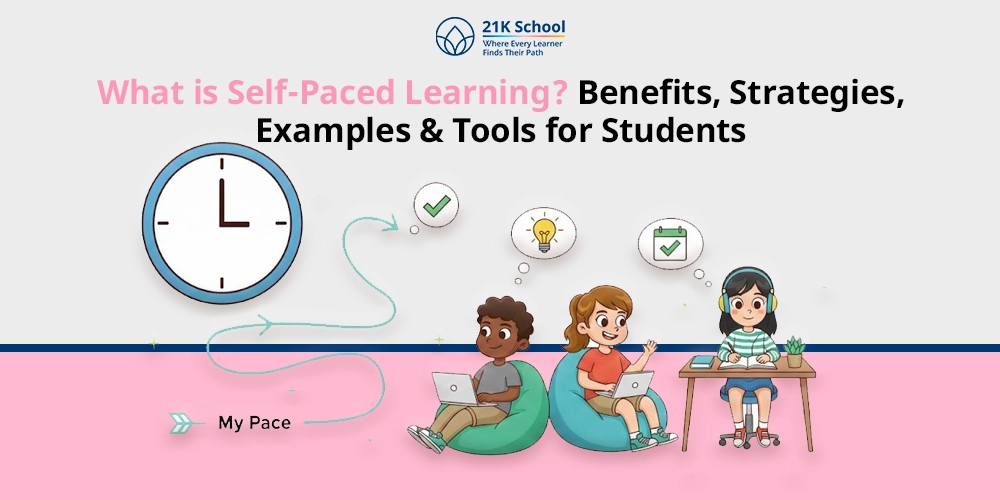
Self-paced learning is an approach in which students learn at their own pace and desired time and structure instead of a fixed schedule or classroom timeline.
It is one of the ideal approaches where students can start, stop, pause, review as per comfort level.
Common Examples of Self-paced Learning
Some common examples of self-paced learning includes:
- Online Courses: Students choose various platforms like Coursera to learn new chapters/topics for upcoming tests.
- Skill-Based Learning Apps: Students can learn different skills like coding, learning new language, or test preparation with flexibility.
- Recorded Lectures: To study at their own pace, children can learn through recorded lectures where one can start, pause, and stop anytime.
5 Benefits of Self-paced Learning
Self-paced learning gives the opportunity to learn effectively without any rush or stress. Some of the common benefits of self-paced learning include:
1. Flexibility in Schedule
Students often look for flexibility in their schedule through which they can also participate in other activities.
And self-paced learning offers the same benefits to learners so that they can learn anytime, anywhere without distractions.
2. Personalised Learning Experience
As we know, each student is unique and their requirements are different. Self-paced learning recognises the need and offers personalised learning experience.
With self-paced learning students can:
- Learn fast or slow
- Learn in morning or evening
- With customised approaches
3. Better Retention and Understanding
To improve knowledge retention and deep understanding, learners can control their pace of learning concepts, revisions, and self-assessments.
Remember, the stronger understanding leads to long-term memory retention.
4. Develops Discipline and Time Management
Self-paced learning brings flexibility in the education system where students can plan schedules, realistic goals, and self-learning.
With time this helps them to develop discipline, consistency, and time management skills.
5. Reduces Anxiety and Peer Pressure
Learners often feel pressure to compete in the classroom with peers. However, with self-paced learning students can avoid anxiety and peer pressure and focus on self-improvement rather than competition.
This promotes positive thoughts and well-being.
How to Implement Self-Paced Learning? 7 Easy yet Effective Ways
There are many benefits of self-paced learning students can avail in their learning journey. But understanding how to implement self-paced learning is essential:
1. Creating a Study Routine
Start with creating a study routine based on flexibility. A study routine must:
- Provides structure
- Prevents procrastination
- Ensures consistent progress
Allocate desired time, space, and methods to make learning effective.
2. Following the Pomodoro Technique
By following the pomodoro technique students can increase their productivity focus, reduce burnout.
In this process:
- Studying for 25 minutes
- Taking a 5 minute break
- Repeating the cycle
3. Using Spaced Repetition
Using spaced repetition refers to revising the content in increasing intervals to improve memory and avoid forgetting which leads to high retention rates.
4. Note-Taking Strategies
One of the popular yet effective strategies is note-taking in which students can organise their notes to revise faster and clearer.
Some popular methods include:
- Mind maps
- Cornell notes
- Bullet points
- Digital notes
5. Active Learning Methods
Students instead of passive learning approach use active learning to improve understanding and engagement.
For example:
- Solving problems
- Teaching concepts to others
- Writing summaries
- Practising quizzes
6. Organising Materials
Students who disorganise material often reduce focus and waste learning time. For stress-free learning:
- Arrange notes by subject
- Use folders
- Keep learning tools easily accessible
7. Tracking Progress
To understand the progress over time one should track the content assigned vs. achieved.
This gives clarity in learning and motivates to increase productivity.
5 Key Role of Teachers and Parents in Self-Paced Learning
Discover the top 5 key roles of teachers and parents in self-paced learning:
1. Creating Guidelines
Students in self-paced learning create their own schedules and timeline. However, they can also take help from teachers and parents to strategize clear objectives.
2. Monitoring Progress
Self-paced learning promotes self-tracking methods to understand progress. But, teachers and parents can also help in supportive monitoring instead of controlling.
3. Providing Feedback
Getting constructive feedback improves performance, builds confidence, and helps students to understand mistakes and rework.
4. Encouraging Accountability
Teachers and parents can encourage student accountability by conducting periodic check-ins, encouraging self-assessment, and celebrating milestones.
5. Emotional Support
Students who learn at their own pace often need emotional support from time to time to become focused, maintain consistency, and growth.
Teachers and parents can create a positive learning environment that leads students to achieve desired goals.
5 Disadvantages of Self-Paced Learning
Some common disadvantages of self-paced learning are:
1. Need of Self-Disciplined Environment
In self-paced learning students need to create a self-disciplined environment to achieve desired outcome.
However, this can be difficult for some students.
2. Lack of Continuity
Students may experience learning gaps or continuity issues especially when students fail to schedule their learning process.
This can disturb the environment and create trouble for previous knowledge.
3. Limited Real-Time Interaction
Implementation of self-paced learning often limits students real-time interaction with teachers and peers.
Students feel isolated due to lack of real-life interaction.
4. Digital Distractions
Students often feel distracted in online learning environments. This can lead to social media distractions, notifications, screen fatigue etc.
One should manage their habits to avoid distractions.
5. Overload of Content
Unlimited access to resources often confuse students which is a kind of distraction. That’s why selecting quality over quantity is essential.
3 Tools and Resources That Support Self-Paced Learning
Discover various tools and resources that support students self-paced learning in the 21st century:
1. Quizzes and Flashcards
Quizzes and flashcards are the ideal tools which help students in self-assessment, quick revision, memory retention.
In this way, students can measure their learning and reorganise if needed.
2. Coursera
Coursera is a platform through which students can pursue self-paced online courses with certificates from universities.
Here, students get a flexible deadline option.
3. Notion
Notion is a versatile, all-in-one workspace which is used for notes, tasks, project management, and knowledge base.
In this way, students can easily organise notes, track goals, and create study planners.
Conclusion
Students often feel scared to implement new ways of learning.
However, by understanding the particular approach like self-paced learning one can implement without any obstacles. So, students must discover the right strategies, tools, and support from teachers and parents in detail.
I hope the content helps to understand everything about self-paced learning in-depth

You may also want to read
CBSE Passing Marks Out of 100: Theory, Practicals & Grading

- Last updated on: 04 Mar, 2026
- 6 min read