Toughest Board in India: IGCSE, ICSE, CBSE or IB? An Honest Comparison
 Written byAnshu KumariContent Specialist
Last modified: 22 Oct 2026 7 min read
India already has so many educational boards that students follow to make their future bright.
But, do you know the toughest board in India? To answer that question, we would first have to know what defines toughness for us.
Each board of education has its own significance and is accepted individually by our national universities and government.
The basis of finding the toughest board would be syllabus, curriculum, exam patterns, and assessment levels, and we will find that after reading the following article.
What is the toughest board in India?
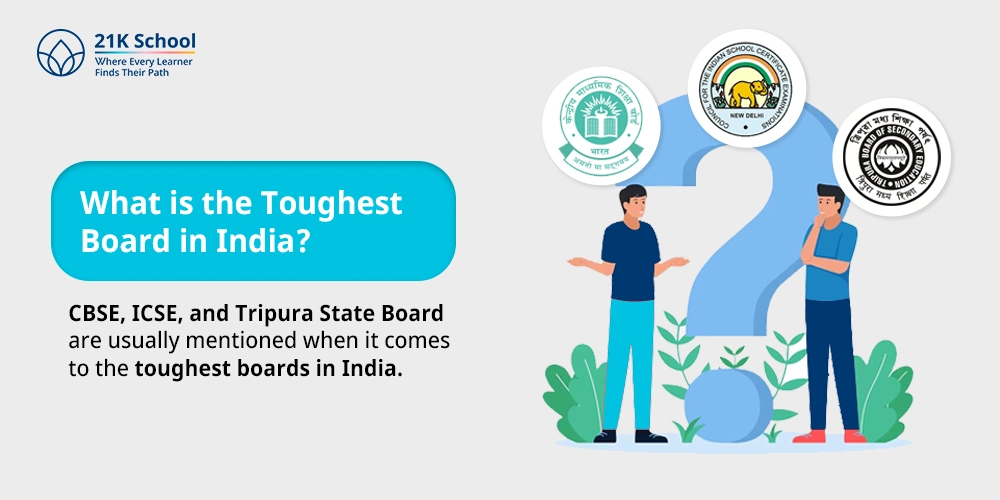
CBSE, ICSE, and Tripura State Board are usually mentioned when it comes to the toughest boards in India.
Among these, ICSE board can be regarded as the toughest board, as it has an elaborate syllabus, emphasis on English language abilities, detailed conceptual understanding, and extensive assessment processes.
CBSE, on the other hand, is more competitive in nature. It is well-structured and is especially useful to those students who are preparing for national entrance examinations.
Apart from this, Tripura Board of Secondary Education also earns its place in the list due to its highly rigorous and difficult question papers.
List of toughest state boards in India
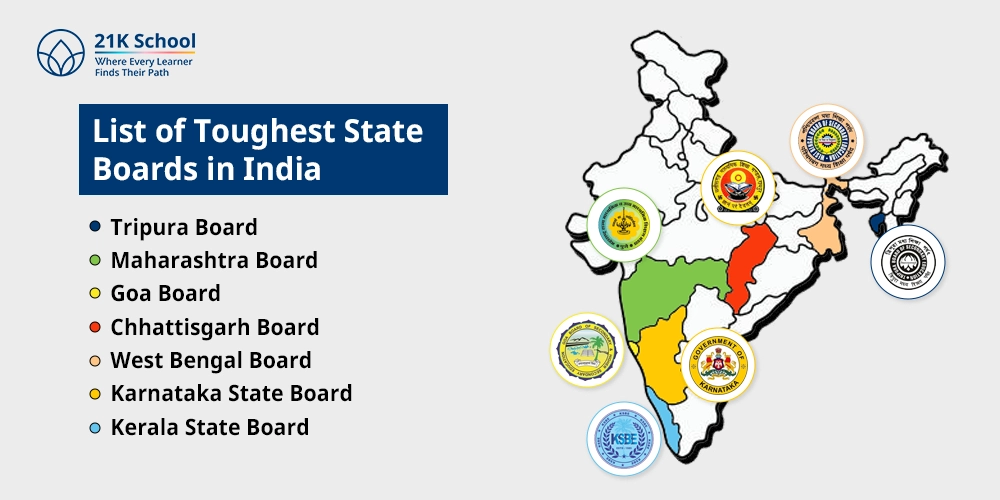
The toughest state boards in India form the following list as per their exam syllabus and workload:
- Tripura Board
- Maharashtra Board
- Goa Board
- Chhattisgarh Board
- West Bengal Board
- Karnataka State Board
- Kerala State Board
Major education boards in India
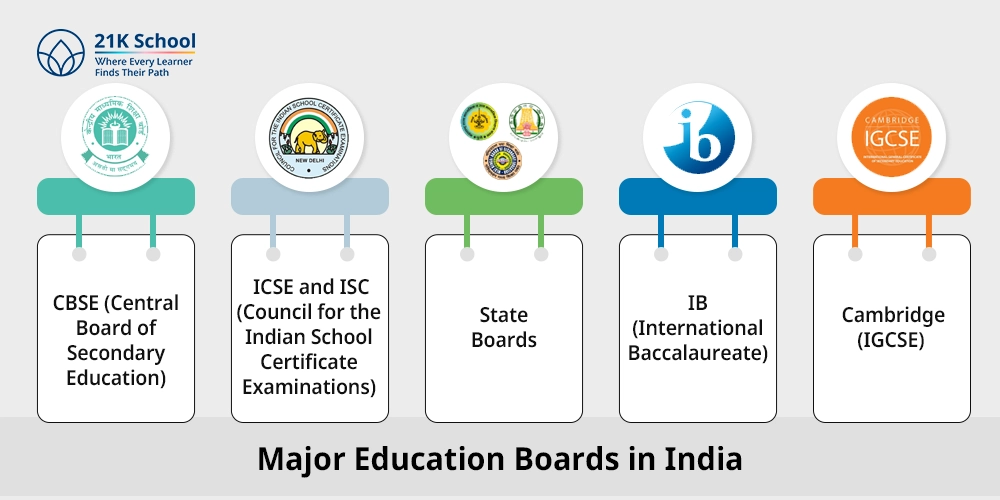
The below mentioned education boards in India are some of the most famous ones among Indian students and parents:
1. CBSE (Central Board of Secondary Education)
The Central Board of Secondary Education is one of the most popular boards in India. It is based on the NCERT curriculum and is nationally recognized.
CBSE focuses mainly on conceptual clarity and systematic learning.
Their curriculum is intellectually focused since it closely resembles national competitive exams for engineering, the military, the civil service, and medicine.
2. ICSE and ISC (Council for the Indian School certificate examinations)
The CISCE board conducts Class X (ICSE) and Class XII (ISC) examinations on a national level and was established in 1967.
This board follows a comprehensive and thorough syllabus.
It lays emphasis on the English language proficiency, literature, analytical thinking, and project-based internal assessments.
Students have to write descriptive and in-depth answers, which many students find academically challenging.
3. State boards
The state boards operate under distinct state governments and plan their curriculum according to the regional interests in education.
Although some of the state boards might have a more basic syllabus than ICSE or IB, they are characterized by strict marking and a high level of academic competitiveness in the state.
4. IB (International Baccalaureate)
The International Baccalaureate has internationally known programs like IB Diploma Program
IB focuses on inquiry-based learning and critical thinking.
Students can practice writing an Extended Essay and learn about the Theory of Knowledge, as well as internal assessments.
This puts IB among one of the strictest and time-consuming boards in India.
5. Cambridge (IGCSE)
Cambridge Assessment International Education provides another alternative examination internationally, and it operates the IGCSE and A-Level exams.
Cambridge programs are characterized by the clarity of the concepts and the flexibility of the subject options.
The assessment format promotes critical thinking and project-based learning.
What makes a board "Tough"?
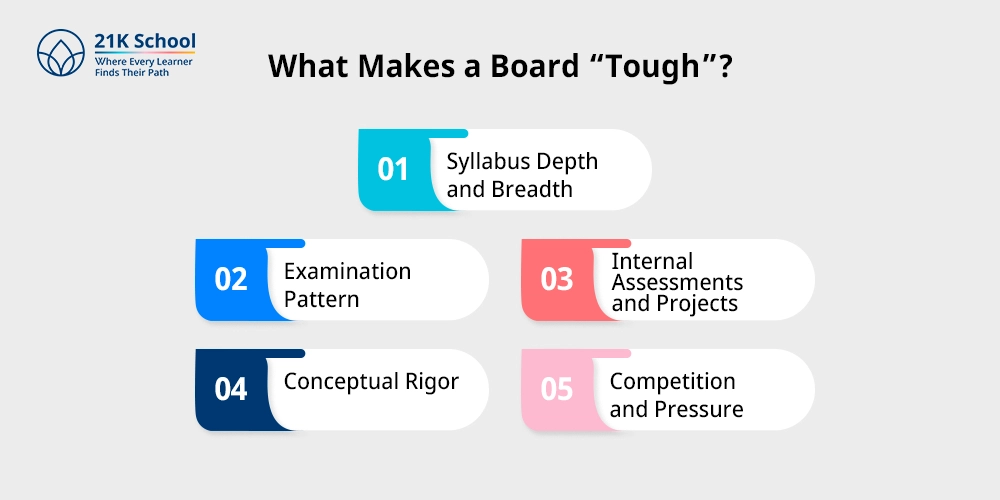
Among so many boards being chosen by children all over the nation, how can we decide which one is the toughest. Well, you can describe toughness of a board based on the following features:
1. Syllabus depth and breadth
A board can be called tough when its syllabus has in-depth learning content, is rigorous, and consists of practical assessments. Boards like IB and ICSE are found tougher due to fulfilling these criteria, instead of just focusing on rote learning.
2. Examination pattern
Evaluation through case studies, research papers, application-based, and analytical types of questions is difficult as opposed to direct, memory-based examinations.
The boards who have a stricter examination procedure and grading system are considered tough.
3. Internal assessments and projects
Boards such as IB and ICSE demand research projects, presentations, and practical works, which puts the benefits of the ICSE board into sharper focus while making the academic work pressure more intense.
4. Conceptual rigor
When a board is dedicated to critical thinking and problem-solving rather than on rote memorization, then it is often thought to be more difficult.
5. Competition and pressure
Boards whose syllabus and curriculum align with competitive examinations are intense, and consequently become more demanding.
Is ICSE the toughest board in India?
ICSE is often regarded as one of the most difficult Indian boards due to its elaborate syllabus and a rigorous language-oriented assessment.
Learners are supposed to submit detailed responses and show in-depth knowledge.
The significance of internal assessments and projects is an extra burden on schoolwork.
Though, highly competent students with excellent writing skills and analytical abilities might find ICSE more appropriate.
Is CBSE the toughest board?
CBSE is strong fundamentally and competitive, but might not always be the toughest considering its syllabus length.
The key strength of it is the conceptual clarity and alignment with competitive tests.
Students who are interested in working in the fields of engineering and medicine usually agree that the benefits of CBSE board make it the most appropriate choice. This is because its content is in alignment with the syllabus of the national entrance tests.
To some students, the competition aspect of CBSE could be very stressful.
Is IB the toughest board in India?
IB has been considered one of the most demanding boards because of its holistic and research-based nature.
Students have to write longer research papers, internal assessments, and cross-disciplinary courses like Theory of Knowledge.
It is academically rigorous since it focuses on independent learning and international standards of evaluation.
The key to success in IB programs is time management as well as analytical thinking.
Side-by-side comparison: ICSE vs CBSE vs IB
You can see differentiation of various Indian boards in the table given below, and for a deeper comparison between IB and CBSE you can refer to this detailed guide:
| Feature | ICSE | CBSE | IB |
|---|---|---|---|
| Syllabus | Detailed and extensive | Structured and concept-based | International and analytical |
| Exam Pattern | Descriptive answers | Balanced theory and application | Analytical and research-based |
| Internal Assessment | Important | Moderate | Very high weightage |
| Language Emphasis | Strong English focus | Moderate | Multiple languages |
| Competitive Exam Support | Moderate | Strong | Not specifically aligned |
Final comments
Among so many boards in India, ICSE is considered the toughest, though other boards also hold significance.
Many state boards are individually tough due to their strict exam conduct and comprehensive structure.
Apart from this, CBSE is recognized all over India because it is aligned with competitive exams that lead to government jobs, as also outlined in the Indian curriculum overview.
This shows that different boards suit different learners and they need to choose what's best for them.
Frequently asked questions
7 questions
Which is the toughest board in India?
Most often, ICSE is considered the toughest board in India.
Is CBSE tougher than ICSE?
No. ICSE is tougher due to its elaborate syllabus and stricter assessment methods. While CBSE is more objective-based and favors competitive exams and focuses on conceptual clarity.
Which board is best for competitive exams like JEE and NEET?
CBSE is the best board if students want to appear in exams like JEE and NEET.
Does studying in the toughest board guarantee success?
Success cannot be decided by any board but individual commitment and hard work towards it.
Are State Boards easier than CBSE or ICSE?
The syllabus used by some state boards might be relatively easier, although it differs across states.
Which is the 2nd toughest exam board?
Maharashtra State Board is the 2nd toughest exam board in India after Tripura State Board.
Which state board is toughest in India?
The toughest state board in India is the Tripura state board.
About the author
Anshu Kumari
Content Specialist
Anshu Kumari is an Education Content Specialist at 21K School- a fully accredited institute- Cambridge International (IA702) and Pearson Edexcel (94883). She focuses on the in-depth research and creation of the well-drafted guides on NIOS admission, Indian Education Policy, and competitive exam preparation. With around 2 years of experience at 21K School, her psychology background informs her approach to the education content and hence focuses on creating guides to address the real anxieties of the guardians. She writes well-researched articles on competitive exam timelines, stream selection, and board choices by referring to the official resources. All Anshu’s content pieces are fact-checked against the board and primary government official resources and is dedicatedly reviewed by the school’s academic team.
Every 21K School guide is written by our education team and reviewed by a subject facilitator before publishing.
Exploring a CBSE-pathway online school?
Talk to an advisor about 2026–27 admissions — no obligation.
Talk to an advisorComments
No comments yet — be the first to share your thoughts or ask a question.