Pedagogical Structure in the Proposed NEP 2020 - 5+3+3+4 Framework Explained
 Written byAnshu KumariContent Specialist
Last modified: 1 Sep 2026 9 min read
Do you know about the pedagogical structure proposed in the NEP 2020?
National Education Policy (NEP) 2020 is one of the most transformative policies that has taken place in the history of educational reforms.
With this new change in structure, the policy brought foundational education into the system, thus giving importance to a child's early development.
If you really want to know all the necessary details about the new pedagogical structure in the latest NEP, you can refer to this piece.
What is pedagogical structure in the proposed NEP 2020?
The pedagogical structure in the proposed NEP 2020 is a new education framework that accepted the 5+3+3+4 system and dismissed the old 10+2 system. "Education for All, Lifelong Learning for All" is a clear objective of the new National Education Policy.
This was a well-thought-out change as it considered the significance of preschool education for kids before precisely focusing on their academic training.
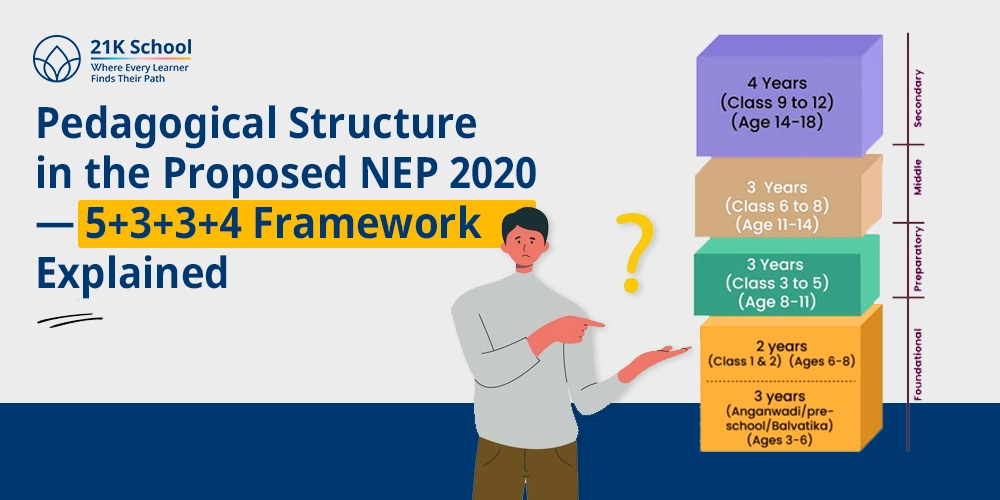
In the new education system, there are four educational stages that are divided depending on the age of children between 3 and 18.
These stages are the foundational stage (for children aged 3- 8 years), preparatory stage (for children aged 8- 11 years), middle stage (for children aged 11- 14 years), and secondary stage (for children aged 14- 18 years).
The foundational stage has brought a major change in structure as it has 3 separate years of early childhood education, including basic numeracy and communication abilities.
Why did NEP 2020 change the pedagogical structure?
The previous system devised the same learning styles for all learners, ignoring the fact that different children require different ways of training, depending on their cognitive development. As a result, this way of approaching education was ineffective.
NEP 2020 has solved this problem by introducing the 5+3+3+4 structure, so that each stage aligns with the development needs of the student.
Besides, keeping pace with the global education system is also an important factor.
In the current era, along with theoretical knowledge, skills, creativity, critical thinking and problem-solving ability are very important. NEP 2020 has introduced a methodology that prepares students for real life.
Pedagogical structure in the proposed NEP: The 5+3+3+4 structure of NEP 2020 explained
The National Education Policy (NEP) underwent changes and came up with the new 5+3+3+4 structure. The structure is explained accurately in the section below:
1. Foundational stage (5 years)
The foundational level includes 3 years of pre-school that consists of nursery and both levels of Kindergarten, and grades 1 and 2. Children aged 3 to 8 are usually placed in this level.
This stage is based on activity and can be said to apply play-based learning, where foundational literacy and numeracy are the prime focus.
The kids are exposed to the classroom environment to let them attain social skills and communicate.
2. Preparatory stage (3 years)
The next 3 years of children's lives are for the preparatory stage, ranging from classes 3 to 5.
Learners are introduced to a more formal setting of classrooms where they are trained to score well in exams and learn about the concepts included in the syllabus.
Formal instruction is in reading, writing, mathematics, and languages, with practice of art, music, and craft.
This level prepares the students to learn further to internalise knowledge of environmental science, basic computational thinking, rational problem-solving , and conceptual proficiency.
3. Middle stage (3 years)
The middle stage (grades 6 to 8) consists of students from ages 11 to 14. Subject-based learning begins here, and emphasis is placed on developing students’ analytical skills.
Subjects such as science, mathematics, social studies, etc. are taught in depth. In addition, coding and skill-based learning are included.
The main focus is towards experimentation and research to build a foundation for experiential learning (design, technology, information communication, farming, and coding).
The most common ways to experience education in this stage might include developing critical thinking and self-directed learning.
4. Secondary stage (4 years)
In this stage, learners are in the age group of 14-18; their board exams are held in Class 10 and Class 12.
It puts emphasis on future preparation for career choices based on personal choices and interests, comprising arts, science, and commerce streams.
This gives a multidisciplinary education choice revolving around research, higher learning, and other internship opportunities.
Pedagogical structure in the proposed NEP: New circular framework and 5+3+3+4 structure
The latest National Education Policy, 2020, introduced the 5+3+3+4 educational system. The new structure is more focused on holistic performance and interdisciplinary tutoring to tackle the challenge of real life.
It divides the whole schooling process into four discrete phases named the foundational stage, preparatory stage, middle stage, and secondary stage.
This pattern cuts across the ages 3-18, and in the first instance, it establishes preschool education as a part of the mainstream schooling sequence.
In this way, the new circular provides learners an opportunity to explore their likes and dislikes when small, and then follow a structured framework that aligns with their brain development levels.
Differences between new (5+3+3+4) and old (10+2) structure
The new 5+3+3+4 education system has significant differences from the old 10+2 structure. Some of the major ones are included in the table given below:
| Aspect | New 5+3+3+4 System (NEP 2020) | Old 10+2 System |
|---|---|---|
| Structure | 5 years (Foundational) + 3 years (Preparatory) + 3 years (Middle) + 4 years (Secondary) | 10 years (General Schooling) + 2 years (Higher Secondary) |
| Age Group | 3-18 yrs (Nursery to Class 12) | 6-18 yrs (Class 1-12) |
| Entry Age | Starts at age 3 | Starts at age 6 |
| Focus | Emphasis on holistic development of learners and their skill-based training | Primarily academic and exam-focused |
| Foundational Stage (5 years) | Includes 3 years of preschool + Classes 1-2; play-based and activity-based learning | No official preschool stage included |
| Assessments | Continuous and competency-based. Includes formative assessments and summative assessments | Mostly summative (annual exams and board exams) along with formative tests |
| Board Exams | Taken in Classes 10 & 12 but redesigned to test application & analysis | Traditional memory-based board exams in Classes 10 & 12 |
| Subject Choice | Flexible subject combinations, having science, commerce, and arts streams. Skill-based subjects also included. | Rigid streams (Science, Commerce, Arts) from Class 11 onwards |
| Technology Use | Strong focus on digital learning, coding, computational thinking | Limited emphasis on technology integration |
| Outcome Goal | Critical thinking, creativity, life skills, flexibility, and employability | Exam scores and content knowledge |
Key features of the pedagogical structure in the proposed NEP 2020
The following are the characteristic features of the NEP pedagogical structure proposed in 2020:
1. Child-centric learning
The new framework of NEP 2020 focuses on a child's cognitive development and age. It ensures that children grow holistically instead of just in academics.
The emphasis on multilingualism and play-based learning shows the seriousness of the new structure.
This education system teaches students flexibility. Educators provide quality assistance and training to learners of all ages, depending on their brain development.
2. Experiential and activity-based learning
In this type of educational system, students are taught through projects and various games.
This enhances the students’ problem-solving skills. Because of this hands-on learning approach, students retain information for a longer period.
3. Multidisciplinary approach
The students are free to choose subjects that cut across arts, commerce, and science.
Education under NEP 2020 is aimed beyond textbook learning, thus giving opportunities to foster intellectual, emotional, ethical, and physical growth.
Importance of the pedagogical structure in the proposed NEP 2020
The points below mention the key importance of the new pedagogical structure centring on NEP 2020:
1. Enhanced learning outcomes
Learners acquire knowledge through practical work according to their own interests in the NEP 2020 education system.
Since the learners work in groups, this enhances their communication skills. Learners get education through an activity-based approach that helps them to better understand their subject and retain maximum knowledge.
2. Reduced academic burden
The education system under NEP 2020 reduces academic pressure because kids are trained socially and emotionally along with fulfilling scholastic goals.
The performance of students is judged through continuous assessment, projects, and participation in activities. When a student learns with a project, they understand the topic easily, and they can remember it for a long time.
3. Focus on skill development
The current education system focuses on skill development of learners through experiential learning. In the new system, learners acquire education through different means in different stages of development.
Practicals are given to test learners' understanding level and help them improve their critical thinking skills and problem-solving abilities.
Concluding comments
The pedagogical structure in the proposed NEP includes a 5+3+3+4 education system that has brought a historically important change.
It welcomes a modernised schooling system that announces learner-centred and flexible schooling in India. The new framework is well-planned and structured to ensure the social, emotional, and physical wellness of small learners.
With the inclusion of so many real-world skills and multidisciplinary opportunities, NEP 2020 expects to produce a generation of confident and future-ready students.
Frequently asked questions
6 questions
What is the 5+3+3+4 system?
The 5+3+3+4 system is a new educational framework of NEP 2020, which is divided into four stages according to the age and mental development of the students. It includes 5 years of Foundational, 3 years of Preparatory, 3 years of Middle and 4 years of Secondary level.
Why was the 10+2 system replaced?
The 10+2 system was mainly focused on theoretical knowledge and conventional assessments. This is why the old 10+2 structure was replaced.
Can you list the stages in the NEP structure?
Yes, the four central stages in the new NEP pedagogical structure include: Foundational (3-8 years kids) Preparatory (8-11 years children) Middle (11-14 years children) Secondary (14-18 years children).
How does NEP improve learning outcomes?
NEP has shifted the focus from theory-based learning to acquiring real skills and hands-on training. This is how the new structure has improved learning outcomes.
What is the role of ECCE in NEP?
Early Childhood Care and Education(ECCE) provides children with the base knowledge and exposure required for small learners to develop holistically and gain confidence.
What is the pedagogical structure in the proposed NEP 2020?
The pedagogical structure in the proposed NEP 2020 is the new education system (5+3+3+4 structure) that replaces the old 10+2 system.
About the author
Anshu Kumari
Content Specialist
Anshu Kumari is an Education Content Specialist at 21K School- a fully accredited institute- Cambridge International (IA702) and Pearson Edexcel (94883). She focuses on the in-depth research and creation of the well-drafted guides on NIOS admission, Indian Education Policy, and competitive exam preparation. With around 2 years of experience at 21K School, her psychology background informs her approach to the education content and hence focuses on creating guides to address the real anxieties of the guardians. She writes well-researched articles on competitive exam timelines, stream selection, and board choices by referring to the official resources. All Anshu’s content pieces are fact-checked against the board and primary government official resources and is dedicatedly reviewed by the school’s academic team.
Every 21K School guide is written by our education team and reviewed by a subject facilitator before publishing.
Exploring a CBSE-pathway online school?
Talk to an advisor about 2026–27 admissions — no obligation.
Talk to an advisorComments
No comments yet — be the first to share your thoughts or ask a question.