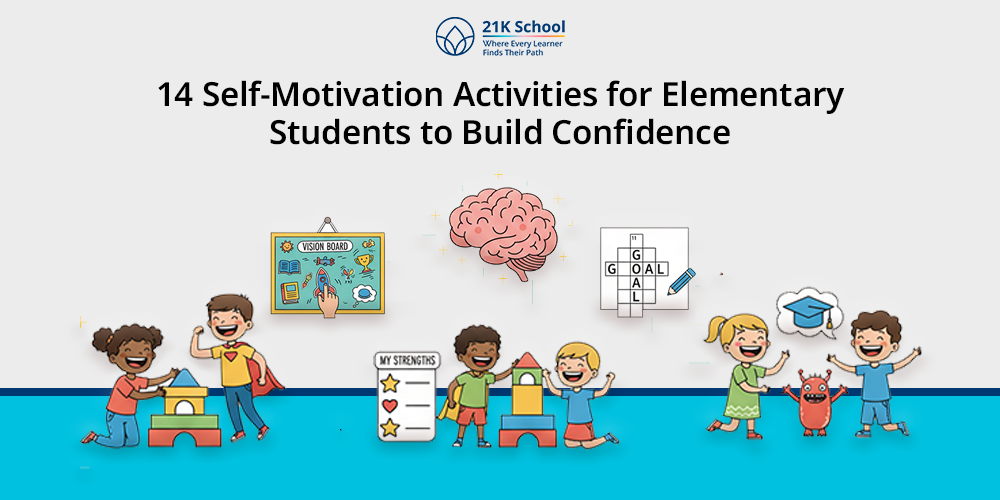
14 Self-Motivation Activities for Elementary Students to Build Confidence
 Written byAnkita SinghaContent Specialist
Last modified: Jul 27, 2026 6 min read
Self-motivation is key to success especially for students who are in elementary school. It not only helps them to gain desired marks but also encourages creativity and builds confidence .
In modern education , students are required to have motivation to perform better. And to do so facilitators and parents ensure a positive learning environment .
But the question is how to become self-motivated to fulfil short-term and long-term goals
Explore short term goals and examples for students
Here comes "Self-Motivation Activities for Elementary Students" to make everyone lifelong learners who welcome challenges.
To know more about self-motivation activities for elementary students let’s begin with a simple question: What is Self-Motivation for Students?
What is self-motivation for students?
Self-motivation for elementary students is an internal stimulation which guides them to work on objectives, learn new skills , and improve themselves.
It is also ideal to strengthen students mental health . With self-motivation learning becomes enjoyable, and self directed.
Integrating fun learning activities related to self-motivation to improve students both academic problems and personal development .
14 self-motivation activities for elementary students
Let's understand the 14 creative and practical self-motivation activities for elementary students which are ideal for learning and strengthening:
1. Crossword puzzles
One of the ideal activities known as crossword puzzles in which learners fill in the blank areas to discover the correct result in the end.
This is an interesting and interactive game which improves self-motivation abilities in students. Facilitators can also create subject-wise puzzles to engage them.
2. Drawing games
An activity which not only improves concentration and focus but also creative thinking skills of students is known as drawing games.
From drawing an ancient art form to creating multiple pictures to building a story to participating in competition, the game motivates students to do better.
By trying collaborative drawing activities students can increase curiosity .
3. Play three stars and a wish
"Play Three Stars and a Wish" is a kind of self-motivation game in which students complete a task or assessment and share:
- Three Stars: Three things they did well
- A Wish: One thing they would like to improve
It is an exciting game that helps learners to set realistic goals and achieve them. And in the end students give feedback to themselves to improve.
4. Create vision boards
Motivation comes from various short-term and long-term goals set by self.
And creating or writing a vision board is a physical form which represents what they aspire to achieve. It is a kind of daily reminder or motivating tool.
Vision board is an amazing idea because it motivates through visual representation.
5. Practice positive self-talk
Students often forget they know themselves in the best way and to explore what inspires them, they need to practice positive self-talk.
Self-talking helps in reducing and removing negative thoughts and surrounds students with self-esteem and belief.
6. Experiential learning
Experiential learning is a part of modern education and implementation correctly can help in self-motivation.
Science experiments , nature walks, or classroom projects activities connect learners with real life experiences.
By watching the progress learners become strong, motivated, and risk takers.
7. Managing time tasks
Learning time management skills in early stages of education is important. Students starting with easy and quick tasks are more capable of dealing with difficult challenges.
Start with a simple one such as solving 5 maths problems in 20 minutes. These kinds of quick achievements build a feeling of accomplishment.
Using "Time Journals" can also be beneficial for students.
8. Puzzles
Winning different kinds of educational and non-educational puzzles gather students’ interest which ultimately stimulate critical thinking and persistence.
Some common examples such as jigsaw, word, or logical puzzle. In free period teachers can also give a time bound puzzle to improve childrens mental health .
9. "Challenge of the week" game
Students often seek different activities. Playing the "Challenge of the Week" game focuses on character building and motivating students.
Some common examples of "Challenge of the Week" games are reading a book in ten days or writing an essay in an hour.
10. Gamification and activity-based learning
Teachers to motivate students often turn lessons into exciting games. For example, a maths probability or numerical can convert into treasure hunt.
By this way learners can solve easy to difficult problems with gamification and activity-based learning .
11. Rebus puzzles
It is a type of game where students use pictures, letters, and symbols to represent a word or phrase. Students critically analyse things to resolve.
By this way students self-confidence which motivates them to take on more complex challenges.
12. Cooperative board games
Cooperative board games include Outfoxed!", "Pandemic Junior," or teacher-created games in which instead of becoming one winner students work together to achieve a common objective.
In these self-motivation activities for elementary students they learn teamwork, communication, and problem-solving skills .
Explore various educational online games for elementary schools .
13. Draw a wheel of life
"Draw a Wheel of Life" is a popular activity in which students draw a wheel and label them based on life priorities like education, family, friends, and hobbies.
Later, students color and express how satisfied they are feeling. The objective is students' emotional awareness and self-management skills .
14. Storytelling and reflection sessions
The story not only engages kids but also adults. Storytelling in terms of learning and reflection sessions are ideal opportunities for self-motivation.
Sharing different stories and its morals help learners to enhance their empathy , courage, and self-awareness. All these strengthen inner motivation.
Learn more self awareness activities for students .
Conclusion
The journey of self-motivation exists especially when learners include the above mentioned activities in their daily lives.
These activities not only motivate students but also provide the environment to enhance creativity, problem solving , critical thinking skills , and empathy.
From crossword puzzles, vision boards, gamified learning , storytelling, to reflection each game is important and meaningful.
Start an exciting journey with excitement, curiosity, and self-confidence.
Frequently asked questions
8 questions
What are self-motivation activities for students?
Students can avail various self-motivation activities to improve and achieve desired goals such as drawing games, give responsible tasks, motivational games, positive competition, motivational seminars etc.
How can teachers encourage self-motivation in the classroom?
Teachers are the backbone of education who encourage students' self-motivation especially in the classroom. By creating a positive learning environment, Provide timely feedback, Building relationships, Teaching different strategies, and collaborative learning approaches
Why is self-motivation important for kids?
Self-motivation is important for kids to build confidence and self-esteem, goal achievement and academic success, and help them to plan long-term goals.
How do rewards affect motivation in elementary students?
Rewards positively impact on elementary students where they learn good behavior, supporting learning, building self-esteem to achieve desired objectives.
How can students develop self-motivation?
Students can develop self-motivation by aligning long-term plans, creating a routine, eliminating distractions, tracking progress, rewarding yourself, and working on feedback.
What are the different types of motivation in the classroom?
The different types of motivation in the classroom include: intrinsic and extrinsic motivation . Both are effective for students' progress.
How to motivate a lazy student?
A lazy student can be motivated through setting goals, embracing routine, encouragement to participate, extracurricular activities, friendly competition, promote strengths and make learning active.
What is a real time example of self motivation?
A simple example of self-motivation waking up early and continuous learning daily to get good marks in upcoming examinations.
About the author
Ankita Singha
Content Specialist
Ankita Singha is an Education Content Specialist at 21K School, India’s first accredited fully online K-12 School. She focuses on the in-depth research and creation of the well-drafted guides on early childhood education, school admission processes, and CBSE/ICSE curriculum guidance. With more than 2 years of experience at 21K School, a fully accredited institute- Cambridge International (IA702) and Pearson Edexcel (94883), Ankita works closely with the school’s curriculum heads and academic coordinators. Ankita’s every article reflects on the official board guidelines, practical realities, and current policies of online education in 78+ countries. Ankita’s content has helped thousands of parents in understanding the topics like RTE eligibility, NIOS pathways, and age-appropriate admission criteria.
Every 21K School guide is written by our education team and reviewed by a subject facilitator before publishing.
Exploring a CBSE-pathway online school?
Talk to an advisor about 2026–27 admissions — no obligation.
Talk to an advisorComments
No comments yet — be the first to share your thoughts or ask a question.