

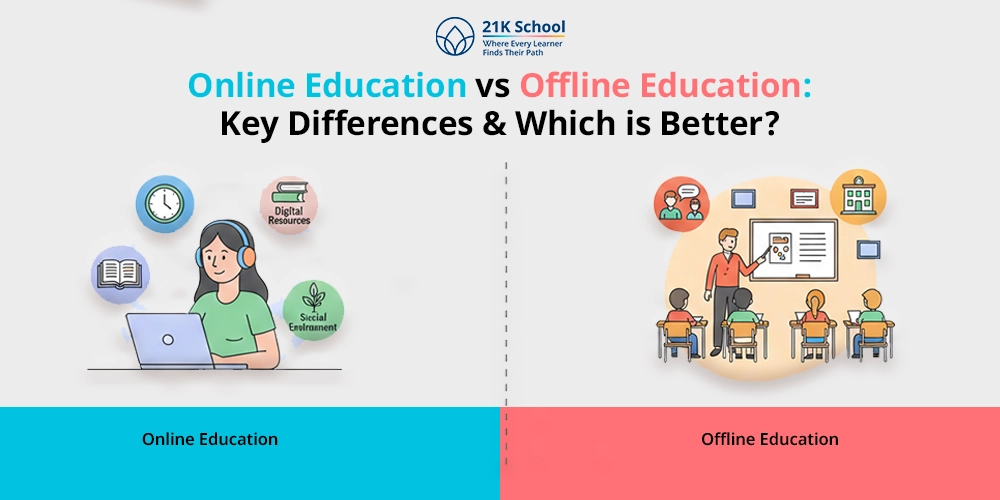
Parents and students before enrolling in school or university often feel confused to choose between online education and offline education.
If you are also a parent then one question always comes to mind, online education vs offline education: which is right? The question is simple but difficult to choose because it helps students to build their future.
However, understanding the real difference between online education and offline education with importance, pros, and cons help in choosing the right option among both. To do so, let’s begin the comparison journey.
Contents
What is Online Education?
Online education is the procedure of learning such as taking classes, lectures, completing assignments, and assessments through various technological tools.
Through various devices like mobile phones, laptops, computers, tablets or any other type of technology students can learn from anywhere, anytime.
Through online learning individuals can easily access the same quality of traditional education regardless of socioeconomic background.
However, the internet plays a major role in online education making it simple for students to connect with teachers and peers. Also, explore how online education is better than classroom education.
What is Offline Education?
Offline education is a traditional process of learning in which students learn in a classroom and face-to-face interaction with teachers for understanding concepts and clearing doubts.
Students in offline education are less distracted and develop social skills and personal growth. It is a better choice for those who are looking for physical classrooms, fixed schedules, real-life connection with teachers and peers.
10 Key Differences Between Online Education vs Offline Education
Let’s check out how online education vs offline education differ in terms of various aspects of education:
| S No. | Particulars | Online Education | Offline Education |
| 1. | Meaning | Digital learning via the internet. | Traditional classroom learning. |
| 2. | Mode of learning | Virtual learning. | Face-to-face learning. |
| 3. | Access to resources and study materials | Digital materials anytime. | Physical books and notes. |
| 4. | Learning flexibility | Highly flexible. | Fixed schedule. |
| 5. | Student-teacher interaction | Limited or virtually possible. | Direct and personal connection. |
| 6. | Learning pace | Self-paced. | Teacher-controlled. |
| 7. | Accessibility | Learn from anywhere. | Location-dependent. |
| 8. | Discipline requirement | High self-discipline needed. | Discipline enforced. |
| 9. | Assessment and examinations | Online tests and submissions. | Written, in-person exams. |
| 10. | Technology dependency | High. | Low to moderate level. |
1. Meaning
Online Education: Online education is a virtual mode of learning with flexibility. It is useful for students who travel a lot, reside in rural areas, or have a more individualised approach to learning.
Offline Education: While offline education is a physical form of learning for students. The teachings are taught directly in the classrooms and adopt a predetermined daily routine.
2. Mode of learning
Online Education: The mode of education online is through:
- video lectures
- live webinars
- learning management systems
- mobile apps.
Offline Education: While offline education works physically and based on:
- classroom lectures
- blackboard or whiteboard teaching
- group discussions
- practical labs etc.
3. Access to resources and study materials
Online Education: There are an immense amount of options available in online mode for students such as e-books, PDFs, recorded lectures and online libraries.
Offline Education: Offline or traditional education is appropriate to provide access to various physical resources and study materials. For example, printed textbooks, class notes, library books etc.
4. Learning flexibility
Online Education: Education in online education is highly flexible means students online learn from anytime, anywhere, and are suitable for working professionals.
Offline Education: While offline education is less flexible. Some simple examples are the curriculum is fixed, mandatory, and pre-designed.
5. Student-teacher interaction
Online Education: Student-teacher interaction online happens through the internet. This is mainly done via video calls, chats through apps, through emails, and discussion forums.
Offline Education: But, in offline education students and teachers face-to-face communicate, get immediate resolution, and personal guidance.
6. Learning pace
Online Education: In online education, students learn at their own pace.
Offline Education: While offline education learning pace is controlled by the teacher in the classroom according to school rules.
7. Accessibility
Online Education: Online education is highly accessible which ensures students can learn from anywhere without obstacles.
Offline Education: While online education is comparatively less accessible. This means students need to preplan and align the day according to schedule.
8. Discipline requirement
Online Education: In online education, students need strong self-discipline during learning on virtual platforms such as zoom.
Offline Education: On the other hand, offline education naturally enforces discipline by teachers in the classroom and school.
9. Assessment and examinations
Online Education: Teachers in online education mainly use different ways like online quizzes, assignments, open-book exams etc which makes learning interesting.
Offline Education: In offline education, assessments are mostly preplanned and in written exams and practical tests.
10. Technology dependency
Online Education: It is highly dependent on technology where students use technological tools and resources daily.
Offline Education: While offline education is comparatively less dependent on technology means students use tools but sometimes.
Importance of Online Education
Here, are some key points to understand the of online education, students must know to take right decision:
1. Internet-based learning
Online education is all about learning through the internet and tools like smartphones, laptop, computer etc to connect with teachers for classes.
Through this way, instead of physically attending classes students can communicate with instructors and peers via video calls, message boards, emails, and online assignments.
2. Self-paced or instructor-led
Self-paced learning is an effective approach through which students can manage their learning speed and schedule effectively.
And instructor-led learning is when students take live online classes, webinars etc.
3. Digital study materials
One of the reasons why online education is highly considered by parents and students is it offers digital study materials to improve curiosity in learning.
For example:
- Digital textbooks and PDFs
- Recorded lectures
- Online quizzes and assignments
- Interactive presentations
4. Remote access
Remote access in online education makes learning flexible and comfortable which means students can learn from anywhere and anytime.
It is beneficial for everyone from young students to working professionals.
Examples of Online Education
Simple daily life examples of online education are:
- Online certification courses
- Online degree and diploma program from home
- Students taking virtual coaching classes for competitive exams like NEET, JEE etc.
Importance of Offline Education
Given below are some of the key importance one must know before taking offline education.
1. Face-to-face interaction
Students often choose offline or traditional education for face-to-face interaction and communication with teachers and students.
This gives them confidence to represent themselves in front of school.
2. Fixed schedules
As compared to online education, offline education has a fixed schedule.
For example, a student needs to follow a rigid curriculum mentioned by school.
3. Classroom environment
In offline education, the classroom environment mainly focuses on collaborative and positive learning environments.
In this way, students can grow social, emotional, and academically.
4. Physical books and materials
In offline education, students and teachers use physical books and materials for learning which improve their reading and writing habits, memory power and concentration.
Students often feel concentrated and curious by learning through physical resources.
Examples of Offline Education
Some common examples of offline education includes:
- Students enrolled in nearby or local schools.
- Admission in coaching centres/classes for government exams like SSC.
- Graduating from state universities and professional institutions
Pros and Cons of Online and Offline Education
Pros of online education includes:
- Students can learn anywhere and anytime.
- It is one of the cost-effective ways of learning.
- Anyone can easily access teachers and courses worldwide.
- Develops digital skills for future growth.
- One can learn from a secure and familiar environment.
Understand the cost analysis of online education.
Cons of online education includes:
- Internet connectivity is one of the prime challenges students face.
- Students have difficulty focusing on the screen for a long time.
- Teachers with basic understanding of technology.
- Online education limits social interactions with students and teachers.
Pros of offline education includes:
- Ideal to gain real-time experiences in daily life.
- Students can connect with the people physically.
- Offline education is more competitive.
Cons of offline education includes:
- In offline education students are dependent on teachers and material.
- Use of teacher-centred techniques in offline education.
- The fee for offline education is not affordable for everyone.
- Inflexibility with schedules which can stress out students.
Conclusion
With time students are getting new opportunities and options to choose the best kind of learning.
Between online and offline education selection becomes easy for parents and students if they understand the importance, pros, and cons of both.
Discover the key role of parents in online education.
Hopefully, the blog helped to understand the real difference between online vs offline education to make the ultimate choice right for future growth.

You may also want to read