
Ultimate Guide to Virtual Education: Definition, Importance, Advantages, and More
The traditional educational system's effortless functionality appeals to many parents. However, some parents prefer to be more active and actively participate in their child's education. To give their children the best chance of success, they select alternate learning methods and tools. Parents who are involved in their children's education frequently view virtual education as a complement to or alternative to traditional schooling.
Your guidance to this type of instruction is this article. It discusses several forms of virtual schooling as well as their benefits and drawbacks. You will have a better understanding of virtual education by the end of this article, and you will also know whether it is appropriate for your ward. So let's begin with a quick overview.
Learning Beyond the Classroom
What is virtual education?
Virtual education, also known as online learning, encompasses instructional and learning experiences in an online environment, utilizing the internet as a delivery medium and learning resource. While these terms are often used interchangeably, the key difference lies in the extent of in-person involvement. In online learning, students may have a hybrid schedule, attending in-person classes on certain days while learning online on others. On the other hand, virtual education implies a fully online experience. Meet Sachi, an ambitious high school student with a passion for environmental conservation. Sachi lives in a remote village with limited access to quality education and lacks specialized courses in her area of interest. However, thanks to virtual education, Sachi's dreams are no longer limited by geographical constraints. Through online platforms, she can enroll in specialized environmental science courses from top universities around the world, learning from renowned professors and collaborating with like-minded students globally.

How does virtual education work?
Virtual education stands in stark contrast to conventional education as it operates entirely online, with students learning from home while instructors are in remote locations. The class size in virtual education can vary depending on the specific program or platform used. To ensure a high-quality education, virtual education providers prioritize delivering the right curriculum, comprehensive learning resources, and effective assessments, even in the absence of a physical classroom. Here's how a high-quality virtual education works.
The curriculum
Any curriculum that can be used in conventional education can be used in virtual education as well. For instance, 21K School offers virtual education in CIE, NIOS, IGCSE, and other popular curricula. Learn more here:
Learning resources
In conventional education, multimedia learning resources have long been utilized for educational purposes, including videos played in classrooms since the era of VHS. Presently, many traditional schools embrace online platforms like YouTube to access educational videos. Therefore, when conventional classrooms seamlessly integrate online learning platforms there is no doubt that virtual education can do the same.
The instruction
The effectiveness of virtual education remains a subject of debate, with some parents endorsing it, while others believe in the benefits of in-person teacher-student proximity. It is evident that online instructors need specific training to excel in virtual teaching, as not all classroom teachers can seamlessly transition to virtual education. One thing is clear: those teaching online must be taught how to teach online. Not every classroom teacher can be as effective at virtual education. Read about top tips for online teaching in our blog which emphasizes how online schools like 21K School equip conventional classroom teachers with virtual teaching expertise. Our academic crew at 21K School possesses extensive virtual teaching experience and some actively trains high-performing conventional classroom teachers for remote education. When it comes to instruction quality, you can end up with a poor fit in both conventional and virtual schools. So be sure to look at parents' feedback , progress rates, etc., before making your enrollment decision.
The assessment
The most significant challenge in virtual education, particularly at the pre-college stage, lies in the diverse assessment methods used in remote MBA, BSc., and other online degree programs. This includes essay, thesis, and research submissions, alongside browser-trapping quizzes and live vivas. While viva and thesis assessments make cheating difficult, secondary schools often require in-person exams with invigilators. While virtual education schools offer online tests for lower classes, they collaborate with examination centers for in-person tests in higher classes and board exams. This ensures credibility and compliance with mainstream board requirements. Moreover, some types of virtual education do not involve exams, and the term encompasses accredited online schools like 21K School and self-education with online learning materials, providing diverse learning experiences for students.
Forms of virtual education
There are two broad forms of virtual education: synchronous and asynchronous virtual education. In synchronous virtual education, the teacher and the student are in sync (present at the same time) in the online classroom. Zoom classes and private online lessons fall into this category. In asynchronous online education, the learning materials are available for on-demand consumption, and the students can access them at different times. Within real-time and non-real-time virtual education, there are various other subcategories. The following are some of the most common forms of virtual education.
Online coaching
This is a form of synchronous education that isn't usually a part of one's formal education. From singing lessons to accent coaching and cooking lessons to second-language coaching, there are plenty of private learning opportunities online.
Online tutoring
While online tutoring is similar to online coaching, it is in addition to the student's formal education. Just like some students get private tuition in-person after school hours, others get it online.
Online School
Most online schools offer synchronous and asynchronous options. Students can attend classes in real time, or they can access the class recordings later. Online classes are closer to conventional education in curricula but can differ in instruction methods. For example, 21K School has an adaptive learning approach with the benefits of personalised learning , which caters to the strengths of its students. As a parent, you must judge the instruction methods and philosophy of the individual institution and not just the mode of education.
Self-education
Self-education with online learning resources has emerged as the prevalent form of virtual education. From picking up new hobbies like crochet through YouTube tutorials to children learning origami from Instagram, social media plays a pivotal role as a major resource for virtual learning. Platforms like Khan Academy have enabled millions of individuals to access education virtually, bridging the gap for those unable to participate in formal schooling. Self-education in this context is typically asynchronous and self-paced, yet equally valid and impactful as conventional forms of education. Universities, including Yale and Stanford, offer access to pre-recorded lectures from select degree programs. Those can be used for virtual education as well.
Remote degrees
Universities differ in their virtual education offerings, with some providing open-access resources, while others offer formal online degree programs. Platforms like MIT Open Courseware cater to self-education, distinct from remote MBAs and distance learning programs. For remote degrees, students attend real-time online classes and submit assignments graded by professors, ensuring a comprehensive and interactive learning experience.
Remote diplomas
Remote diplomas entails online learning and assessments but often has self-paced study schedules as well. However, the type of online classes offered for remote diplomas depends on the institution. Some require students to attend live online lectures, while others give them access to pre-recorded materials.
Learning on the job
In progressive positions and esteemed organizations, continuous learning on the job is integral. If your work is remote and involves learning while doing, your education falls within the broader scope of virtual education. As evident, virtual education surpasses the realm of online schools and remote classes. Lifehacks acquired from Instagram and YouTube, as well as classes offered by skilled instructors on platforms like Skillshare, Coursera, and Domestika, all constitute virtual education. Virtual education goes beyond being an alternative to traditional classrooms; it represents an expansive opportunity for billions, irrespective of career stage, education level, or financial status, revolutionizing access to knowledge and growth potential.
Importance of virtual education
- Education: Accessible to all!
Virtual Education facilitates easier and more efficient delivery across vast distances, reaching a larger audience. In regions where the internet is accessible, but resources for quality conventional schools are limited, virtual education bridges the gap and opens up opportunities for learning. It allows children in underdeveloped regions to access the same quality of education that is available to children living in major cities.
- Education: Affordable!
Sometimes, regional proximity isn't the cause of inaccessibility in education. When financial limitations hinder a child's access to high-quality education, virtual education emerges as a remarkable alternative, surpassing underperforming schools. It serves as a significant upgrade in education quality, allowing remote education-providing schools to prioritize curriculum design and enhance educational standards. By operating with lower business costs, they can create smaller classrooms and foster enriched teacher-student interaction, enriching the learning exp
- Education: Depth
As covered earlier, virtual education isn't limited to online schools only. Almost all remote education or online learning is a part of virtual education. Therefore, many students who go to standard schools can use virtual education to get a deeper understanding of what they learn in school. Because of virtual education, we're no longer limited to the private tutors who live in your region. We can easily access virtual tutors from online tutoring platforms and can even use the services of online schools to arrange additional school hours for our child. With virtual learning, we can get quality education at our fingertips .
- Education: Expanding Horizons!
Another advantage of virtual education is that it allows people to continue learning regardless of their financial standing and schedules. Learning is an ongoing process, but very few people have the time and the resources to take special classes for technical skills or soft skills once they finish their formal academic education. Once one starts working, one might be too busy to enroll onself in a college for further learning and development. Skill-based education fosters and enhances the art of learning, allowing students to excel academically and in the modern world. Students who familiarize themselves with online learning at a young age are far more open to virtual education once they start working.
- Education: A Life-Long Process
Through the choice of enrolling your child in an online school or utilizing remote tutor services, you bestow upon them the invaluable gift of lifelong education. Studies have shown higher student enthusiasm for online learning which translates to openness towards virtual education later in life when the formal education is completed. A student who graduates with some online learning experience is likely to take online courses, attend webinars, and self-educate with online resources in the future.
Key considerations for your online education journey
Choosing an online school can offer several advantages, such as better education quality at a lower cost and enhanced parental monitoring. One might have specific reasons for opting for virtual education. However, don't fall into the trap of focusing solely on one aspect. Instead, consider the key factors mentioned below when selecting an online school for your child. One important tip is avoid looking at just the fee structures when choosing an online school for affordability. Below are the most important factors to consider when enrolling your ward in an online school.
Curriculum
Choosing online education for your child is an unconventional decision in itself. While some parents might find experimenting with the syllabus too risky, opting for online schools with a standard curriculum, widely adopted by high-end schools, provides a safer and reliable learning path. If you want to go with an alternative curriculum like Montessori, that's okay too. Just make sure that the online school you choose offers the curriculum you want for your child.
Teaching philosophy
This is an oft-ignored aspect of virtual education. Students are not robots. Rote Learning is the thing of the past. The more student-oriented an institution's teaching philosophy is, the better its students will understand its learning modules.
Culture of the school
Teaching philosophy might not be explicitly mentioned on a school's website or brochure. But it is definitely evident in its culture. The enthusiasm and understanding shown by its general staff and admissions department are reflective of the culture your child will be exposed to. Another indicator of a student-oriented culture is the accessibility of higher-ups. In online schools that genuinely care about their students, parents can get an appointment with the principal in an instant.
Assessment method
Education is tied to the economic reality of life. While learning matters, how it improves one's employability is also important. A school that has legitimate and reliable assessment methods is trusted by higher education institutions. One should never forget to ask questions about how students are assessed, especially in the 8th, 9th, and 10th grades.
Affiliations & accreditations
School accreditations are important as they provide an external validation of a school's quality and credibility. Accreditation reflects that the school has met certain standards of educational excellence and adheres to established guidelines. Knowing about a school's affiliations & accreditations must be one of the deciding factor in the school you pick.
Cost
Affordability is crucial in school selection to avoid financial strain and undue pressure on children. Although online schools often have lower fees, it's essential to verify the exact costs before enrolling. 21K School is an incredibly affordable option for quality education from the comfort of your own home. Our tuition fees are competitively priced. Visit the following link for a detailed break up of our fees:
Schedule
Aside from financial feasibility, one must focus on practical aspects like schedule flexibility. What happens if your child misses a class? How can online schools accommodate emergencies? The flexibility of an online school's teaching schedule is usually beneficial for children. However, some parents may prefer schools with a strict, real-time instruction and mandatory attendance. As the future of schooling is flexible and remote learning, . ensure that your school choice aligns with your schedule preferences, whether it's discipline-oriented or focused on comfort and accessibility. You might prefer a discipline-instilling institute or a school that makes education more comfortable and accessible. Please make sure that your school choice matches these schedule expectations.
Extracurriculars
Finally, you must not ignore extracurricular activities as they are the most important aspect for a child's social life. Check whether the online school you're interested in also offers co-curricular activities and socializing opportunities. Even if it does, one must focus on arranging these opportunities at home as well. Hobby and activity clubs, summer camps, etc., are all some of the things one can do to get their child the social life he might not have in the absence of a physical classroom.
Advantages, disadvantages, and challenges of virtual education
"The child won't have a social life" is the most common objection people raise with regards to virtual education. Amidst objections about limited social life in virtual learning environments, it's essential to recognize that some people's social interactions are already confined to online media. Virtual education presents a powerful opportunity to transform the fortunes of multiple generations, but it requires a balanced consideration of its pros and cons. In this section, we delve into the specific advantages and disadvantages of virtual education, aiding you in making an informed decision between online schools and traditional physical ones.
Advantages
Inclusive
Most physical schools are financially exclusive and racially discriminatory in their enrollment practices. Online schools are relatively more open.
Accessible
Your child can access a virtual learning environment from almost anywhere. This makes education accessible to them regardless of where they are and how often they move.
Cost-effective
Online schools are financially accessible. Parents who can't afford to provide their kids an expensive education don't have to settle for poor-quality education anymore. Also read, how can expensive education transform into affordable online education ?
Global
Online schools like 21K School have an international student base. This prevents teachers and students from getting locked into specific cultural blindspots. It also helps to nurture cultural awareness in children . Students who graduate from online schools are set up for international success.
Personaly interaction
Virtual Education often has a lower teacher-to-student ratio. This makes room for more student-teacher interaction and personalized feedback.
Flexibile
The schedules are flexible and you will not see instructors snapping at kids or children suffering from insomnia in online education.
Comfort
Academicians assert that comfort is crucial for learning. And for most children, no environment can be more comfortable than their homes. Online Schools make it possible for students to be more relaxed so they can learn more easily.
Improved technical skills
Virtual Education doesn't limit learning to the school curriculum. Students who get acquainted with learning from online resources can pick up technical courses and classes which can enhance their employability and productivity.
Personalised learning
Self-study, individualised attention , and a lot of other modes of education are available to students who study online. Visual learners can watch videos, while auditory learners can access audiobooks. Students interested in their academic success can personalize their path to a diverse education.
Lifelong education
Most students choose not to attend brick and mortar universities once they start earning. However, education continues throughout an individual's life. From online professional workshops to youtube videos, those familiar with learning online can continue to educate themselves even when they're not enrolled in a physical institute.
Disadvantages
Isolation
Socializing online isn't the same as socializing in person. And students who are limited to online schools do not have as many opportunities to socialize in person with their classmates or kids their age. However, this guide will guide one on how to make friends at school in an online setup ?
Distractions at home
Learning from home may expose students to various distractions, making it challenging to maintain focus during study sessions. One way to offset it is to arrange for a set study area for your child with limited access to it from anyone or anything which can be a potential distraction.
Technical issues
Sometimes, internet speed and power outages can become a barrier to virtual education. It is always advisable to have a backup for it.
Reduced physical activity
In traditional education, physical activity is often integrated into the school day as a standard practice. However, in virtual education, parents must proactively schedule dedicated time to encourage and ensure their child's physical fitness.
Managing screen time
Screentime is bad for children's focus and eyesight. Virtual Education can increase children's screen time, so it is advisable to schedule regular breaks. Also read, 5 Screen Time Rules For Kids .
5 secrets that no one will tell you!
- Technical issues
A poor internet connection or power outages on either end of the instructor-student connection can interrupt virtual education. Investing in a fiber-optic connection alongside a UPS can fix this.
- Lack of interaction
Some virtual education providers adopt the traditional lecture model, where the teacher talks continuously and expects students to listen. This doesn't work in virtual education.
- Online distractions
If the parents aren't tech-savvy, the children can play games and browse social media under the guise of studying.
- Poor digital literacy
While Virtual Education makes high-quality education affordable, it requires digital literacy. Parents who don't have a basic foundational understanding of remote services might not be able to get their children the quality education they deserve.
- Inability to Stay Motivated
Virtual Education has a self-invigilation burden that students might not be able to bear. They might not feel motivated to attend classes, participate in discussions, or engage in self-study.
Future trends
Parents may sometimes base enrollment decisions on short-term factors, as seen during the engineering boom in the 2010s. Enrolling their children in engineering programs was believed to offer job security. However, But by the time their children graduate, the market dynamics changed, and an oversupply of the workforce emerged by the time their children graduated. To ensure your child's long-term success, it's essential to consider both short-term benefits and long-term implications of enrollment decisions. As we explore future trends, it becomes evident that Virtual Education is poised to undergo significant transformations in the next decade. Let's look at the some of these future trends.
 A. Artificial intelligence (AI) and Machine Learning (ML)
Machine Learning and Deep Learning are phenomenas that allow virtual robots to learn more about specific subjects and disciplines. Artificial Intelligence can be used to create personalized educational tools and chatbots that can reduce the need for teacher-student interaction.
Homework assistance bots will become common in Virtual Education. These bots will be well trained to the school's curricula and will mostly be available for clarification and grading. The potential of the future of artificial intelligence in education goes far beyond the current state of implementation.
 B. Blockchain and Credentialing
Traditional printed degrees and certificates are commonplace, but they are susceptible to manipulation through Photoshop or other digital tools. Blockchain technology offers a solution by creating non-replicable tokens, contracts, or certificates. Although not guaranteed, there is a high likelihood that blockchain may be utilized for secure remote certification in virtual education.
 C. Emerging technologies shaping the future
AI, AR, and VR form the essential technology tracks that can elevate virtual education to new heights. The impact of their progress on Virtual Learning hinges on the extent of their advancements. With significant improvement in Augmented Reality, classroom interaction could substantially increase. Similarly, if Virtual Reality doubles its current capabilities, it has the potential to revolutionize traditional schools, making virtual education more accessible and widespread.
Virtual education vs. traditional education
Traditional Education and Virtual Education vary most prominently in their mode of delivery. But this is a mega difference that ripples out into various sub-categorical differences. Let's take a closer look at how Traditional Education and Virtual Education differ.
| Aspect | Virtual Education | Traditional Education |
|---|---|---|
| Mode of Delivery | Virtual Education is delivered online. | Traditional education requires in-person instruction. |
| Schedule Flexibility | Virtual Education providers are more open to self-pacing and a relaxed schedule because of the playback option. | Traditional Education has a fixed schedule. |
| Curriculum Design | Virtual Education might have a standard curriculum or a customized one. | Traditional education, by definition, has a traditional curriculum. |
| Customizability | Virtual Education is far more customizable than traditional education. However, customizability also depends on the provider. | |
| Technical Requirements | In virtual education, you need a strong internet connection, a decent laptop, and uninterrupted electric power. | In traditional education, you need a timely pick-up and drop-off of uniform and physical textbooks. |
| Fees | Virtual Education is usually cheaper than its traditional equivalent. | |
What the shift to virtual learning could mean for the future of education
In 2020, lockdowns forced schools to move to a hybrid model in some cases and an entirely virtual model in others. More schools are opening up to virtual education, and more colleges are accepting certificates and diplomas from online schools. The shift to virtual education can make high-quality education far more accessible. If the literacy rates increase, with each generation, we might move towards a more peaceful, civilized, and productive global society. The future of education is here. The education system is changing, and with new personalized teaching and learning experiences, education will be transformed forever.

Virtual education and special needs students
Virtual Education is an excellent and affordable option for parents of children with special needs. While most traditional schools cannot make economic sense of a special education , virtual schools can afford to create smaller virtual learning environments for students with special needs.
For instance, here are a few contexts in which 21K School can provide virtual education and other relevant services:
- If your ward has mild to moderate Autism Spectrum Disorder.
- If your child has Asperger's Syndrome
- If your ward suffers from specific learning disabilities, like Dyslexia, Dyscalculia, and Dysgraphia.
- If there are developmental delays or moderate intellectual disabilities that affect your child's education.
- If health concerns or orthopedic concerns keep you from enrolling your child in a traditional school.
- If traditional education can't accommodate your child's speech or Language Impairments or their differentiated learning requirements.
What entails a virtual classroom
If you're excited about getting started with Virtual Education but are unaware of what you'll need or what enatails a virtual learning environment, read on. Here are the features of a virtual classroom :
Digital blackboard
Video conferencing
Video recording
Participation controls
In high-end virtual classrooms
In high-end virtual classrooms, you can also find the following:
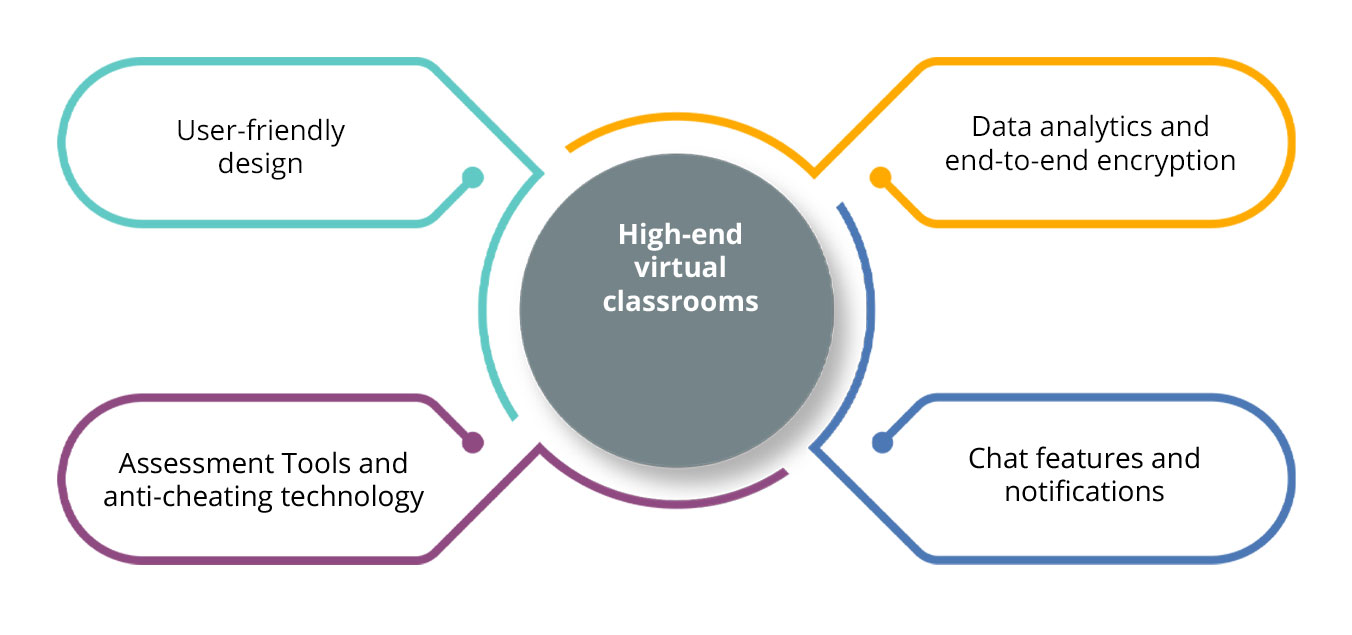
An insight into 21K School virtual learning platform
21K School's Virtual Learning Platform is secure, accessible, and easy to navigate. It has End-to-End Encryption, and AI features alongside data analytics and online assessment tools. To get started, you need a laptop and an internet connection. Learn more about 21K School's Virtual Learning Platform by Clicking Here .
Final thoughts

Virtual Education is an accessible and affordable alternative to in-person education. It has its advantages, but it leaves in-person socializing and screen time management to the student/parents. If you're an active parent who wants to get your child high-quality education adapted to their learning style, then you should look into an online school. For future-proofing and security, make sure it is board affiliated. 21K School, affiliated with multiple domestic and international boards, is bringing you an educational institution you cannot say no to !
How can we help you?
What is virtual education?
Virtual Education is a mode of education where the instruction is delivered online. It can be asynchronous or synchronous, involve a live instructor, or be student-driven (self-study online). The term "virtual education" is quite broad and covers learning life hacks from Youtube videos as well as taking online classes in a structured program. In all of its forms, virtual education is quite different from conventional education.
How does virtual education differ from traditional education?
In traditional education, a student has to be in the classroom with the teacher. In contrast, a virtual learner doesn't even need to be on the same video call as the teacher as he can play back the lecture recording.
Traditional Education is slow to adapt, can be dated in some aspects, and has a rigid curriculum and assessment system. Virtual Education is more student-oriented, adaptive, and open-ended, making it far more suitable for people who don't want the liabilities of an outdated education system.
What are the benefits of virtual education?
Virtual education is more accessible, flexible, and affordable. It is also broad and open-ended, making room for more education and continuous learning after graduation. Almost all the drawbacks of conventional education are erased by virtual education. In traditional schools, parents often complain about their children not getting enough interaction with the teacher, the rigidity of the schedule, and fewer opportunities for parental involvement. Virtual education flips the script with openness, accessibility, and smaller student groups. Above all, virtual schools do not have discriminatory enrollment practices that are often associated with certain traditional schools.
Almost all the drawbacks of conventional education are erased by virtual education. In traditional schools, parents often complain about their children not getting enough interaction with the teacher, the rigidity of the schedule, and fewer opportunities for parental involvement.
Virtual education flips the script with openness, accessibility, and smaller student groups. Above all, virtual schools do not have discriminatory enrollment practices that are often associated with certain traditional schools.
Are virtual education programs accredited?
Some virtual education programs are accredited, while others are not. Because accreditation can vary from degree to degree and certificate to certificate, you should ask for a written accreditation guarantee from your virtual education provider.
Remote degrees can be categorized as virtual education. In most countries, you can get your online degree attested by the university and your local education authority. School certificates attained virtually are harder to attest. Most online schools have in-person exams at board-affiliated examination centers to ensure that their secondary education certificates are accredited.
What technology and tools are needed for virtual education?
You need a laptop, an internet connection, and electricity for virtual education. Noise-canceling headphones, uninterrupted power supply (UPS), and Fiber Optic internet connection can further enhance your virtual learning experience.
If you go by the loose definition of virtual education and consider watching youtube tutorials as a part of virtual education, then you can learn with just an internet-enabled smartphone. You can even attend Zoom classes with a smartphone. But for an optimal virtual learning experience, most schools require students to have laptops.
How can virtual education be accessible to students with disabilities?
Virtual Education can be accessible to students with disabilities if the provider can accommodate their specific disability. Online schools like 21K School provide special services to children with moderate learning disabilities.
There are also online centers that cater to children with specific disabilities. Online centers for the education of students with special needs are not as common as online schools. However, they don't need to be in your town, city, or country. You can enroll your ward in an online special needs education center, even if it is abroad.
How do virtual classrooms work?
Virtual Classrooms work via video conferencing, online lectures, and virtual assessment programs. Often, these programs and media pieces are integrated into a single platform for easy and secure access.
Virtual Education classrooms have two-way video, interaction management for classroom control, and an online blackboard. They also have online assignment submission portals and assessment tools to track student progress.
Virtual Education hasn't been around to be standardized. That's why different online schools have different platform designs and tech quality. Moreover, they also have different instruction quality and curriculum designs.
When enrolling your ward in a virtual school, remember not to focus on the tech alone. You should also look at the school's awards, affiliations, and student success rate to determine whether it is good or not.