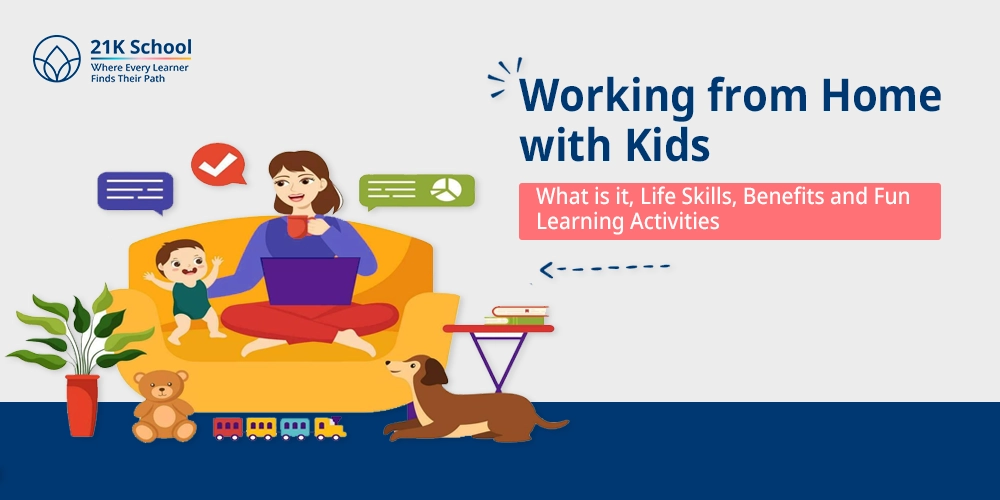
Working from Home with Kids: What Is It, Life Skills, Benefits and Fun Learning Activities
 Written byAnnapurna SContent Specialist
Last modified: Sep 1, 2026 9 min read
Do you consider how working from home is beneficial to your child's learning?
Working from home and having kids is a tradeoff between work and learning time. This can help your child develop life skills, independence, resilience, and build a routine through shared activities between parents and children.
Thus, we will look into some of the most helpful tips for working at home with children and their benefits that would contribute to the holistic development of your child.
What does working from home with kids mean?
Working from home with kids means managing professional responsibilities while monitoring childcare in the same environment. This is possible with a flexible daily schedule, as parents need to focus on their children and family and fulfil work commitments.
This also varies based on age, learning style and the pace of children at home. Parents often navigate the situation with sudden interruptions, blurred boundaries, and unforeseen alterations in the routine.
Working from home with kids: 10 key success strategies
Top key successful strategies for working from home with kids are listed below.
1. Prepare your schedule
Parents working at home with their children need to plan a flexible routine around the nature of the work type and the learning needs. Create a schedule that helps parents switch their roles between meetings and learning hours.
Prioritise critical work deadlines during their nap time and handle sudden interruptions in the routine. This helps parents with quality family time and focus with a fresh mind on their work.
2. Create a dedicated workplace
Set up a dedicated workstation to separate personal life and effectively carry out work requirements. It specifically does not require allocating a separate room, but a common space where the working parent can monitor the activities of the children with less distraction. This helps the child to read the room and understand the availability of the parent.
3. Plan a visual routine
Children respond and follow the routine better by simply colouring a section of the calendar or pasting colourful charts on the wall than by reminding them of every detail verbally.
List the daily routine and activities like meal time, outdoor play, reading, and family time on the calendar. This can help children understand the schedule independently and follow it with fewer reminders and interruptions.
4. Create work signals
Working parents are offsite and are compelled to multitask, and this can disrupt their focus. Work signals, visual and auditory, may be created to help express the needs of both parents and their sense of the parent’s presence.
A sticky note or any other type of signalling can be used to communicate the needs, in order to minimise their interference during meetings and not to disrupt the working process.
5. Try front-loading your tasks
Working mothers and fathers could rise early in the mornings to enhance their productivity in the workplace before they are liable for their responsibilities. This assists them in relieving stress, getting their work done on time and dealing with unforeseen interruptions.
6. Prepare meals in advance
A working-at-home parent must plan a healthy diet for their children. The snacks and lunch a day before start with breakfast, having them easily at the commencement of their routine. Preparing a snack and carrying it around will come in handy when you develop cravings as well as to establish healthy eating habits as you continue working at home.
7. Plan proper screen time
It is interesting to note that parents are expected to select digital content that would allow their child to learn. Arrange their screen time based on important meetings, time restrictions on screen time and avoid screens during family time.
Individualise the program to be viewed by the children and restrict the hours. Include educational content that does not interfere with sleep and physical activity.
8. Manage kids with engaging activities
Parents can brainstorm activities in which children can have fun independently. Children can also be engaged in problem-solving activities using puzzles, building blocks, colouring books, art and crafts, and sensory play to help them learn problem-solving skills.
These activities decrease the amount of screen time and ensure that they are cognitively engaged.
9. Share home responsibilities
Parents can start sharing household responsibilities and childcare with the members of the family. Through cooperation from both parents, they will be capable of alleviating the stress and taking care of the child in a more suitable way. Older children can perform tasks independently and also contribute to household work.
10. Set realistic expectations
Giving an equal amount of attention to every activity of your child sounds impossible. Some days can be productive, while other days can have unexpected interruptions. So it is important to set realistic expectations and build the routine around it.
5 benefits of working from home with kids
Now let us look at some of the benefits of working from home discussed below.
1. Improved work flexibility
Working from home, parents can schedule flexibly. Parents actively participate in activities and events and help with their child's projects. This reduces exhaustion and saves time to maintain a healthier life with a balanced routine.
2. Reduced childcare needs
Working parents will no longer have to be this reliant on external factors since they would get to organise their time by having kids of their own at home. Young children would need childcare and attention. This approach saves time and allows you to gain extra hours with your child.
3. Equal focus on family
Parents can have a clear overview of their child's daily life. Right from their routine, observing their behaviour, cherishing their small milestones, sharing meals, helping them with their school assignments, and focusing better on their child's needs without compromising professional commitments.
4. Smooth handling of sick days for kids
In unforeseen circumstances like a child being sick or requiring immediate medical attention, parents can provide care and compassion without compromising their work. They can pause and resume their work at any time in the day to cater for the needs of their child. Parents can take short breaks to monitor the health of the child and switch back to their work.
5. Enhanced security
The physical presence of the parent in the growing environment of the child itself can ensure their sanity and safety. Parents can directly supervise the needs of their children and nurture them. Children feel safe and protected around their parents and emotionally feel secure.
Parents can quickly respond to their concerns and provide undivided attention to consistently support them.
5 challenges of working from home with kids
Some of the challenges of working from home with kids are discussed below.
1. Managing interruptions
Parents working from home often face many obstacles and deadlines. Young children are not aware of the parents' availability to attend to their needs and end up interrupting while they are on a call, meeting, or working in general.
In this situation, parents can communicate with signs and create an independent activity plan, and plan their work around their nap time. This helps the parents handle sudden interruptions and accordingly cater to parental duties.
2. Reduced boundaries
Parents often find it difficult to separate their professional duties and family time while working from home. This leads to poor concentration and the postponement of daily household duties. In an environment like this, parents go through burnout and stress, which hamper their productivity.
Therefore, it is important to set a designated workspace and a defined schedule of work for the parents to have a flexible routine.
3. Parental guilt
Many parents feel that they are not doing enough when it comes to giving the right amount of attention to work and their children. They constantly juggle between family time and falling behind on their deadline when focusing on their children.
The elements that parents can start with include establishing realistic goals and investing diverse hours in quality time with the family.
4. Sacrificing personal time
In other instances, parents work 24 hours in order to complete all the work in time without taking breaks. This may lead to exhaustion and worries in the future.
Parents need to prioritise personal time. This helps them to stay productive and easily switch between professional and parental duties.
5. Managing invisible housework
Managing the invisible housework with work duties is difficult, especially for working mothers. Cleaning utensils, laundry, and managing childcare cause obvious stress and burnout.
Sharing responsibilities and switching roles helps to follow through with the daily routine and reduce the need for managing all the tasks.
Conclusion
Working parents with children can play a role in meeting the needs of learning while managing their work. These responsibilities would also require some timetables so that a parent can switch roles and be prepared to address any unexpected situation.
Remote working parents can benefit from implementing the practical strategies discussed and also look out for challenges. With the right approach, working parents can effectively achieve their productivity and be involved in their child's learning process, which directly contributes to the overall development of the children.
This approach creates the opportunity for children to develop teamwork, cognitive growth, and learn through everyday experience.
Frequently asked questions
5 questions
How does working from home affect child development?
The flexibility of working from home positively supports your child's development by having meaningful conversations with your child, building life skills, and developing independence through everyday activities.
What are the best educational activities for kids?
The best educational skills for kids are a blend of fun activities and life skills. Activities like reading books, solving puzzles, and arts and crafts help children develop critical thinking, communication, and problem-solving skills.
How can parents balance work and their child's learning?
Parents can start by focusing more on quality work, which is performed in full focus, developing a virtual schedule with a visual routine plan, and promoting self-directed learning.
What daily schedule works best for balancing work and remote learning?
Time blocking and energy management are the most suitable schedules since they provide a balance between distance learning and work.
Does working from home help children become more independent?
Working from home allows children to be more independent as they have the capacity to be responsible and independent, as well as learn individually.
About the author
Annapurna S
Content Specialist
Annapurna is an Education Content Specialist at 21K School, India’s first accredited fully online K-12 School with more than 20,000 learners across 78+ countries. She holds a Bachelor’s degree in Electronics and Communication Engineering that helps her structure information logically and structure technical concepts for an understandable educational content. With more than 3 years of experience at 21K School, a fully accredited institute- Cambridge International (IA702) and Pearson Edexcel (94883), Annapurna specialises in creation of the learner-centric resources for school-age students. Annapurna’s every article is based on the official resources and focuses on Cambridge/Edexcel, and CBSE curriculum frameworks. Annapurna’s content helps guardians, and learners to navigate through the modern online education system.
Every 21K School guide is written by our education team and reviewed by a subject facilitator before publishing.
Exploring a CBSE-pathway online school?
Talk to an advisor about 2026–27 admissions — no obligation.
Talk to an advisorComments
No comments yet — be the first to share your thoughts or ask a question.