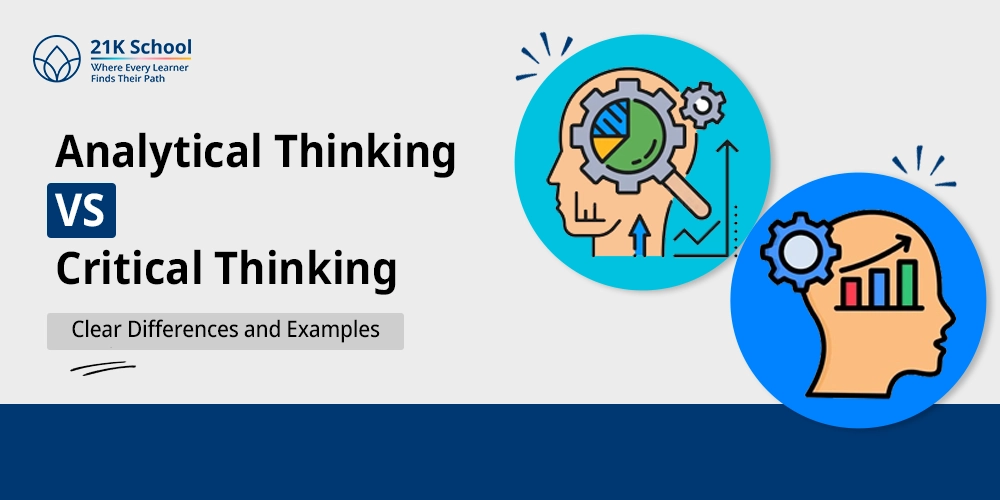
Analytical Thinking vs Critical Thinking: Clear Differences and Examples
 Written byAnnapurna SContent Specialist
Last modified: Sep 4, 2026 11 min read
Have you ever wondered how some people could solve a problem in a few seconds, make an impulse decision or make a judgment before acting? The answer can be found in the development of analytical and critical thinking skill sets.
Many compare analytical thinking with critical thinking, but both of these skills are interconnected and offer unique features of their own.
Having a clear knowledge of both is important for solving problems and making better decisions.
So learn about the meaning, differences, features and examples of analytical and critical thinking. Find out why it’s important in education.
What is analytical thinking?
The process of analysing a piece of information into small sections, finding patterns and formulating logical solutions using facts is known as analytical thinking. Respond to problems through observation and reasoning and without guesses.
It has a wide application in almost all areas, education, business, science and day-to-day living, as we have to analyse numerous situations to make fast decisions.
1. Features of analytical thinking
The features of analytical thinking are mentioned below:
1. Breaking down complex problems
Thinking analytically is the process that enables people to subdivide complicated information to comprehend it.
2. Logical reasoning
Through logical thinking, analytical thinkers are able to relate facts to the information. They do not have assumptions or emotions.
3. Data collection and evaluation
They conduct thorough research and gather information with supporting evidence before coming to a conclusion.
4. Pattern recognition
Analytical thinking helps to recognise patterns and repeated actions in certain situations.
5. Cause-and-effect understanding
Analytical thinking encourages individuals to ask questions about the cause behind it and what it may lead to.
6. Attention to detail
Analytical minds would pick up mundane errors, discrepancies or details that others are not mindful of.
Usage examples of analytical thinking
Some examples of analytical thinking in the diverse context of life are discussed below.
1. Solving technical problems
The first steps in the role of an IT professional are the identification of the root cause of the problem and problem analysis (in terms of error detection and verification of the main parts of the problem (in terms of hardware and software).
2. Interpreting data and reports
A business analyst keeps an eye on the traffic of the sites, monthly sales and precision of cons and suggests performance strategies.
3. Budgeting and financial planning
Proficiency in analysis is used by companies to look into revenue operations and expenditure, and forecast the fate of the corporate finances.
4. Research and trend analysis
Consumer behaviour, industry statistics and market trends are observed so that the marketing strategists and researchers make predictions of future consumer preferences. They attempt to know what is going on or what may happen in future.
5. Improving processes
The existing processes will be viewed with the aim of doing away with mistakes and wastage of time. This will help them improve and be more productive.
6. Academic problem-solving
Thinking is applied by students in classes, such as math, science and case studies, to seek sensible answers. They work towards reaching the solution in a step-by-step manner.
What is critical thinking?
Critical thinking refers to objective analysis, evaluation and interpretation of information to arrive at a conclusion.
This helps in appraising the information and analysing it on the basis of evidence as compared to taking the information literally. Critical thinking makes sure that the information is checked to ascertain its credibility. It explains and juxtaposes facts and assumptions, and takes into account different points of view.
It begins with questioning and accepting the prejudices and references that can be utilised to impact thinking.
1. Features of critical thinking
Critical thinking is useful in the evaluation of information by use of questioning, among other ways, through analytical thinking.
1. Reasoning
Critical thinkers analyse and evaluate the information. They examine what evidence there is to support these ideas, arguments or situations.
2. Questioning assumptions
These thinkers do not just take things at face value. They ask questions about what people claim, what assumptions they make and whether the sources are trustworthy or not.
3. Evidence evaluation
Critical thinking is about doubting the facts, information or examples which must be supported with the expectation of a conclusion.
4. Open-mindedness
Good thinkers do not listen to other people in such a manner that they fail to listen to what the other people have to say and are willing to change their mind based on superior facts.
5. Self-reflection
The essence of critical thinking is the essential requirement to check whether facts, evidence or examples actually support the conclusion.
6. Logical decision-making
The completion of the decision-making process is based on facts that are logical and reasonable, to form an informed decision.
2. Usage examples of critical thinking
Critical thinking is useful when one is required to evaluate a circumstance based on data and assess choices so as to make improved choices. These are some examples.
1. Evaluating news and online information
When believing or passing around new information, a person may look at the source, evidence and potential bias.
2. Solving workplace problems
The first solution may not always be adopted by a manager, but they could analyse an issue, compare solutions and experiment with the most appropriate solution.
3. Comparing products or services
When we intend to buy something, we put in our mind the amount it will cost, and how good it will be, whether it will be worth it or not. Critical thinking entails making comparisons of these attributes before we make decisions.
4. Listening to different viewpoints
When debating a point of argument, critical thinkers can consider alternative points of view and challenge their own.
5. Detecting misinformation
Critical thinkers use their skills to identify fallacies, manipulative marketing strategies and unsubstantiated claims.
6. Academic decision-making
The analysis of arguments and the writing of essays or sources make use of critical thinking.
Comparison table: Analytical thinking vs critical thinking
Analytical and critical thinking have some unique characteristics. This comparison table indicates these differences between these skills.
| Sl.No | Features | Analytical Thinking | Critical Thinking |
|---|---|---|---|
| 1. | Primary goal | The ability to read a problem, break it down and obtain a solution. | To analyse a situation and come up with a plausible decision. |
| 2. | Approach | Structured, step-by-step, and logical. | Reflective, questioning, and evaluative. |
| 3. | Method | Studies have descriptions of and trends in data. | Critique reasons, facts and suppositions. |
| 4. | Role of facts | Use facts and analyse the data to solve problems. | Use facts to test accuracy, credibility, and validity. |
| 5. | Main focus | The manner in which something works and happens. | Check the validity and authenticity of the news. |
| 6. | Key questions | How to divide this and solve it? | Was this a justifiable and legitimate claim to make? |
| 7. | Typical outcomes | Clear understanding, knowledge and answers. | Balanced conclusion and better decision making. |
| 8. | Common uses | Research, planning, budgeting and troubleshooting. | Reasoning, critiquing sources and evaluation. |
When the skills are combined, they can be applied in a particular situation. Thinking about the problem is analytical thinking, and critical thinking is linked to an evaluation of solutions.
Why these skills matter in education?
Analytical thinking and critical thinking in the educational process provide students with an understanding of the phenomenon in terms of its importance and reasons rather than studying the syllabus.
Now let's see why these skills are critical in education:
1. Improves academic knowledge
When students are capable of being in a position to correlate the academic information to real life by relating, comparing and evaluating concepts critically and correctly, this results in better academic outcomes.
2. Builds independent learning
Students are able to study and analyse information without depending on others so as to come up with conclusions.
3. Strengthens problem-solving skills
It helps the students be wary in assessing information in order to be able to make decisions based on their acquired information.
4. Increases digital literacy
Digitised students can put the credibility of the source into question and can therefore be cautious in the digital landscape.
5. Prepares for future careers
These are the skills which can be applied in problem-solving, reasoning, flexibility and the thinking process in any industry.
How to improve analytical and critical thinking skills?
Analytical and critical thinking can be developed through consistent practice. Here are some of the ways to improve these skills:
1. Ask better questions
Don’t simply buy the information at face value. Think about why this is, how it works and what evidence supports it. Also, think about what might be missing. This will both help you better understand and buy less on assumptions.
2. Break down complex problems
Break down the problem into two and look for causes, discover plausible solutions, and outcomes. This helps in problem-solving and gains clear ideas about a situation.
3. Analyse data and evidence
Try to read reports, case studies and research results. Understand how to read facts, data and trends.
4. Consider different perspectives
Consider whose views may be contrary and whom else you may listen to. It will help you take the whole picture in decision-making.
5. Practice brain exercises
Puzzles, chess, strategy games, coding puzzles and logic quizzes sharpen your pattern recognition and reasoning skills.
6. Reflect on your thinking process
Once you make a decision, see if emotion, assumption, or missing information affects your choice. This is called metacognition.
7. Seek feedback
Instructors, advisers, or co-workers may identify any knowledge gaps you have and provide more effective techniques for reasoning and problem-solving.
8. Apply skills in daily life
When you want to buy something, just look at the options and compare them. Verify that what you are reading is the news. Make a budget. Think about it step by step. You’ll be able to think clearly in the long run if you do that on a daily basis.
Benefits of analytical thinking and critical thinking
The benefits of analytical and critical thinking are mentioned below:
1. Better problem-solving
Analytical thinking breaks down problems into small parts, and critical thinking relies on the foundational steps. Thus, the outcome becomes more effective.
2. Smarter decision-making
These skills help to make decisions based on facts, logic and judgment rather than emotion or guesswork.
3. Reduced errors and bias
Critical thinking helps to identify baseless arguments, wrong information and personal bias. This reduces the risk of making decisions.
4. Higher productivity and efficiency
Process improvement tools are valuable to analytical thinkers in determining where delays, gaps or unnecessary steps exist in a process for improving time management and workflow.
5. Greater adaptability
In a fast-changing world, those who make decisions are the ones who sense it and realise it is happening, and those who think of alternatives.
6. Encourages innovation
The process of thinking is analysed, and new trends and possibilities arise. The way things are done is scrutinised with critical thinking. This helps in developing and making things richer.
7. Career growth and employability
All employers want problem-solving, reasoning, and good judgment across industry sectors.
Conclusion
Although there are some similarities between analytical and critical thinking, there are distinct characteristics to these two.
Analytical thinking might assist in analysing the information, identifying trends and solving problems in a rational way, but critical thinking can assist an individual to judge facts based on the evidence and make an informed judgment.
In order to acquire these skills, one must ensure that they practice by asking, reflecting, networking and solving real-world problems regularly. These abilities can be used in the appropriate ratios, which are relative to your learning style, learning requirements and your career objectives.
Frequently asked questions
7 questions
Why are analytical and critical thinking important for students?
Analytical and critical thinking are important for students because they make learning insightful and engaging by evaluating the piece of information based on facts and making reasonable judgments.
Can analytical thinking and critical thinking be improved?
Yes, critical and analytical thinking can sometimes be developed by active learning, constant practice and the application of ideas.
How can teachers and parents help students build these thinking skills?
Students can develop these skills, and this can be backed by both teachers and parents through instilling curiosity in students to learn on their own, not through following their feelings and asking questions, but by answering them.
How do online learning environments support thinking skills?
Online learning environments support thinking skills by providing personalised and interactive platforms and encouraging active learning rather than passive learning.
Which of these skills is more important?
Both of these skills complement each other in solving problems and decision-making.
What are the 7 skills of critical thinking?
Analysis, interpretation, inference, evaluation, explanation, self-regulation, and problem-solving are the seven main critical thinking skills.
Do analytical thinkers have high IQ?
Analytical thinkers are closely associated with high IQ standards and tests.
About the author
Annapurna S
Content Specialist
Annapurna is an Education Content Specialist at 21K School, India’s first accredited fully online K-12 School with more than 20,000 learners across 78+ countries. She holds a Bachelor’s degree in Electronics and Communication Engineering that helps her structure information logically and structure technical concepts for an understandable educational content. With more than 3 years of experience at 21K School, a fully accredited institute- Cambridge International (IA702) and Pearson Edexcel (94883), Annapurna specialises in creation of the learner-centric resources for school-age students. Annapurna’s every article is based on the official resources and focuses on Cambridge/Edexcel, and CBSE curriculum frameworks. Annapurna’s content helps guardians, and learners to navigate through the modern online education system.
Every 21K School guide is written by our education team and reviewed by a subject facilitator before publishing.
Exploring a CBSE-pathway online school?
Talk to an advisor about 2026–27 admissions — no obligation.
Talk to an advisorComments
No comments yet — be the first to share your thoughts or ask a question.