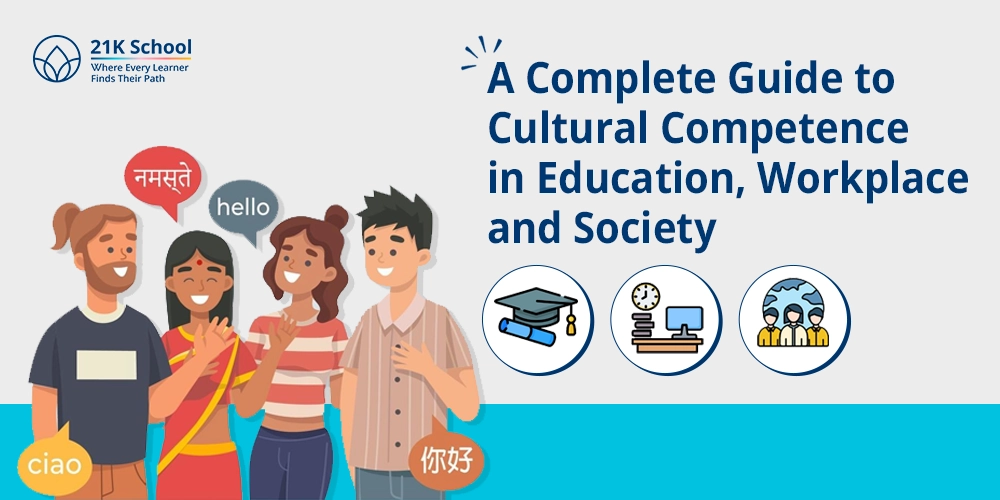
A Complete Guide to Cultural Competence in Education, Workplace and Society
 Written byAnkita SinghaContent Specialist
Last modified: Aug 26, 2026 10 min read
Culture isn’t limited to race or ethnicity, though people often think. It is the set of experiences, family tradition, individual heritage and community membership that is unique to every person.
It’s easy to think people know someone based on their assumption about their culture, but each person is unique, and culture is not a fixed set of defined rules.
If we treat it as such, our assumptions can lead us to create obstacles for others that we may not see.
This article provides you with a detailed version of cultural competence in education.
What is cultural competence?
Cultural competency is the ability to understand, communicate and effectively interact with people across cultures.
Cultural competency involves appreciating cultural differences that affect communication. Everyone must respect the culture of others.
The person who can easily adapt to different cultures has the highest cultural competence. Whether in their professional life or personal life, they do not have to face many problems. Everyone should be aware of diverse cultures.
4 importance of cultural competence
People skilled in cultural competency help reduce challenges adapting to the cultures of other places. Cultural competency helps to unite people of diverse ideologies.
1. Improves communication
People from different places have varying attire, speech patterns, and mannerisms. Cultural competence helps people overcome these barriers. When people can adapt to the culture of another place, they can communicate better with them.
This proves very helpful in one’s professional and personal lives. It also reduces misunderstandings among people from different regions.
2. Promotes inclusion and respect
When there is more conversation among people, respect for one another will increase. People from different places will respect each other, which will reduce discrimination. People will not be isolated because of language or customs.
When a person becomes aware of their responsibilities, their self-confidence will increase. This has a positive impact.
3. Improved outcomes
Cultural competence plays a leading role not only in people’s personal lives but also in their professional lives. Its importance is better understood in the field of education or work because there are people of different cultures or ideologies.
Everyone’s culture has to be seen equally. If there is a very big difference between cultures, it can create challenges, but also improve innovation and outcomes when managed well. Having cultural competence is very necessary to achieve good outcomes.
4. Personal growth
Every person should be familiar with other cultures. The more a person is aware of cultural relations, the more progress they will make in their personal life. For growth in personal life, one must acquire the skill of cultural competence.
In personal life, when a person talks to another person, they will gain knowledge about that person’s culture, and the relationship between them will be strong. That person will be aware of the other person’s language and behaviour.
4 core components of cultural competence
To develop cultural competence, people need to learn about different cultures.
1. Cultural knowledge
Every person should have cultural knowledge; otherwise, they will not easily adapt to other cultures. To gain this knowledge, they should have a love for other cultures.
Culturally knowledgeable people have no problem communicating with people from other cultures. So, a good bond is created between them, which helps them to increase their confidence and become more interested in learning about the culture.
2. Cultural awareness
Each person must be aware of and respect their own culture. Cultural awareness is expressed in language and conduct. Cultural awareness has gone through various changes and created a huge impact on global businesses and relationships.
Through cultural awareness, people can share their ideas, thoughts, traditions, religion, ethics, morals, and so on. Cultural awareness is very much essential in order to promote a healthy society, equality, social cohesion and tranquillity.
3. Cultural skills
Cultural skills refer to the knowledge one has about different cultures. The more cultural skills a person has, the easier it is for them to interact with other people. There are very few problems during conversations because they are aware of the other culture.
To acquire this skill, one has to communicate with people from different cultures and read various cultural books.
When communication increases, good relations are created between them, and in this way the skill increases.
4. Cultural encounters
Cultural encounter refers to a person’s respect, gaining knowledge about that culture and admiration for other cultures.
When a person has a good understanding of other cultures, they do not have much difficulty in adapting to those cultures.
When they talk to others, they speak well with confidence and without any fear, believing in themselves and gaining more knowledge about the culture.
Applications of cultural competence in key sectors
Acquiring cultural competence is very important. It greatly helps a person in every aspect of life. Its importance is immense, whether in the field of education or in the workplace.
1. Healthcare
Knowledge of cultural competence is essential for every person, and its importance in the health sector is immense.
If there is a cultural difference between the opinions of a doctor and a patient, it becomes difficult for the doctor to treat the patient.
Language differences are an important problem in the health sector. Just as it is important for a patient to know the culture of the doctor, it is also important for a doctor to be aware of the culture of the patient.
2. Education
In the field of education, its importance is no less. If a teacher does not have an understanding of the students’ culture, then this lack of cultural understanding may reduce engagement and create problems in the academic field for the students.
Cultural competence generates interest among the students when they listen to lectures attentively; it makes teaching easier for the teachers.
Students’ behaviour towards their teachers improves, and they show respect and reverence towards their teachers with humility.
3. Workplace
People from different places travel to various locations for work, and therefore, cultural competence plays a crucial role.
In the context of work, people from different places have to go to different places; in that case, having knowledge about different cultures becomes very useful.
In the context of work, people have to work within teams, and within that group there are people from different cultures. Everyone’s language and behaviour are different.
Therefore, everyone has to work with different opinions. Everyone has to respect everyone’s culture; everyone has to act as one, and as a result, work will improve.
5 ways to develop cultural competence
It is very important for everyone to acquire cultural competence. This education can only be achieved when there is a good understanding, learning and interaction with other cultures and dialogue with people from that culture.
1. Practice self-reflection
Everyone should have a very good idea about their own culture. One can get an idea about a person’s culture from their behaviour. This culture comes from their family or society. One has to keep oneself updated about the culture at every moment.
One has to learn about culture without having a bad idea about the culture of others. When talking to someone, if one speaks according to their culture, the relationship becomes better. This will help them understand their own problems and move forward.
2. Listen actively
During a conversation with someone, one should listen very carefully to the other person. By listening carefully, one can gain knowledge about that culture.
It is very important during a conversation that if one does not listen to the other person very well, it will be difficult to understand what they are saying, which later causes a breakdown in the relationship.
This culture of conversation comes from the family or society. It plays an important role in every moment of a person, be it in the field of education, work or health.
3. Seek knowledge
It is essential to gain knowledge about cultures other than one’s own. This knowledge will be gained only when one acquires education about that culture.
If someone does not respect the cultures of others by giving more importance to their own culture, a wrong idea is created about that culture, which prevents them from gaining knowledge about that culture.
4. Learn continuously
Everyone has to continuously learn about diverse cultures by communicating with people or by learning about that culture from books.
Communicating has to overcome the fear of speaking, and without education, one cannot know much about other cultures.
Nowadays, there are various methods of acquiring education by which people can understand the relationship between cultures.
People become more interested in learning about cultures when they implement that knowledge in real life.
5. Adapt communication
Languages vary from place to place, so everyone needs to respect all languages. Even among people who speak the same language, there are differences in usage, and these differences must be taken into account when speaking.
The same linguistic style cannot be used all the time. Language strengthens relationships, so during conversations, one must listen attentively to the other person’s language and respond thoughtfully.
Conclusion
In today’s time, acquiring cultural skills is very important for every person. As a result, differences between people are reduced, and relationships are strengthened. It is necessary to look at others with respect and admiration.
It helps people in their education, work, health and every moment. For this, every person should be interested in education.
This education must be acquired. During communication with the above, attention should be paid to the meaning of friendship.
Frequently asked questions
9 questions
Why is cultural competence important in the workplace?
Cultural competence is of paramount importance in the workplace. Here, people from diverse cultures work together in groups, so everyone must work with respect and consideration for each other's cultures. This reduces conflicts and improves work performance.
Why is cultural competence important in education?
Teachers need to be aware of the students' culture and teach them. They need to be aware of the students' language and manners before giving lectures. This will increase the students' interest in learning and create a good relationship with the teacher.
What are the key skills needed for cultural competence?
The key skills needed for cultural competence are that everyone needs to learn about other cultures. Listen well during conversations and overcome the fear of speaking.
What are common barriers to developing cultural competence?
The common barriers are giving priority to one's own culture over others, not speaking well, and being afraid to speak for fear of making mistakes.
What is the main difference between cultural competence and cultural humility?
Cultural competence focuses on acquiring knowledge and skills to work effectively across cultures, while cultural humility emphasises lifelong self-reflection, acknowledging limitations, and addressing power dynamics without claiming full expertise.
How to develop cultural competence?
To develop cultural competence, every person must acquire education about other cultures. By acquiring education, one can learn about that culture and speak with people from that culture.
Why is cultural competence important?
The better one's cultural competence, the more they will grow in their personal life as well as their professional life because they will be able to adapt to all cultures.
How to improve cultural competence?
Education about cultural competence is needed. They must listen attentively and patiently to others. Every culture must be respected and honoured.
What is an example of cultural competence?
Cultural competence helps people at every moment, be it in personal life or professional life. From the field of education to the workplace. It strengthens the relationship between teachers and students in educational centres. It maintains good relations with colleagues in the workplace.
About the author
Ankita Singha
Content Specialist
Ankita Singha is an Education Content Specialist at 21K School, India’s first accredited fully online K-12 School. She focuses on the in-depth research and creation of the well-drafted guides on early childhood education, school admission processes, and CBSE/ICSE curriculum guidance. With more than 2 years of experience at 21K School, a fully accredited institute- Cambridge International (IA702) and Pearson Edexcel (94883), Ankita works closely with the school’s curriculum heads and academic coordinators. Ankita’s every article reflects on the official board guidelines, practical realities, and current policies of online education in 78+ countries. Ankita’s content has helped thousands of parents in understanding the topics like RTE eligibility, NIOS pathways, and age-appropriate admission criteria.
Every 21K School guide is written by our education team and reviewed by a subject facilitator before publishing.
Exploring a CBSE-pathway online school?
Talk to an advisor about 2026–27 admissions — no obligation.
Talk to an advisorComments
No comments yet — be the first to share your thoughts or ask a question.