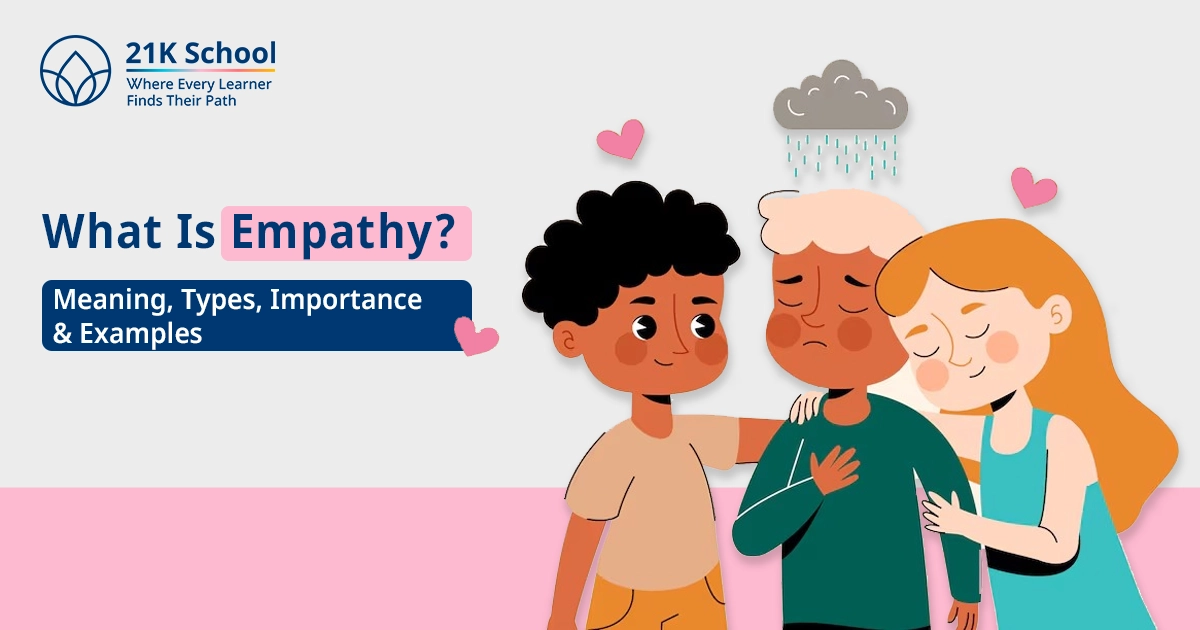
What Is Empathy? Types, Importance, Examples, and Ways to Develop It
 Written byAnshu KumariContent Specialist
Last modified: Sep 3, 2026 16 min read
Have you ever been accused of lacking enough empathy in a given situation, and you might have thought, "What is empathy"?
Empathy is a special emotion that shows your emotional response to another person's feelings and situations. It is more like being in someone else's place and understanding their personal take on a scenario.
But often, this is what most people know about empathy. You will be able to explore much more about empathy once you read this piece from start to end and get a detailed idea about how it is significant in daily living.
What is empathy?
Empathy is a feeling that lets you connect with others' points of view and emotional conduct. Through empathy, people connect to each other's emotions instead of just having pity for them in dire situations.
The term empathy comes from the Ancient Greek word "empatheia", which means physical passion or affection.
To understand better, consider a situation where a girl has faced a lot of childhood trauma and all kinds of abuse. When she says that she feels lost and cannot do her daily routine, an empathetic person would understand where she is coming from and how to make her feel at ease.
Thinking of it deeply, empathy is the only emotion that allows you to take action and solve others' issues when they ask for help. It is an emotion that gives space to humanity in us.
Mostly, individuals with empathy serve in areas like nursing, NGOs, healing, and psychology. They do it as they can better understand someone's vulnerable state of mind and feelings.
3 types of empathy
Empathy shows up in layers in human beings. It can be noticed in different ways, and this defines the type of empathy it is. Let's have a look at each one of them separately.
1. Cognitive empathy
Cognitive empathy is the kind of empathy where someone understands the other person's ongoing situation on a mental level without feeling it. It is quite a reflective and clear-headed process when a person sees someone else's pain, instead of absorbing it completely.
2. Affective empathy
Affective empathy moves one step further to comprehend the emotions of other people by feeling them personally. It is also called emotional empathy.
People who show affective empathy deeply resonate with somebody's mental and emotional state, thus forming a stronger bond with others.
4. Compassionate empathy
Empathy in which a person takes action to reduce the suffering or stabilise an individual's feelings is called compassionate empathy.
For example, when you see a child crying on the street and instead of just hearing, feeling and understanding the reason behind it, you give him something to eat and then make arrangements so that he can reach his parents.
5. Somatic empathy
Somatic empathy is the physiological involuntary response of your body to certain situations or emotions that you are not directly concerned with or affected by.
For better or worse, your ears might become red, or your stomach might churn seeing someone wailing and throwing up in tense situations like death.
Difference between empathy and sympathy
It is quite common to witness that people misinterpret and misuse empathy and sympathy in their regular lives. But both of these terms reflect different emotions and understanding.
Let's look at the most evident differences between empathy and sympathy with the help of the following table:
| Criteria for Difference | Empathy | Sympathy |
|---|---|---|
| Meaning | Understanding another person's feelings or perspective | Feeling sorry for another person's difficulties |
| Focus | Understanding the other person's experience | Expressing concern about their experience |
| Perspective | Involves putting oneself in another person's position | May maintain more emotional distance |
| Emotional connection | Often involves emotional or cognitive connection | Usually involves concern or pity |
| Example | “I can understand why you feel hurt.” | “I'm sorry that you're going through this.” |
| Purpose | To understand and connect | To express care or concern |
Causes of empathy
Empathy is inbuilt and can also be learned through exposure in a healthy environment. The main causes of empathy can be described as:
1. Neuroscientific explanations
The research of neuroscientists indicates that empathy is a process of the brain involving several systems. People witnessing other people feeling emotions could engage certain parts of the brain that are related to social cognition, perspective-taking, and emotion.
There has been research on systems engaged in observing and interpreting the actions of other people, which has also led to the discussion of how humans interpret others' experiences. Empathy is, however, a multifaceted process instead of a single brain structure or mechanism that can explain it.
When an individual reads others' facial expressions, tone of voice, body language and social cues, he or she is able to identify the emotions of others. Such processes can be responsible for empathic reactions.
2. Emotional explanations
Emotions are a crucial component of empathy. Empathy is often acquired through the ability to recognise, understand, and manage their own emotions.
If a person has had a loss, they may be more aware of signs of grief in another person, for instance. While each experience is different, past emotional experiences may help to give clues as to how other people are feeling.
The development of emotion is crucial in childhood. Children slowly come to recognise their own emotions, to understand the impact of their emotions and to be sensitive towards others' emotions. This can be shaped by the caregiving relationships and social interactions.
3. Prosocial explanations
Empathy is very related to pro-social behaviour. This is an action that's carried out for or to support others. When a person understands another person's emotions, they can be encouraged to assist, cooperate, comfort, share, and/or protect the other person.
Empathising with someone who is struggling might lead to a person's compassionate response to wanting to help. This way, empathy can help in cooperation and social bonding.
Social learning is also a pathway on which prosocial behaviour emerges. Parents, teachers, peers and others will model empathy and helping behaviours for children to learn.
6 importance of empathy
Empathy is significant as it helps promote good relationships, communication, emotional wellbeing, and cooperation. It has significance in the below-mentioned aspects of life:
1. Builds stronger relationships
Empathy can help people build more meaningful and profound relationships. Emotions and thoughts are recognised and accepted when people feel their thoughts and feelings are understood.
Empathy enables individuals to be sensitive to the feelings of others in friendship and family situations when they are happy, sad, frustrated, frightened or disappointed.
For instance, a person who can be empathetic might listen to what a friend is concerned about and try to identify why this is important to them. This can help foster trust and an emotional bond over time.
2. Improves communication
Communication is more than just about being able to talk clearly. It also needs to be aware of the other person's point of view and be able to react to it.
People can listen to and respond to verbal and non-verbal signals (tone, facial expression, gestures, body language) by paying attention to them. This will help minimise miscommunication.
For instance, when there is a disagreement, an empathetic individual may attempt to understand the concern of the other person instead of only defending his/her own, which may be based on an unrelated issue.
This can then help to produce a more respectful and productive interaction, as the two sides can communicate at a more empathetic level.
3. Helps resolve conflicts
Conflict is frequently caused by differences in needs, expectations, beliefs, and/or perception of a situation. When caring for him, it is important to be empathetic to understand these differences.
If individuals try to grasp each other's opinions in a better way, they might lessen their tendency to blame and focus more on solutions.
For instance, in the event of a disagreement in the workplace, learning why each member of staff is keen on a specific aspect of the matter may assist the staff in finding a compromise.
It does not involve a person giving up his/her own point of view. Rather, it provides room for other points of view to be honoured.
4. Promotes emotional support
Empathy can help a person to give emotional support to individuals who are facing difficulties.
An empathetic response will make someone feel heard and less alone when they are in grief, stress, disappointment, fear or loneliness.
Often giving advice isn't emotional support. Very often it is more beneficial to listen without judgement and to validate another person's emotions.
For instance, if someone is having difficulties, you can say, “This must have been very hard for you". This shows that YOU understand it is difficult, but you do not try to impose solutions or rationalise the person's problem.
5. Supports emotional intelligence
Empathy is one of the key factors of emotional intelligence. Emotional intelligence is the ability to identify, understand and control personal feelings, and to react to others' emotional states.
Empathy plays an important role in interpersonal skills of emotional intelligence. It is helpful for people to identify emotional signals, grasp other people's points of view and respond appropriately.
Empaths with more developed empathetic skills may experience more success in social situations, in dealing with relationships, in effective communication, and with working collaboratively with others.
6. Encourages compassion and prosocial behaviour
Empathy can help people to take action for the benefit of others. People who feel compassion for another person's problems may be willing to help that person or show them some empathy.
If a child observes that a classmate is not doing well, he/she might offer to share notes with her. One of the workers can assist another to perform a hard task. A person can volunteer to assist a person who is affected.
These are behaviours which help to build cooperativeness, kindness and social connectedness.
Examples of empathy
Empathy is visible in multiple areas of existence. It is seen as:
1. Empathy in psychology
In psychology, empathy plays a crucial part in treating patients, especially in the areas of counselling and psychotherapy. Empathy is a quality of the psychologist/psychotherapist who can understand the thoughts, feelings, experiences and concerns of their client from the client's perspective.
For instance, an empathetic psychologist does not just say to someone in grief, “Let it go". Rather, they listen intently, validate the client's emotional state and provide a secure space for the client to share painful emotions without fear of judgment.
In psychology, empathy is not that the professional has to have the same feelings as the client. Instead, it's about knowing the client's experience and keeping to an appropriate professional distance. This can help to build trust and enhance the therapeutic connection.
Also, psychological research and social psychology are relevant to empathy. Knowing how others experience other people's experiences, and how these experiences are responded to, can help to provide a window into people's interpersonal relationships, prosocial behaviour, prejudice, interpersonal conflicts and social cooperation.
2. Empathy in education
In educational environments, empathy is beneficial because students are not all the same personality type, learn in the same ways, come from different backgrounds, face different problems, etc., and have varying emotional needs. Empathy can be displayed by the teachers, thus making the learning environment supportive and inclusive.
A caring teacher, for instance, who observes a student's performance in an exam dipping drastically one day, may first consider that the student may be having difficulties with learning and/or anxiety/stress, or that there may be difficulties at home or elsewhere, rather than assume that the student is coming to the exam lazy.
Pupils have the opportunity to practise 'empathy' with their peers too. Empathetic behaviours in education include listening, respecting other opinions, supporting someone who is having difficulties and not judging someone.
Empathy can thus help to improve the teacher-student relationship, cooperation in the classroom, communication and emotional wellbeing.
3. Empathy in everyday life
Many common interactions have a component of empathy. Listening to a distressed friend, empathising with a family member's frustration or helping a friend in a difficult time.
If a friend has not been successful in a job he or she wanted, for instance, a sympathetic reaction might be, “I know how important this job was to you. It's natural that you are disappointed." This is a response that acknowledges the person's feelings, rather than dismissing their emotions right off the bat and saying to be positive.
Actions are also evidence of empathy. Empathy can be supporting a friend who is feeling stressed, worrying about a neighbour who has a cold, helping an elderly person to carry something, supporting a colleague who is feeling stressed, etc.
How to develop empathy: 6 ways
Empathy is easy to learn. It is a part of healthy communication and trustworthy relationships. To develop empathy, follow the following steps:
1. Practice active listening
Active listening is the act of listening, paying attention to what someone is saying, but not necessarily talking. Notice the person's body language and tone of voice and try not to interrupt.
It's also good to ask questions that are relevant to see how they have experienced things. For instance, ask a person, “How did that situation make you feel?” rather than immediately giving him/her a solution to his/her problem.
Active listening enables people to be heard and helps to foster deeper communication.
2. Try to understand different perspectives
What may seem the same to one person can be a very different experience to another, due to their experiences, beliefs, values and circumstances. Helping to see things from another point of view can help build empathy.
When responding to someone's behaviour, ask:
- What may be going on for them?
- What do they think this might be important to them?
- Do I have more information about the circumstances that I don't know?
This is not to say that you must come to an opinion that you agree with the other person. It doesn't mean to say that they need to be understood. It just means that an effort is made to understand them.
3. Avoid immediate judgement
Judgement can be an obstacle to understanding. It's easy to judge people when their behaviour is not what we expect, even if we don't know what has happened.
Don't take offence right away at the person's rudeness, laziness, insensitivity, or irresponsibility, but rather think about other reasons.
Resist the urge to make hasty judgements, to be sure there will be time for curiosity and understanding. It is also more respectful in communicating.
4. Pay attention to non-verbal communication
Communication is more than just words. Facial expressions and body language, tone of voice, eye contact, posture and gestures can help you identify how someone may be feeling.
For instance, one person might tell you that he or she is “fine” when he or she is speaking very softly and doesn't make eye contact. These cues could be a sign that he or she is feeling a feeling that he or she is not ready to voice.
While non-verbal communication can be a sign of what is going on in a person's mind, it should not be taken as proof of their emotions. It is a guide to their sensitivity, which can be used to prompt you to respond in a more sensitive way.
5. Validate feelings
Emotional validation is simply putting another person's emotions into words as being comprehensible in their context. Validation does not imply approval of all of what they say or do.
For instance, if someone has a difficult situation and you say to them, “I can see that was hard on you,” you are just putting yourself in the shoes of that person.
People feel heard and respected through validation. Also, it helps them to express themselves freely about issues they have.
6. Read and learn about different experiences
Experiences outside of your own can increase your awareness of other people's perceptions and experiences of the world.
When reading books, biographies, people's stories, literature and credible educational information about various cultures, communities, life situations and experiences, it encourages perspective-taking.
Ears that are open to listening to others' stories can also confront us with assumptions and a deeper understanding of experiences that we haven't encountered.
Concluding thoughts
Empathy is the ability to recognise others' feelings and to grasp them based on their individual perspective. When you think of lending a helping hand to people suffering, it also becomes a part of empathy.
People have different degrees of empathy showing abilities. It can be grasped through committed practice and self-awareness activities.
Empathy, in today's world, is one of the feelings that can save this earth and the living beings existing on it. This is because empathy shows selflessness and a deeper form of affection.
Frequently asked questions
7 questions
What is empathy in psychology?
Empathy is the capacity to understand the thoughts, feelings and viewpoints of another person and react to their experience in an appropriate way in Psychology. It could be thinking, feeling, and/or doing. Counselling and psychotherapy require a special degree of empathy, as this can aid in establishing trust between professional and client and enable a better understanding of the client's experience.
What is empathy in simple words?
The term empathy can be defined simply as an attempt to understand how someone else feels or thinks about a situation. It is a matter of taking the time to consider what it might be like for them and reacting without hasty judgement.
What is an example of empathy?
Empathy involves hearing a friend's dismay when they are disappointed over a test and acknowledging his or her emotions. Acknowledging the emotions that they have worked hard for by saying, "I understand why you're disappointed after working so hard."
What are the three types of empathy?
There are three primary types of empathy that are discussed: cognitive empathy, emotional empathy, and compassionate empathy. Cognitive empathy: understanding another's point of view. Emotional empathy: feeling the emotions another person feels. Compassionate empathy: understanding and reacting with a desire to help.
Why is empathy important?
Empathy is important because it allows individuals to have better relationships, communicate effectively, resolve conflict, provide emotional support, develop emotional intelligence, and encourage compassionate and pro-social behaviour.
Why don't some people feel empathy?
There are different levels of empathy which people have, and different levels that they are willing to do and feel. Empathic responses can be affected by factors including personality, emotions, social experiences, stress, trauma, learned behaviour, and some psychological and neurological disorders.
Is empathy the same as compassion?
No. Compassion and empathy are two different concepts. Empathy is defined as an understanding of or feeling that is similar to another person's emotional experience, and compassion is defined as recognition of another person's emotional suffering and desire to reduce it. Empathy involves feeling a sense of understanding for somebody without taking any action, but compassion involves having a desire to act to help.
About the author
Anshu Kumari
Content Specialist
Anshu Kumari is an Education Content Specialist at 21K School- a fully accredited institute- Cambridge International (IA702) and Pearson Edexcel (94883). She focuses on the in-depth research and creation of the well-drafted guides on NIOS admission, Indian Education Policy, and competitive exam preparation. With around 2 years of experience at 21K School, her psychology background informs her approach to the education content and hence focuses on creating guides to address the real anxieties of the guardians. She writes well-researched articles on competitive exam timelines, stream selection, and board choices by referring to the official resources. All Anshu’s content pieces are fact-checked against the board and primary government official resources and is dedicatedly reviewed by the school’s academic team.
Every 21K School guide is written by our education team and reviewed by a subject facilitator before publishing.
Exploring a CBSE-pathway online school?
Talk to an advisor about 2026–27 admissions — no obligation.
Talk to an advisorComments
No comments yet — be the first to share your thoughts or ask a question.