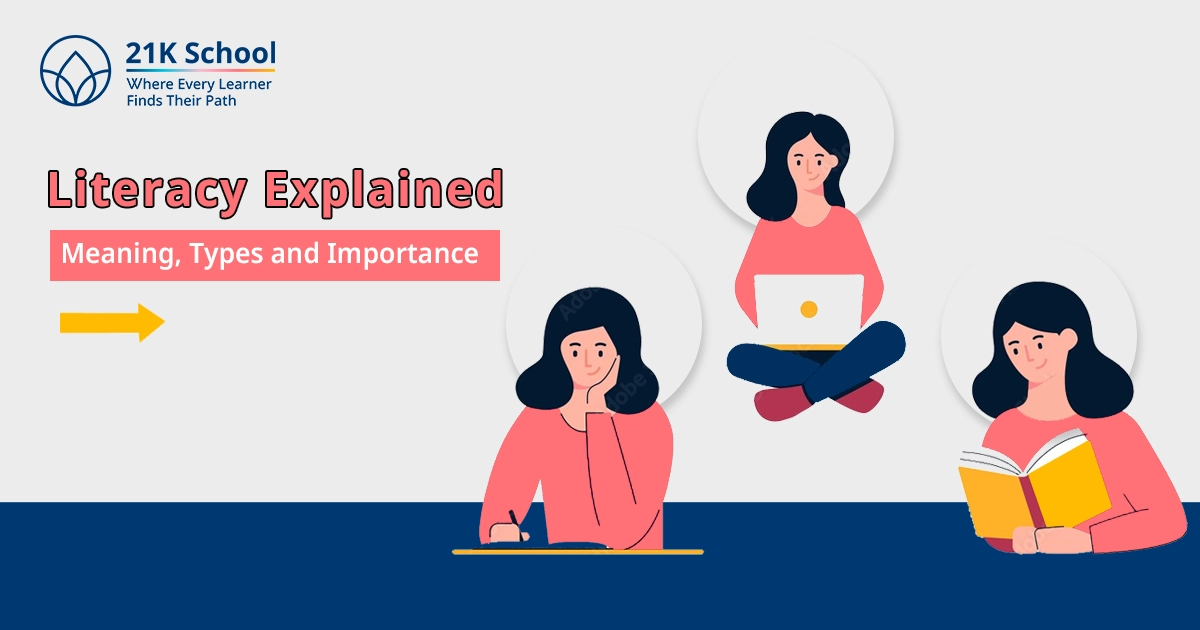
What Is Literacy Explained: Meaning, Types and Importance!
 Written byRahul PalContent Specialist
Last modified: Sep 4, 2026 18 min read
Do you know the actual meaning of literacy?
Literacy is a necessity that facilitates learning, communication and normal life participation.
It assists individuals in their interpretation of written messages, articulating their thoughts, hearing and acting on instructions and making effective decisions.
Traditional definitions of literacy were considered to be mostly related to reading and writing, but society and technology have shifted their attention.
The ability to read and write at an earlier age will assist students in learning better and being more independent in various circumstances.
What is literacy?
Literacy is the ability to read, write, understand and use information correctly. It assists individuals to perceive written texts, interact, think and memorise statements.
The other literacy skills in the modern world are number sense, use of technology, and the ability to understand and use information correctly, which people can trust and the information on various kinds of content.
Literacy for students is a significant base of learning since it helps them to comprehend lessons, assignments, research, and utilise information in interesting ways.
Stages of literacy development
Literacy is an ongoing process through which children and adults acquire the skills of reading, writing, comprehending and communicating. The younger age group is estimated since children do not develop in a similar manner.
1. Early childhood
Early literacy involves the knowledge of letters, sounds, vocabulary, reading stories and simple writing.
The first skills could be encouraged by reading picture books, singing, and regularly talking.
2. Primary education
Students enhance their writing and reading skills in the primary years.
They learn to read independently, understand different books, compose sentences and paragraphs, construct words and vocabulary, and utilise literacy skills in other subjects in school.
3. Secondary education
More advanced literacy skills are developed by students at secondary levels.
They are taught to understand how to read complicated texts, how to organise the information, write down detailed answers, how to conduct research, and so on.
4. Lifelong learning
The process of literacy formation goes on into adulthood.
Examples of how people use and practice their skills are higher education, work, reading information, as well as use of digital services, accomplishment of daily activities, and learning new subjects or skills.
What are the levels of literacy?
The levels of literacy will be determined by the use and the level of work which the individual can undertake with the help of literacy skills, and it will start with writing easy text, followed by the development, analysis and utilisation of information and working on their own.
1. Basic literacy
On the simple level, an individual is able to decode and write simple written language.
They are able to identify common words, comprehend simple sentences, write down simple individual facts and relate written words to their applications in normal life.
2. Functional literacy
This stage is when one can use literacy in performing practical tasks.
They are able to read a bus schedule, fill out an application form, read a product label, read a written instruction or write a brief.
3. Proficient literacy
The application of information to some degree is called high-ability literacy.
The individual is able to take in information in one piece of writing, draw a line between information, organise information, write a structured piece of writing, as well as choose information that fits in a certain activity.
4. Advanced literacy
Greater literacy is to interpret, assess and compare multifaceted information.
The subject can also challenge arguments and assumptions or prejudice, weigh opposing sides, gauge the validity of evidence and generate good conclusions or written works.
6 importance of literacy rate
A high literacy rate is an indicator of the number of individuals in a population who can employ basic reading and writing skills in education, employment and society.
1. Improves communication
The increase in literacy levels implies that the population is able to read, write and comprehend more.
This assists in facilitating communication in learning institutions, workplaces, as well as other environments of interacting with the government and community in general.
2. Supports learning
It is through literacy that learning in the different subjects is possible.
People who can read written materials can refer to educational materials, understand instructions, continue their study and learning and acquire new skills.
3. Builds independence
Increased literacy can assist individuals to cope with routine activities on their own.
Reading, following instructions, checking out bills, accessing services and filling out applications are easy when there are well-literate people.
4. Improves decision-making
Literacy helps people to understand information before they make decisions.
Comparing information, reading and locating the appropriate information by flipping through papers and decoding them will also help to make decisions using more information in real-life scenarios.
5. Supports career growth
Access to education, training and work is a factor of literacy.
The representatives of the higher level of literacy will be able to comprehend the working information, fill out the applications, adhere to the instructions in the workplace, and, moreover, train their professional skills.
6. Encourages social participation
Literacy will help them learn, socialise effectively with organisations and learn essential facts shared by government agencies and community organisations.
It also enhances their participation in community issues, keeps the people updated on the local issues and enables them to access the most crucial communal services themselves.
What is the literacy rate in India?
According to the Surveys conducted by the Ministry of Statistics and Programme Implementation (MoSPI), the above figures indicate that the age group of the Indian population aged 7 years and above with an above literacy level was 80.9%, according to the Periodic Labour Force Survey (PLFS) 2023-24 survey.
The estimation will be done considering the 2023-2024 survey period, July-June. It cannot be compared to the 2011 Census rate of literacy at 74.04%, and the two numbers cannot be compared without taking into consideration their source and mode of the survey.
The latest PLFS figure given above depicts an estimate of 81 out of every hundred persons aged 7 and above years old to be literate in India.
State-wise literacy rate
The 2023-24 Annual Report of the PLFS published by the Ministry of Statistics and Programme Implementation (MoSPI) shows that the literacy rate of the literate at the age of 7 years and above in India, both rural and urban, is 80.9%. This questionnaire will be done in July 2023-June 2024.
1. Mizoram - 98.2%
Mizoram is the most literate state since the high literacy rate was recorded at 98.2%, as compared to the literacy rate of the entire India, which is at 80.9%, indicating that literacy is high in Mizoram.
2. Lakshadweep - 97.3%
This literacy rate was 97.3%, and this was 16.4% above the national literacy rate in Lakshadweep. This contributes to the Union Territory being likened to other parts of India, as far as literacy is concerned.
3. Nagaland - 95.7%
In Nagaland, the literacy rate stands at 95.7%, and this is in contrast to the literacy rate in India, which is 14.8 percentage points lower.
This has resulted in a highly favourable placement of Nagaland, which is the most literate area of the country.
4. Kerala - 95.3%
Kerala state was 14.4 percentage points higher than the average literacy, with 95.3% being attained. This is a pointer that Kerala is a well-literate state.
5. Meghalaya - 94.2%
The literacy in Meghalaya had risen to 94.2%, 13.3% higher than the national literacy rate of 80.5%, and the literacy level was very high in the State.
6. Tripura - 93.7%
The Literacy level of Tripura stood at 93.7%, which is 12.8 percentage points above the national literacy level. It is the best education system in India.
7. Chandigarh - 93.7%
Chandigarh held the ninth position amongst the Union Territories in terms of literacy rate of 93.7% against that of Tripura and 12.8 percentage points higher than that of the country; Chandigarh is said to be one of the most literate Union Territories.
8. Goa - 93.6%
Goa has registered literacy in the 93.6% position, which is 12.7 percentage points above literacy in India. The number ranks Goa as one of the highest performing regions in the country.
9. Puducherry - 92.7%
The literacy level of Puducherry was ranked as one of the most literate states, with a literacy level of 92.7% compared to the 81.1% literacy level of other states in the country and an increase of 11.8 percentage points.
10. Manipur - 92.0%
There was a literacy rate of 92.0% in Manipur, which was 11.1 percentage points above the literacy rates in other parts of India. This boosts the literacy level in the nation to a greater rate.
11. Andaman & Nicobar Islands - 91.1%
The literacy level in Andaman and Nicobar Islands was 91.1%, compared to the national literacy level of India (10.2% above), and the Union Territory is also more literate than in other regions in India.
12. Himachal Pradesh - 88.8
The literacy level of the people of Himachal Pradesh was relatively high, as it stood at 88.8%, which is 7.9% better than that of the country, India.
13. Dadra & Nagar Haveli and Daman & Diu - 87.8%
This Union Territory was in the higher-literacy category with ease since the literacy level of 87.8% was 6.9 percentage points higher than that in the rest of India.
14. Maharashtra - 87.3%
Maharashtra had a literacy rate of 87.3%, which was 6.4 percentage points higher than the literacy rate of India. Its rate puts the state in the list of regions which perform above the national average.
15. Assam - 87.0%
Assam state, too, was well literate with a literacy rate of 87.0 as compared to the literacy rate in India, which was 6.1 percentage points lower.
16. Delhi - 86.9%
The literacy level in the state of Delhi was 86.9%, which is an increase of 6 per cent compared to the level of literacy in the whole of India. The number puts the Union Territory well above the national literacy standard.
17. Tamil Nadu - 85.5%
Tamil Nadu had a literacy rate of 85.5%, 4.6 percentage points higher than the national literacy rate, which has seen the state overtake the national literacy index.
18. Haryana - 84.8%
The literacy rate of Haryana was 84.8%, and it was 3.9 per cent higher than the literacy rate in India. It thus enjoys an average level of education which is marginally greater than the national average.
19. Sikkim - 84.7%
The literacy level in Sikkim was 84.7% (3.8 percentage points higher than the national literacy level in India), and therefore, the state was marginally higher than the national literacy level in the country.
20. Gujarat - 84.6%
In Gujarat, the literacy rate was 84.6% and 3.7 percentage points higher than the literacy rate of the nation. This puts the state in a very poor standing as compared to the national literacy standard.
21. Arunachal Pradesh - 84.2%
The literacy level in Arunachal Pradesh was 84.2% at the national level, which was 3.3 points higher than the national literacy level.
22. Uttarakhand - 83.8%
The literacy in Uttarakhand is at 83.8%, which is 2.9 per cent higher than the literacy level in the country. The reason behind this is that the state-level literacy is marginally above the national level of literacy.
23. Punjab - 83.4%
Another well-off state is Punjab, whose literacy rate is 83.4% higher by 2.5 compared to the national literacy rate in India. It has a fairly high literacy level as compared to the national average.
24. Karnataka - 82.7%
Karnataka had an enrolled literacy level of 82.7% (0.8 per cent higher than the national literacy level), and this has enabled the state to take the lead over the national literacy level.
25. West Bengal - 82.6%
The literacy in West Bengal had soared to 82.6%, which was 1.7 above the national literacy rate in India. This is a very high state rate; only much higher than the literacy rate in the state.
26. Jammu & Kashmir - 82.0%
The Jammu and Kashmir literacy level stood at 82.0% as compared to the national literacy level of 80.9% in India and was 1.1 percentage points higher.
27. Ladakh - 81.0%
The level of literacy in Ladakh was practically the same as the level of national literacy, as 81.0% was only 0.1 percentage point above the national level of literacy of 80.9%.
28. Odisha - 79.0%
The literacy level of Odisha was 79.0% in comparison with the national literacy level of 1.9 percentage points in India. It ranks a little below the rest of the country, as regards the degree of literacy.
29. Chhattisgarh - 78.5%
The literacy level in Chhattisgarh was 78.5%, or 2.4 percentage points below the national literacy level of India, and thus slightly less than the national literacy level.
30. Uttar Pradesh - 78.2%
The literacy level in Uttar Pradesh was 78.2%, or 2.7 percentage points lower than that of the country, and it means that the state had massive but, to a large extent, more common dispersion than the national level.
31. Telangana - 76.9%
Telangana has a literacy level of 76.9%, which is 4.0 percentage points lower than the national literacy level of India of 80.9%, and thus depicts a low level of literacy.
32. Jharkhand - 76.7%
Jharkhand is among the states where the rate of literacy is relatively low, as the literacy rate, at 76.7%, is 4.2 percentage points lower than the national literacy level in India.
33. Rajasthan - 75.8%
In Rajasthan, the literacy level is 75.8% as compared to 75.8% of the national literacy level; a difference of 5.1 percentage points. This puts the state very low as compared to the national literacy standard.
34. Madhya Pradesh - 75.2%
The literacy rate in Madhya Pradesh was at 75.2%, or 5.7 percentage points below the national literacy rate, and indicated that the difference between the national level and the Madhya Pradesh level was quite large.
35. Bihar - 74.3%
The literacy in Bihar was 74.3%, which is a disparity of 6.6 percentage points with that of literacy in India. The figure ranks Bihar as one of the states that have lower estimates of literacy.
36. Andhra Pradesh - 72.6%
Andhra Pradesh was at 72.6% in literacy levels; this was a lower literacy level than the national literacy level in India by 8.3 percentage points. The estimate of literacy is low as compared to the listed other states and Union Territories.
| Rank | State/UT | Literacy Rate (%) |
|---|---|---|
| 1 | Mizoram | 98.2 |
| 2 | Lakshadweep | 97.3 |
| 3 | Nagaland | 95.7 |
| 4 | Kerala | 95.3 |
| 5 | Meghalaya | 94.2 |
| 6 | Tripura | 93.7 |
| 7 | Chandigarh | 93.7 |
| 8 | Goa | 93.6 |
| 9 | Puducherry | 92.7 |
| 10 | Manipur | 92.0 |
| 11 | Andaman & Nicobar Islands | 91.1 |
| 12 | Himachal Pradesh | 88.8 |
| 13 | Dadra & Nagar Haveli and Daman & Diu | 87.8 |
| 14 | Maharashtra | 87.3 |
| 15 | Assam | 87.0 |
| 16 | Delhi | 86.9 |
| 17 | Tamil Nadu | 85.5 |
| 18 | Haryana | 84.8 |
| 19 | Sikkim | 84.7 |
| 20 | Gujarat | 84.6 |
| 21 | Arunachal Pradesh | 84.2 |
| 22 | Uttarakhand | 83.8 |
| 23 | Punjab | 83.4 |
| 24 | Karnataka | 82.7 |
| 25 | West Bengal | 82.6 |
| 26 | Jammu & Kashmir | 82.0 |
| 27 | Ladakh | 81.0 |
| 28 | Odisha | 79.0 |
| 29 | Chhattisgarh | 78.5 |
| 30 | Uttar Pradesh | 78.2 |
| 31 | Telangana | 76.9 |
| 32 | Jharkhand | 76.7 |
| 33 | Rajasthan | 75.8 |
| 34 | Madhya Pradesh | 75.2 |
| 35 | Bihar | 74.3 |
| 36 | Andhra Pradesh | 72.6 |
| - | India | 80.9 |
Difference between literacy and education
Education and literacy are two closely related concepts which cannot be interchanged. Literacy is just a skill, whilst education is more of a wholesome approach to learning, skills, values and knowledge.
| Aspect | Literacy | Education |
|---|---|---|
| Meaning | Literacy is the skill of reading, writing, comprehending and decoding any simple information. | Education is learning, and in the process of learning there is knowledge, skill, values and understanding. |
| Scope | Literacy concerns the communication and information-processing skills needed in both everyday life and education. | Education involves classroom learning, fieldwork, personal, social and general knowledge. |
| Purpose | Literacy will teach one to get used to knowledge in a written form, be in a position to express him/herself, read instructions and perform daily tasks independently. | Education enables individuals to be knowledgeable, think, have practices, values and knowledge on different topics. |
| Development | Literacy is a highly instructed activity by reading, writing, and processes that involve language, practice and constant exposure to a lot of information. | Some of the ways in which education evolves are schooling, higher education, training, experience, observation and lifelong learning. |
| Focus | The concept of knowledge and application of information through reading, writing and other techniques is primarily the concept of literacy. | Education is the overall intellectual, applied, social, emotional and personal growth as achieved in the various education experiences. |
| Example | An announcement is an example of literacy, as is writing information, instructions and filling out a simple form. | Learning mathematics, science, history, languages, and learning professional abilities are some examples of education. |
How to improve literacy skills?
The common practice can help students become better readers, writers, comprehenders, and conveyers of information and express their ideas lucidly.
1. Regular reading
Help students read books, newspapers, stories and other pertinent articles based on their age.
Vocabulary and comprehension of work, sentence structure and definition of key material could be enhanced by reading various kinds of work.
2. Writing practice
Every day writing would assist the pupils in structuring their thoughts and ideas and presenting them in a structured manner.
They are able to practise writing short paragraphs, summaries, journal entries, answers, stories or descriptive passages on subjects that they know.
3. Vocabulary development
New words enable students to understand the texts and improve their speech.
By reading, it is possible to observe the words that the students do not know, as well as to locate the definition of these words and repeat them in sentences and re-read them regularly so that they can memorise them.
4. Reading comprehension activities
Comprehension activities assist students in being able to read and understand what they are reading.
Questions about a passage, pointing out key points, elucidating concepts, summarising, and identifying key details can be used to reinforce knowledge.
5. Discussion and communication
Continuous discussions also allow the students to listen, share thoughts, ask and answer questions.
Teaching in a classroom, group discussion, storytelling and argument can be used to increase their understanding and effective communication.
Conclusion
Literacy is more than simply reading and writing. It assists in thinking or cognitive processing of information, good communication, personal learning, in doing everyday things and in making good decisions.
The development of literacy could be broken down into various stages and may encompass reading, writing, numeracy, digital literacy and information literacy.
In the case of students, a well-developed literacy level will not only offer them a platform on which to base their academic learning but will also enable them to be able to impart any learnt knowledge both at school and in the real world.
Frequently asked questions
9 questions
What is literacy in simple words?
Literacy is simply the ability to read and write, process and apply the information learned in learning, and in interpersonal and real-life situations.
What is an example of literacy?
One such piece of literacy is reading a series of instructions, reading a school notice, writing a message, filling out a form or clarifying the information on a piece of writing.
What are the main types of literacy?
The primary ones are reading literacy, writing literacy, numeracy, digital literacy, media literacy, information literacy, financial literacy and health literacy.
What are the basic literacy skills?
Basic literacy skills include: reading, writing, listening, understanding, developing vocabulary and articulating information.
What is the difference between literacy and education?
Literacy means the ability to read, write, comprehend and utilise information, and education is a more general process of acquiring knowledge, skills, values and a sense.
What is the best definition of literacy?
The ability to comprehend, utilise, interpret and communicate information effectively by reading, writing, and other communication tasks can be determined as literacy.
What is literacy in education?
Educational literacy is a blend of skills that are developed to assist students in reading, writing, comprehending, expressing themselves, observing instructions, as well as learning in other courses.
What is literacy and numeracy?
The process of knowing and applying language, reading and writing, and the process of knowing and applying numbers, mathematical information and simple mathematical knowledge are called literacy and numeracy, respectively.
Why is literacy important for students?
Literacy can help students comprehend the lessons, read textbooks, do assignments, exchange ideas, research, read instructions and develop skills that they would utilise in their further learning.
About the author
Rahul Pal
Content Specialist
Rahul Pal is an Education Content Specialist at 21K School- India’s fully accredited online school recognised by the Cambridge International (IA702) and Pearson Edexcel (94883). His graduation from Journalism and Mass Communication from Swami Vivekananda University gives him a strong foundation in factual reporting, source verification, and investigative research. With around 2 years of experience at 21K School, he has written extensively for the CGPA conversion guides, marking schemes, and Indian and International boards (IGCSE, GCSE, and A-Levels). His articles are highly relevant for the guardians looking to guide their learners for board exam preparation across 78+ countries. All Rahul’s content is reviewed by the school’s academic team to ensure alignment with the latest board guidelines and latest notifications from the official resources
Every 21K School guide is written by our education team and reviewed by a subject facilitator before publishing.
Exploring a CBSE-pathway online school?
Talk to an advisor about 2026–27 admissions — no obligation.
Talk to an advisorComments
No comments yet — be the first to share your thoughts or ask a question.