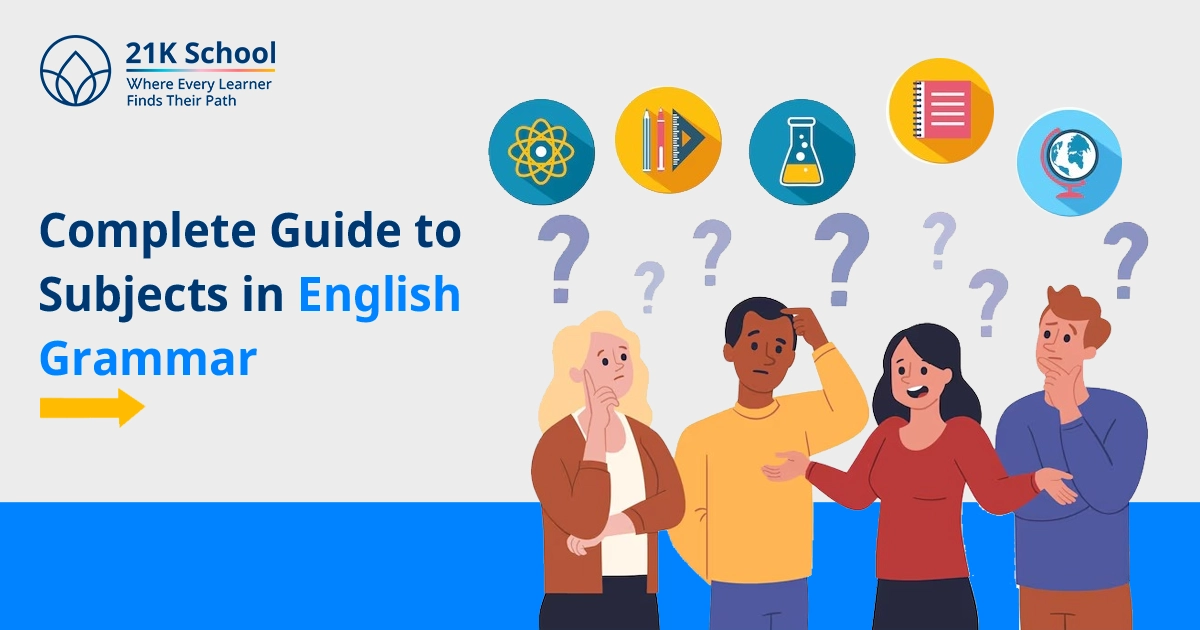
Complete Guide to Subjects in English Grammar
 Written byRahul PalContent Specialist
Last modified: Sep 26, 2026 10 min read
Subject is a significant feature of English grammar insofar as it concerns learning how a sentence is made up.
Being taught how to use each word will ensure that the students can write their sentences without a lot of mistakes due to poor grammar and are also able to know how to structure their sentences correctly.
The subject is one of the most important parts of a sentence that provides a structure and meaning to the sentence. The students too should learn how to recognise and utilise subjects correctly since it will be easy to learn predicates, verbs and subject-verb agreement.
What is a subject in English grammar?
A subject is an essential part of a sentence wherein we are told about the subject of the sentence and who or what the sentence is about. It can be anything: a person, place, thing, animal or idea.
The subject can be either described or do something in the sentence, or they can be able to experience something. The majority of the sentences are characterised by the position of the subject before the main verb; hence, it is simpler to find.
It can be one word which refers either to a noun or a pronoun or a group of words, all of which are a subject.
Examples:
- Ram reads a book. Here, Ram is the subject because she performs the action of reading. - The children are playing outside. Here, the children are the subject because they perform the action of playing. - My new computer is blue. Here, my new computer is the subject because the sentence describes it.
As such, establishing a topic assists us in knowing who or what does the act or is being addressed within a sentence.
Types of subject
There are various types of subjects, and this is based on their appearance and functionality in a sentence. It has four major forms, and they include simple subject, complete subject, compound subject and implied subject.
1. Simple subject
The simple subject is a main noun or pronoun which explains who or what the sentence is about. The modifying or describing words are not included.
Examples:
- The boy is running.
- She loves music.
- Dogs bark loudly.
Here, boy, she, and dogs are the simple subjects.
2. Complete subject
A complete subject comprises the simple subject and all the words which are used to describe or to change it. It includes all the information on what or who the sentence is referring to.
Examples:
- The little boy in the blue shirt is running.
- My elder sister works in a bank.
- The tall trees near our house provide shade.
The entire objects are the blue shirt boy, my elder sister and the tall trees around our house.
3. Compound subject
A compound subject has two or more nouns or pronouns which have the same verb. They are usually related using the aid of such words as or or and.
Examples:
- Riya and Ananya are best friends.
- Tom and Jerry are famous characters.
- My brother and I play cricket together.
Here we have two or more subjects in the sentences that are either doing or being done the same thing.
4. Implied subject
An inferred subject refers to a subject which is not directly stated but can be deduced after reading the sentence. It is mostly used in imperative sentences in an understood sense of the word 'you'.
Examples:
- Close the door = (You) close the door.
- Please sit down = (You) please sit down.
- Bring your notebook = (You) bring your notebook.
The second and third sentences do not directly refer to you, but imply it in the subject you.
Subject in different types of sentences
It will be another thing as far as the kind of sentence is concerned. Knowing where it can be and where it will help in discovering the topic in sentences that are constructed in various structures.
1. Declarative sentences
A declarative sentence makes a statement or provides information. The subject is usually put before a verb and tells us the person or thing that the sentence is referring to.
Examples:
- Riya plays the piano.
- The dog is sleeping.
- My parents love gardening.
In this case, my parents, Riya and the dog are the participants.
2. Interrogative sentences
An interrogative sentence is a question. Depending on the sentence structure, the subject can also follow the helping verb, or it can follow a question word.
Examples:
- Is Rahul coming to school?
- Did the children finish their homework?
- Who opened the window?
The subjects to be used here will be the children and Rahul.
3. Imperative sentences
An imperative sentence is a command, request, instruction or advice. The topic is never brought out directly since you have an implied understanding.
Examples:
- Close the door = (You) close the door.
- Please help me = (You) please help me.
- Complete your homework = (You) complete your homework.
In these sentences, you are the implied subject.
4. Exclamatory sentences
The exclamatory sentence produces such strong emotion that it can be surprise, excitement, joy or rage. One can put the subject in the manner before the verb and an exclamatory phrase.
Examples:
- The children are extremely excited!
- She looks beautiful!
- What a wonderful performance they gave!
In this instance, they, she and children are subjects.
Examples of subject in sentences
A simple sentence contains only one self-sustaining clause consisting of a leading word and a verb. The subject tells us what it is or what the performance is being told.
- Riya reads every evening.
- The cat is sleeping.
- My father drives carefully.
- Birds fly in the sky.
1. Interrogative sentence examples
Sentences that are in the form of an interrogative are called questions. The subject may come following a question word, or a helping verb.
- Is Rahul coming today?
- Did the teacher explain the lesson?
- Are the children ready?
- Who broke the window?
2. Imperative sentence examples
A command, request, instruction or advice is given with the use of an imperative sentence. The subject is normally implied as opposed to being mentioned.
- Close the door = (You) close the door.
- Please help me = (You) please help me.
- Complete your homework = (You) complete your homework.
- Take your seat = (You) take your seat.
3. Compound sentence examples
A compound sentence is referred to as a sentence that is composed of two or more independent clauses bonded with the aid of conjunctions like and, but, or and so. Each of the clauses can be a subject in itself.
- Riya completed her homework, and she watched television.
- The sun was shining, but the wind was cold.
- Jerry likes football, while his brother prefers cricket.
- I finished my work, so I went home.
Subject-verb agreement
Subject-verb agreement is an agreement between the verb and the subject in a sentence in terms of number and person. On a single subject, one normally uses a singular verb as compared to the plural subject, where the multiplicity uses a plural verb.
1. Singular subject with singular verb
There is a single verb in the present tense for one subject (usually).
- She plays tennis.
- The boy runs every morning.
- My sister likes music.
2. Plural subject with plural verb
A plural subject is likely to take a plural verb.
- They play tennis.
- The boys run every morning.
- My sisters like music.
3. Compound subjects
There are two topics that are prone to use a plural verb.
- Riya and Ananya are friends.
- Tom and Jack play football.
4. Subjects joined by "Or" or "Nor"
Joining with or nor in or nor joinings. When the subjects are joined by or nor, the verb is often related to the nearest subject.
- Riya or her friends are coming.
- The students or the teacher are responsible.
5. Indefinite pronouns
Everyone, someone, nobody and each are all singular words and need to be used with a singular form of the verb.
- Everyone is ready.
- Each student has a notebook.
- Nobody knows the answer.
Common mistakes in identifying the subject
At times it is not easy to know the subject, particularly where the subject is mixed with the objects, modifiers, compound subject or implied subject.
1. Confusing the subject with the object
The action is done by the subject, and the recipient of the action is the object. In the event that students might pick the subject as the closest noun to the verb, that might be the object.
Example:
Riya kicked the ball.
Here, Riya is the subject, while the ball is the object.
2. Ignoring compound subjects
And, or, nor are words which may be inserted into a sentence to add two or more subjects. Determination of one of them may result in a partial response.
Example:
Riya and Meera are studying together.
Here, Riya and Meera form the compound subject.
3. Mistaking modifiers for the subject
Adjectives and phrases can precede or follow the subject. These modifiers may result in the forgetting of the actual subject by the students.
Example:
The tall boy with a blue bag is waiting outside.
The complete subject is the tall boy with a blue bag, while boy is the simple subject.
4. Missing the implied subject
Not necessarily part of imperative sentences that are supposed to be about you. Learners will be more prone to consider such sentences as having no subject.
Example:
Open the window.
The subject is you, although it is not written: (You) open the window.
Conclusion
It is a fundamental aspect of English grammar since it is used to ascertain who/ what the sentence is referring to.
Being aware of simple, complete, compound, and implied subjects, one can now better comprehend the structure of sentences and develop grammatical correctness.
Through grasping the functioning of subjects in various types of sentences as well as hindering practice and working with the examples, students are able to recognise them as well as apply them in proper use in their writing and speaking.
Frequently asked questions
9 questions
What is a subject in English grammar?
A person, place, thing or idea which a sentence is about is called its subject. It is capable of doing, of possessing or is capable of being described in the sentence.
How do you identify the subject in a sentence?
First, find the main verb: Who? or What? Then, is the action or it is being described? The answer to the subject is typically the answer.
What are the different types of subjects?
Others that are most popular are simple subject, complete subject, compound subject and implied subject.
Can a sentence have more than one subject?
A compound subject may occur in a sentence in which there are two or more nouns or pronouns with the same verb. Example: Riya and Ananya are playing tennis.
What is an implied subject?
The implied subject is not written in the sentence and can be established by the context. It is prevalent in imperative sentences. E.g.: Open the window. (You) unopen the window.
Why is the subject important in English grammar?
The subject of a sentence is a part of a sentence which shows what or who the sentence is written about. It may be a proper noun, proper pronoun or a word-group.
What is the definition of a subject?
A subject is a component of a sentence, and it tells us what or who the sentence is about. It may be a pronoun, noun or word.
What is the first step in handling difficult subjects?
When you are required to discuss difficult topics in English grammar, the first thing you would do is to identify the main verb. Then Ask Who? or What? Is the thing being explained?
What is a subject example?
Here we have the boy, as we know about the performer; the boy is playing football.
About the author
Rahul Pal
Content Specialist
Rahul Pal is an Education Content Specialist at 21K School- India’s fully accredited online school recognised by the Cambridge International (IA702) and Pearson Edexcel (94883). His graduation from Journalism and Mass Communication from Swami Vivekananda University gives him a strong foundation in factual reporting, source verification, and investigative research. With around 2 years of experience at 21K School, he has written extensively for the CGPA conversion guides, marking schemes, and Indian and International boards (IGCSE, GCSE, and A-Levels). His articles are highly relevant for the guardians looking to guide their learners for board exam preparation across 78+ countries. All Rahul’s content is reviewed by the school’s academic team to ensure alignment with the latest board guidelines and latest notifications from the official resources
Every 21K School guide is written by our education team and reviewed by a subject facilitator before publishing.
Exploring a CBSE-pathway online school?
Talk to an advisor about 2026–27 admissions — no obligation.
Talk to an advisorComments
No comments yet — be the first to share your thoughts or ask a question.