

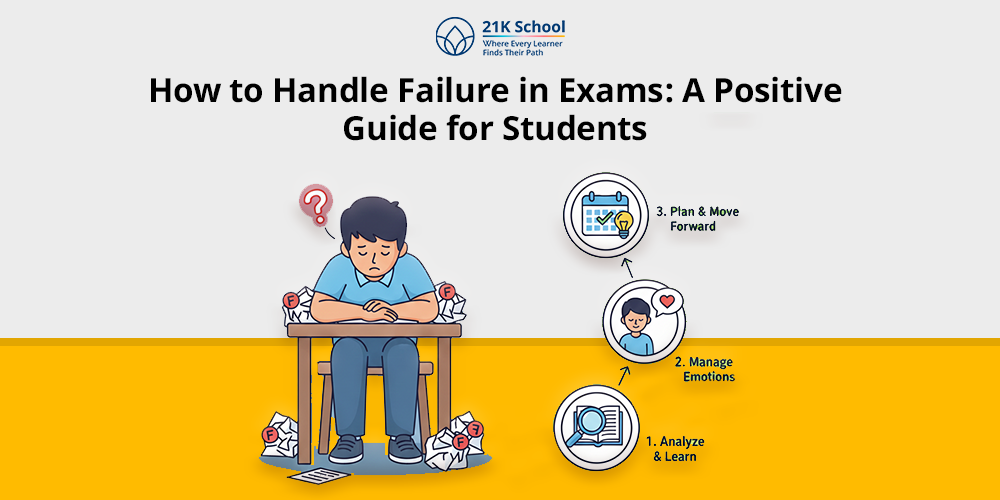
Failure in exams is generally demotivating. It starts creating self-doubt among the students. Moreover, exam results will not decide your strengths & weaknesses.
So, it is just a part of your entire learning journey.
Students need to have self-awareness to handle failure. Instead of accepting failure as the end of their career, students should view it as a challenge on their path to success.
So, let’s find out how to handle exam failure smoothly & convert failures into success & confidence.
Table of Contents
- Understanding Exam Failure
- How to Handle Failure in Exams – 10 Ways
- 1. Process Your Emotions
- 2. Analyze What Went Wrong
- 3. Conduct an Honest Self-Assessment
- 4. Identify Specific Problem Areas
- 5. Learn from Mistakes Without Self-Blame
- 6. Rebuild Your Confidence and Motivation
- 7. Reframe Failure as a Learning Opportunity
- 8. Create an Effective Comeback Strategy
- 9. Manage Exam Anxiety and Stress
- 10. Reach Out for Support
- Sample Recovery Plan to Handle Failure in Exams
- CONCLUSION
Understanding Exam Failure
Failure is a common thing that almost every student faces.
So it occurs due to a hell lot of factors:-
1. Why Do Students Fail in Exams?
Students can face exam failure due to a lot of reasons:
- Lack of Practice due to poor or casual study habits.
- Last-minute Preparation.
- Health issues and Mental Stress can also reduce focus.
2. Breaking the Stigma:
In most cases, failure is taken as a sign of being imperfect & less knowledgeable. But having this kind of mindset is definitely not good.
Failing doesn’t mean the student is unable; it means just that the way they learn didn’t work.
How to Handle Failure in Exams – 10 Ways
The best 10 ways to handle failure in exams are process your emotions, analyse what went wrong, conduct an honest self assessment, and others like:
1. Process Your Emotions
The first step is realising how you are feeling. It’s normal to feel sad, demotivated; these are genuine reactions.
Students should give themselves proper time, & shouldn’t control their emotions.
After your emotions are stable, students are thinking about taking further steps to move forward in their lives in order to achieve success.
2. Analyze What Went Wrong
Instead of ignoring their previous results, the students should take time to analyse their mistakes.
You can ask questions to yourself questions like,
- Did I revise my lessons thoroughly?
- Was my strategy well structured & will it work properly?
- Will I be able to manage my time while appearing for the paper?
These honest evaluations are going to help students improve their insight towards failure, & they can be aware of the weak areas & can work on them accordingly.
3. Conduct an Honest Self-Assessment
You need to be loyal to yourself. Self-assessment is not blaming yourself for the mistakes, it’s about realising it & then working on it.
This might have happened because you did not have a syllabus & practice tests properly.
You need to list out your strengths & weaknesses & plan your strategy accordingly.
After you recognise your strengths & weak points, you can easily work on them & improve your skills.
4. Identify Specific Problem Areas
Instead of normalizing the fact that you are bad at any particular subject, you need to identify your weak point & try to improve & work on it.
By analysing your weak areas, while starting, you can face difficulties, but later you can break the complex problems into simpler ones.
It helps you to stay focused on the areas of improvement.
5. Learn from Mistakes Without Self-Blame
Every student makes mistakes, and it is common nowadays – what’s important is learning from their own mistakes.
Self-blame is only creating fear & discouraging them mentally. So, here you can change your mistakes into lessons.
6. Rebuild Your Confidence and Motivation
Failure usually affects the confidence & morale of the students.
You should try on small steps first & try to acknowledge them once completed & appreciate your performance.
It will help the students to improve their moral strength.
Engulf yourself with positive people who can motivate you & appreciate you.
Learn how to build confidence in children.
7. Reframe Failure as a Learning Opportunity
You need to change your perspective on accepting things & how you are accepting failure.
In place of getting demotivated from it, you can just take it as a 2nd chance or opportunity to build your foundation more strongly.
Every failure will guide you with something that will help you work on yourself more enthusiastically.
So, that is the attitude you can choose to deal with failure by considering it as a part of the learning process in a refined way.
8. Create an Effective Comeback Strategy
Once you have realised your improvement areas, you can immediately start strategizing things, planning & scheduling mocks & revisions in order to avoid the mishappenings like before.
You need to set a comeback plan or strategy ready for your upcoming exams.
Focus on the areas of improvement more strongly, be calm & practice & revise the lessons thoroughly beforehand.
9. Manage Exam Anxiety and Stress
Exam stress & anxiety will hamper your performance, even after you are completely prepared for that particular paper.
You can follow some of the stress management methods:
- By performing Meditation
- By practising Yoga & exercises
- By listening to calm music to feel fresh
- By communicating with the one whom you trust
Basically, a peaceful mind works better than a stressful one. So, try to keep a balance between your study timetable & your self-care routine.
10. Reach Out for Support
It’s not your only responsibility to handle failure solely.
You should talk to the mentors, elders & parents & counselors.
Communication & interaction with these people will motivate you to grow your skills more deeply.
You should take their advice as feedback in order to improve your weak areas.
By only interacting with people & listening to their experiences can also make a huge difference in your thinking, & you can understand that definitely failure is just not the end of your career or future.
Sample Recovery Plan to Handle Failure in Exams
- Week 1: Emotional Processing and Planning
First of all, you need to give yourself to get out of that guilt & accept the fact.
Then write down the lessons learned & note down where you are feeling difficulty.
Create a target & fix a strategy for the next 3 weeks.
Prioritize your areas of improvement, & work on them.
- Week 2: Skill Building and Preparation
Then you need to start preparing yourself for the upcoming exams by working on your areas of weak points.
You need to revise the concepts thoroughly in order to build a strong foundation or base of that particular subject.
And mainly prioritize the daily study habit, which must include short breaks for the refreshment of the mind.
- Week 3: Intensive Study and Practice
Then you should practice the previous year’s question papers, self-assess yourself, and try to find out the improvement areas.
You should prioritize time-based problem-solving & speed up your writing.
Then improve your attention more on the mistakes & work accordingly in order to perform well.
- Week 4: Consolidation and Confidence Building
Finally, at the end, revise the concepts & summary of every subject multiple times.
Apply stress management & relaxation methods in order to keep your mind before appearing for the exam. Stay motivated & have a positive learning environment & calm attitude for the next exams.
CONCLUSION
Failure in an exam is just not the end of the career. It is a second chance to improve your foundation & basics of the topic to make a great move on the next attempt.
By every setback, it provides you the opportunity to grow stronger, work smartly & be successful in life.
Therefore, by understanding the concepts properly, like what went wrong, with proper strategizing & planning in a good way, you can convert the failure into a pillar of achievement.
So, with the proper mindset, you can achieve success in life in a better way & it will enhance your self-confidence.

You may also want to read