


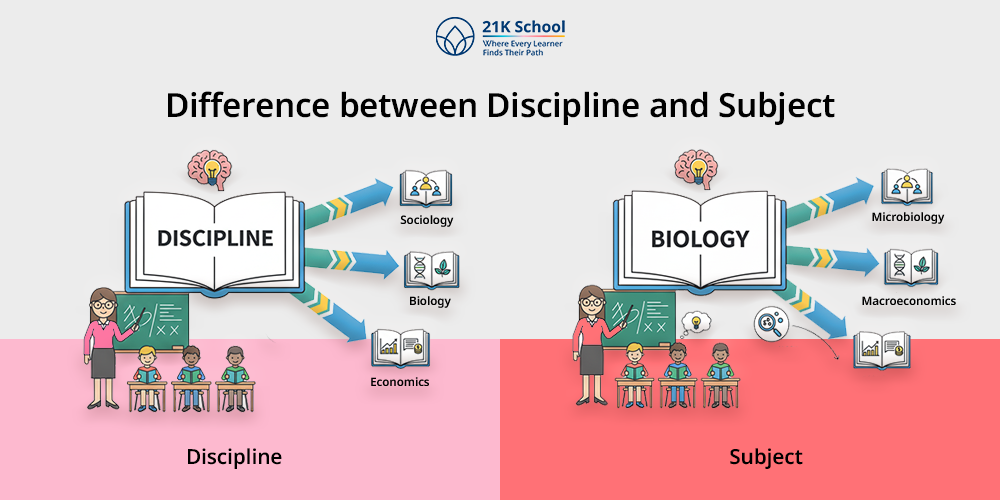
The two terms discipline and subject are utilized in the academic world interchangeably, but mean something different.
Students, researchers, and educators should understand their differences since they all serve different purposes in knowledge, learning, and professional development.
A discipline denotes a wide field of knowledge which is systematic in its structure with respect to a central theme, theoretical framework or methodology, e.g., sociology, biology, or economics.
A subject, in turn, is a particular field of inquiry in a discipline, such as microbiology (in the context of biology) or macroeconomics (in the context of economics).
This essay presents the difference between discipline and subject through a detailed analysis.
Table of Contents
Difference between Discipline and Subject: Key Differences
Although discipline and subject refer to the organised type of knowledge, their definition, goal and role are dissimilar.
Let’s go into deeper insights of the difference between discipline and subject first with a table.
| Basis of Difference | Discipline | Subject |
| Definition | A broad field of academic study with a distinct theoretical and methodological framework. | A specific topic or course of study within a discipline. |
| Scope | Generalized and extensive; and includes several subfields. | Narrower in scope; deals with particular areas of discipline. |
| Purpose | To create knowledge, theories, and approaches to the phenomena. | To impart specialized learning and competencies in a specific field. |
| Focus | Scholarly knowledge and research improvement. | Acquisition and practice of concepts on a general or introductory level. |
| Nature | Idealistic, theoretical, and scientific. | Systematic, constructed to teach and assess. |
| Examples | Psychology, History, Physics, Economics. | Quantum Mechanics, Microeconomics, Cognitive Psychology, World History. |
| Users | Researchers, scholars and academic professionals. | Learners and teachers. |
| Outcome | Theory and progress in knowledge. | Knowledge acquisition and skill application in a certain field. |
1. Definition
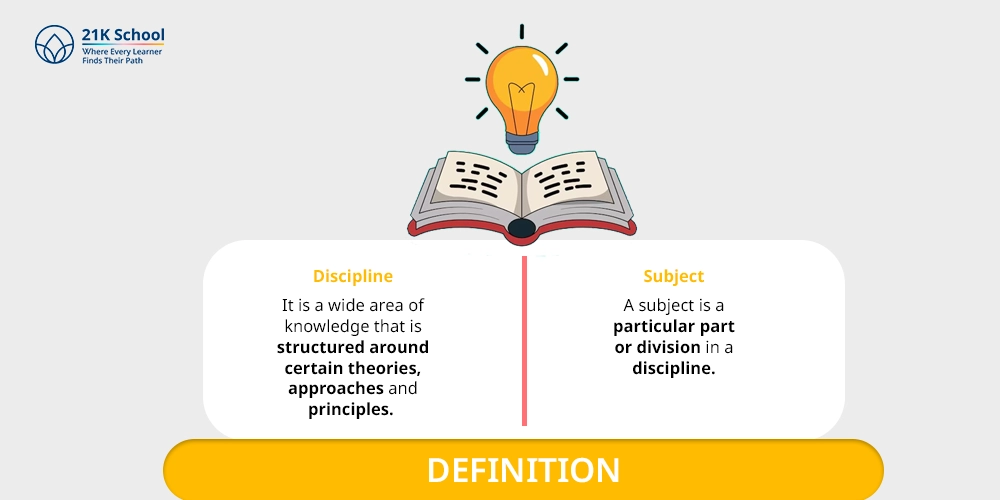
- Discipline: Discipline is a wide area of knowledge that is structured around certain theories, approaches and principles. It is a systematic approach to investigate a given field of reality- e.g. physics, sociology, or linguistics.
- Subject: A subject is a particular part or division in a discipline. It focuses on a specific area and is pedagogically oriented towards teaching and learning, as in thermodynamics (in physics) or sociolinguistics (in linguistics).
2. Scope
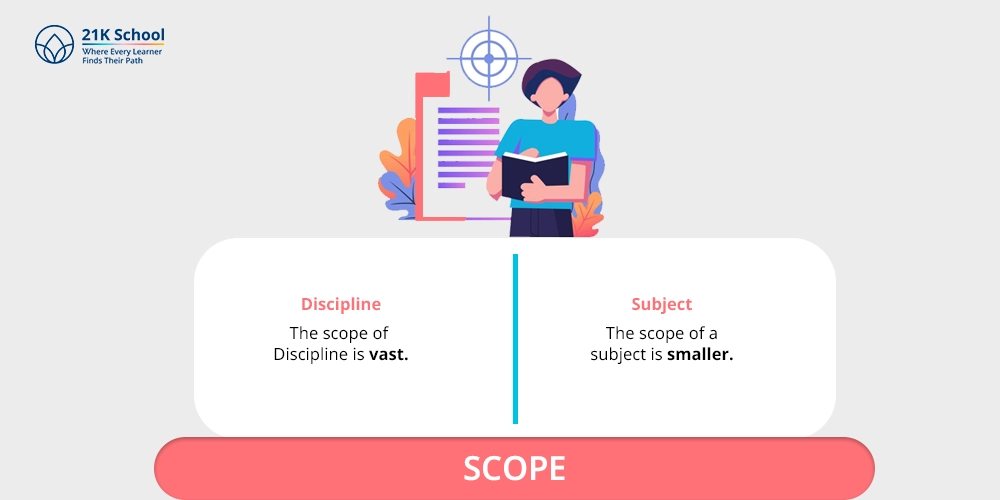
- Discipline: Discipline is vast as it covers a big collection of themes, theories, and practices concerning a broad field of study. The disciplines usually split into several subfields and lead to research that widens the scope of knowledge.
- Subject: The scope of a subject is smaller. It zeroes on one domain or subject within a field, which is supposed to equip particular knowledge or skills. Subjects constitute the practical, pedagogical areas within larger areas of scholarly study.
3. Purpose

- Discipline: A discipline can primarily be understood as the process of coming up with and systematizing knowledge. It tries to comprehend, elucidate, and progress theoretical knowledge by way of research and examination, as well as analytical critique.
- Subject: A subject aims at providing systematic knowledge and usable knowledge to students. It has an educational objective, aiding students to obtain concepts and skills applicable in the discipline.
4. Focus

- Discipline: A discipline is concerned with theoretical growth, conceptualization, and methodology of the research. It tries to examine the more basic principles of a body of knowledge.
- Subject: A subject is application and understanding oriented. It offers a practical application or introductory knowledge on certain topics and enables the learners to implement disciplinary theories to real-world issues.
5. Nature
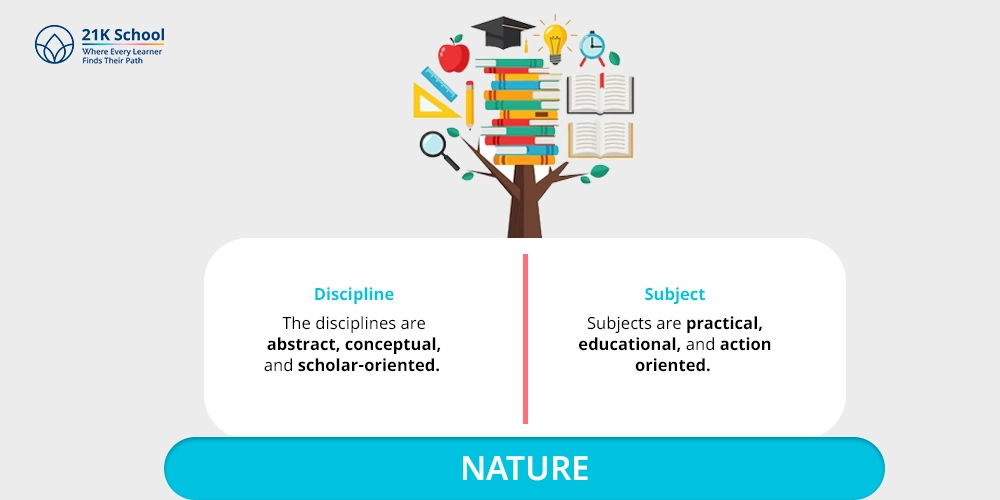
- Discipline: The disciplines are abstract, conceptual, and scholar-oriented. They lay stress on theory formation, testing of hypotheses and scholarly discussion. They need to grow on the basis of innovation, enquiry, and publication.
- Subject: Subjects are practical, educational, and action oriented. They have been put together in the form of curriculum and syllabus to be delivered, and set learning outcomes and tests.
6. Example
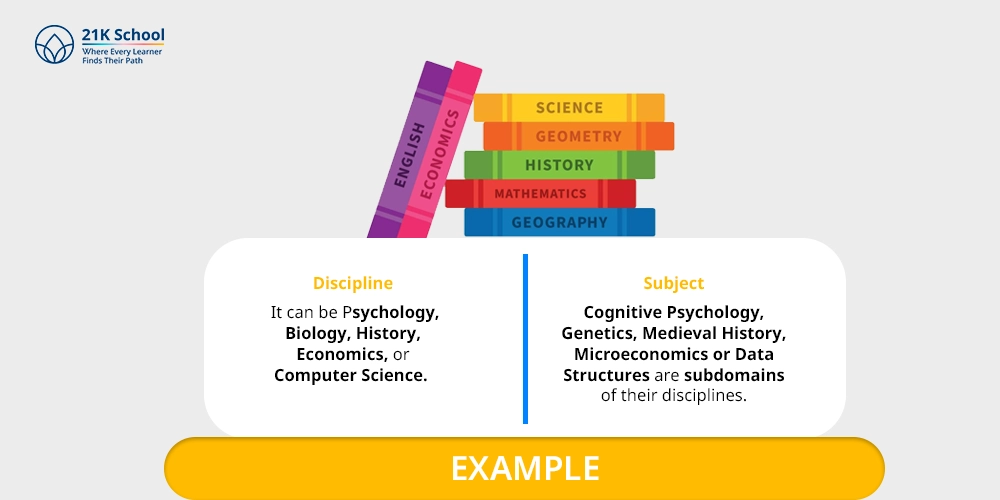
- Discipline: It can be Psychology, Biology, History, Economics, or Computer Science. Each is a complete academic discipline that has their theories and methods.
- Subject: Cognitive Psychology, Genetics, Medieval History, Microeconomics or Data Structures are subdomains of their disciplines.
7. Users

- Discipline: Researchers, scholars, and academics predominantly use disciplines through investigations and publication of their work in an effort to build a body of knowledge in the field.
- Subject: Students and educators utilize or engage with subjects. They serve as the channel by which disciplinary knowledge is found.
8. Outcome

- Discipline: The product of a discipline is the development and progression of new knowledge, theories and practices that influence an academic and professional insight.
- Subject: A subject results in acquiring knowledge and skills by the learners. It facilitates understanding, practice, and prepares one to further study or practice in a field.
What is Discipline?

A discipline is a logical field of study to science examining a range of phenomena under certain theories, principles and procedures.
It is an organized manner of knowing the world and it also leads to the establishment of new knowledge.
Academia is built on disciplines that create intellectual boundaries and establish foundations on which specialized professions and communities of research emerge.
As an illustration, fields such as life sciences, e.g. biology, economics, and philosophy have their conceptualization, vocabulary, and methodologies.
All disciplines aim to find the answers to some fundamental questions in their fields.
Key Characteristics of a Discipline
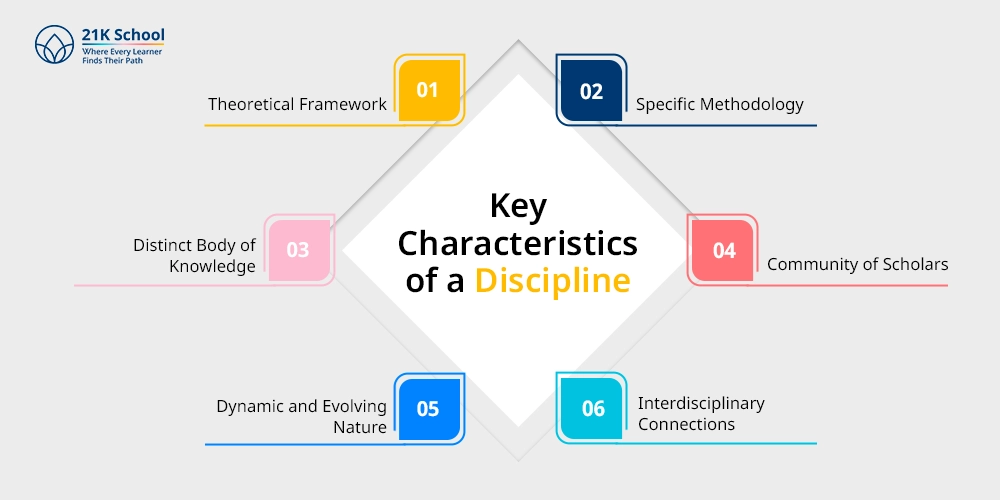
The central features of a discipline are as follows:
- Theoretical Framework: Every discipline is grounded in accepted theories and principles to act as a guiding force to its research and interpretation.
- Specific Methodology: Depending on their nature, disciplines have specific research methods such as quantitative, qualitative, experimental, or theoretical methods used.
- Distinct Body of Knowledge: A discipline has a well organized literature, ideas and terminologies.
- Community of Scholars: Academic communities are disciplines that help enhance their growth through collaboration of researchers, scholars and institutions.
- Dynamic and Evolving Nature: Disciplines keep evolving with new findings, technology and theories being discovered.
- Interdisciplinary Connections: Many disciplines converge to form different sciences of study like biology+psychology forms biopsychology, and many others.
Examples of Disciplines
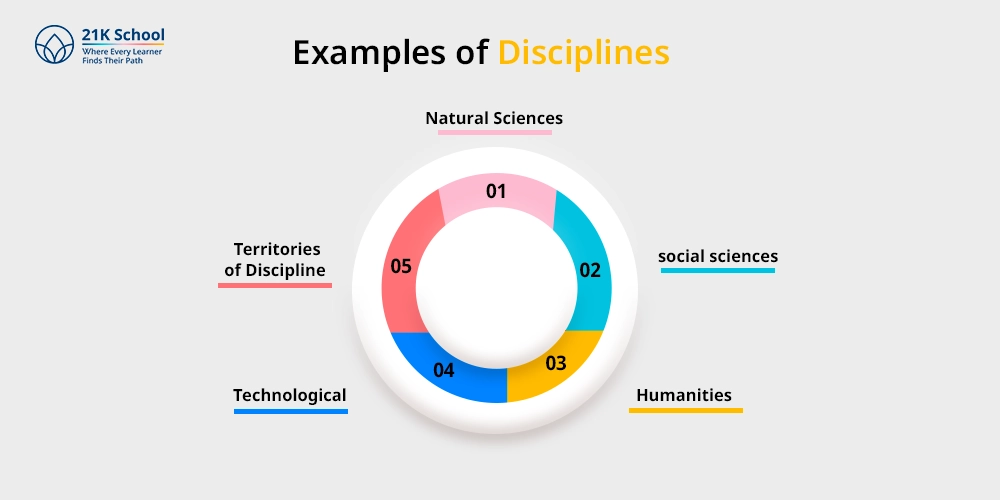
The following are some of the examples of disciplines:
- The Natural Sciences involve Biology, Physics, chemistry and Geology.
- The social sciences are subdivided into Sociology, Economics, Political Science and Anthropology.
- Literature, History, and Philosophy are examples from humanities disciplines.
- Engineering, Medicine, Computer Science, and architecture are from technological background or discipline.
- The Environmental Studies, Cognitive Science, Data Science in Interdisciplinary Territories of Discipline.
What is the Subject?

A subject is a definite field of investigation, which is encompassed in an even greater category of a discipline.
Subjects are practical teachable divisions of knowledge that are to be taught at schools, colleges, or universities.
Although the knowledge is available in a discipline through the theoretical basis, it is a subject where that knowledge can be learned and examined.
In the economics field, as one example, such topics as microeconomics, macroeconomics, and labour economics exist.
Key Characteristics of a Subject
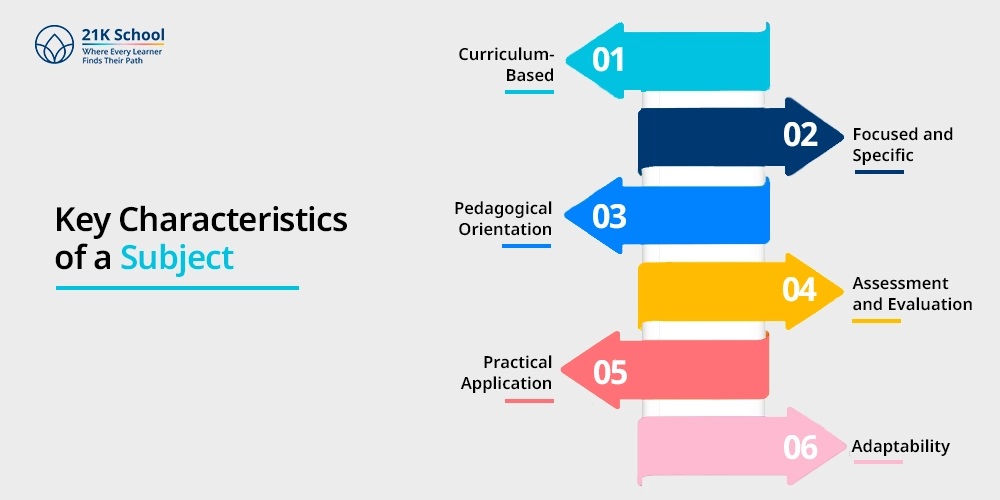
We will now look at the most relevant features of subjects that differentiates it from a discipline.
The following are:
- Curriculum-Based: Subjects are designed to suit learners’ needs of specific school or college, based on specific curriculum.
- Focused and Specific: The subjects are narrowed down to a particular area of knowledge of a larger discipline.
- Pedagogical Orientation: Subjects facilitate teaching and learning based on various practices and strategies.
- Assessment and Evaluation: Subjects involve tests, projects/assignments to detect the extent to which students have attained pertinent knowledge.
- Practical Application: There are many subjects which are oriented to practical tasks, e.g. laboratory work in biotechnology or critical thinking in coding.
- Adaptability: Subjects evolve over time to reflect changing curricular needs of the society and education.
Examples of Subjects
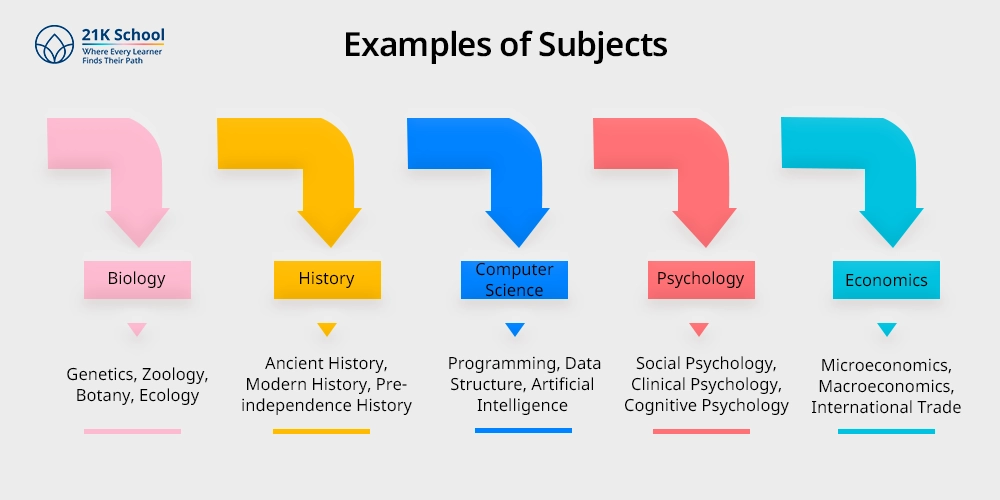
The subjects can be classified as:
- In the Discipline of Biology: Genetics, Zoology, Botany, Ecology.
- In the Discipline of History: Ancient History, Modern History, Pre-independence History.
- In the Discipline of Computer Science: Programming, Data Structure, Artificial Intelligence.
- Under the Discipline of Psychology: Social Psychology, Clinical Psychology, Cognitive Psychology.
- In the Discipline of Economics: Microeconomics, Macroeconomics, International Trade.
Key Takeaways
We now know how a discipline has different identification from subjects.
Though they both are vital elements of human knowledge, they differ on the basis of nature, purpose, scope, and users.
Discipline is no doubt a broader term that with research and practical references may create subjects needed in the world to be explored and learned.
Subjects convey to the new generations what has been learnt by the disciplines. And discipline creates understanding of these subjects.

You may also want to read