


Class 9 is one of the most important years of a modern education life of students, as they start the path of establishing a good base to face the competitive exams in the future.
The stage will provide the most appropriate chance to train in the non-classroom-based tests and practice problem-solving , time management, and confidence. Class 9 exams are also competitive exams that allow the students to test their theoretical knowledge, and the expectations levels are high, which is also expected.
Such exams not only subject them to various types of patterns of questions but also assist in knowing their strengths and weaknesses, not to mention that they will lead to scholarships and even national recognition in other instances.
It is a fact that no matter whether the student is studying science or mathematics or technology, or research, early exposure is a great thing.
Table of Contents
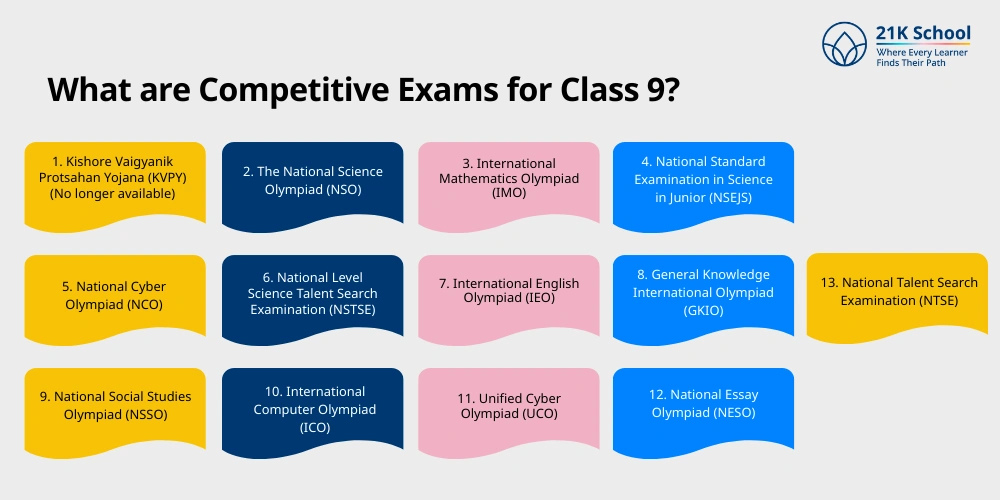
- What are Competitive Exams for Class 9?
- 1. Kishore Vaigyanik Protsahan Yojana (KVPY) (No longer available)
- 2. The National Science Olympiad (NSO)
- 3. International Mathematics Olympiad (IMO)
- 4. National Standard Examination in Science in Junior (NSEJS)
- 5. National Cyber Olympiad (NCO)
- 6. National Level Science Talent Search Examination (NSTSE)
- 7. International English Olympiad (IEO)
- 8. General Knowledge International Olympiad (GKIO)
- 9. National Social Studies Olympiad (NSSO)
- 10. International Computer Olympiad (ICO)
- 11. Unified Cyber Olympiad (UCO)
- 12. National Essay Olympiad (NESO)
- 13. National Talent Search Examination (NTSE)
- Final Thought
What are Competitive Exams for Class 9?
Class 9 competitive exams are those exams which are to be given to test out of the school syllabus. Their tests include analytical reasoning, logical thinking and clarity of concepts in subjects like Science, Mathematics, and Computer Science.
Competitive exams enhance a more application-based learning as compared to school exams, which involve memorisation. The various national and international organisations organise these examinations to assist in naming and sponsoring bright students using scholarships, awards and mentorship programmes.
The tests are also a foundation of other competitive tests in future, such as JEE, NEET, Olympiads and other entrance examinations. Most of them are objective-based and allow schools to participate in them or students to participate individually.
1. Kishore Vaigyanik Protsahan Yojana (KVPY) (No longer available)
KVPY used to be a national fellowship programme which aided in motivating students to pursue careers in the field of scientific research. It was composed in the format of an interview in order to evaluate the aptitude for science and mathematics.
The programme is abandoned and is incorporated in INSPIRE-SHE, where students are screened on the basis of Class 12 board results. Students in Class 9 who are interested in becoming researchers can participate in the construction of conceptual clarity and science Olympiads to establish their science background.
2. The National Science Olympiad (NSO)
NSO is one of the programmes of the organisation, the Science Olympiad Foundation (SOF) is an examination of the scientific comprehension and critical thinking of the students. It will be comprised of Physics, Chemistry, Biology, and Logical Reasoning and will be modelled and founded on the Class 9 syllabus.
It is given at two levels and contains higher-level questions, the Achievers Section, where a higher order of thinking is required. NSO helps the students through strengthening the knowledge of science, enhancing the problem-solving capacities and competing on the national and international level with the prospects of getting medals and certificates.
3. International Mathematics Olympiad (IMO)
IMO hosted by SOF is a mathematical reasoning, logical thinking and numerical problem-solving ability test. It is subdivided into sections like Logical Reasoning, Mathematics, Everyday Math and an advanced Achievers Section.
It has a syllabus that is established on the Class 9 syllabus, including algebra, geometry, probability and statistics. IMO prepares the students with mathematical concepts and provides them with a feel of the higher-level tests, such as Regional Mathematical Olympiad (RMO), the National Mathematics Talent Contest (NMTC) and future competitive tests of engineering.
4. National Standard Examination in Science in Junior (NSEJS)
One of the most difficult Indian junior science Olympiads is the NSEJS, which is conducted by IAPT and can be participated in by students aged below 15. It is the study of standards of higher knowledge in Physics, Chemistry and Biology in a deep conceptual form.
The test is the pre-test of the International Junior Science Olympiad (IJSO). NSEJS paves the way to analytical skills, problem-solving skills , and scientific thinking, and that is why it is a fine option among Class 9 students who are ready to participate in science competitions and careers related to research.
5. National Cyber Olympiad (NCO)
The NCO, which is conducted by SOF, entails the knowledge of students in computers, information technology foundation, computer literacy and critical thinking. The test involves such issues as hardware, software, networking and foundation of the internet and MS Office applications.
It prepares the students for the technological world as well as enhances computational thinking. NCO helps to build the needed digital skills that can be applied in a future job in the sphere of technology, programming, and cybersecurity. The students can win medals, certificates and performance-based scholarships.
6. National Level Science Talent Search Examination (NSTSE)
Both the weaknesses in science and mathematics at the conceptual level are identified by NSTSE, a Unified Council-conducted diagnostic test. It is preoccupied with learning rather than memorising and application of learning by tests, logical thinking and critical thinking.
The students get detailed performance reports and areas of improvement and strengths. NSTSE rewards its best achievers with the best cash, laptops, books and medals, among others, not mentioning that it is a great exam as far as academic development is concerned.
7. International English Olympiad (IEO)
IEO is a test administered by SOF in collaboration with the British Council to determine the academic level of the English proficiency of the students, grammar level, vocabulary, reading comprehension and communication skills.
The test challenges the students to concentrate on their language knowledge and prepares them towards a competitive world where they need to have a good command of the English language. Having 2 levels of testing and the Achievers Section, IEO will assist students to build confidence in English and increase linguistic accuracy and writing skills.
8. General Knowledge International Olympiad (GKIO)
GKIO may review the knowledge of students of an enormous variety of subjects, including history, science, geography, sport, politics, and topical issues. It improves the overall awareness of the students, their analytical capacity and decision-making skills .
The test has the effect of generating interest besides the books, and it helps in developing a good knowledge base, which is useful in case there is an upcoming competitive examination, such as the UPSC, SSC, and in the case of banking tests.
9. National Social Studies Olympiad (NSSO)
NSSO examines the knowledge of History, Civics, Geography and Economics. It studies map skills, political awareness, cultural knowledge and general knowledge about the social structure.
The exam would allow the learners to acquire analytical and interpretative skills, which would be transferred to other subjects, including humanities and in subsequent exams, including the UPSC and State Civil Services. NSSO makes the perception of the current events better, strengthens the fundamentals of knowledge in the social sciences.
10. International Computer Olympiad (ICO)
SOF offers an ICO which is computer, digital tools and logic-oriented. It helps students to attain high levels of IT skills required in modern-day schooling.
The topics to be covered in the syllabus will be computer applications, operating systems, networking, and the new technological advancements. ICO provides logical thinking to students, encourages problem-solving skills, and prepares students at advanced levels in future towards computing, coding and information technology studies.
11. Unified Cyber Olympiad (UCO)
UCO is a test administered by the Unified Council to evaluate the logical ability of the students, mathematics and computer literacy. It is aimed at improving cognitive ability, digital literacy and critical thinking.
The exam makes the students think in a very competitive way, and it is also a way for students to acquire a proper basis of computational reasoning. UCO develops analytical skills to be used in further career paths, such as coding and IT, with certificates, medals, and a national rank.
12. National Essay Olympiad (NESO)
NESO evaluates writing, creativity, grammar and vocabulary of the students and their ability to express themselves clearly. The subject set for the students will be based on the current events or social problems, science or literature. The Olympiad enhances the culture of reading, critical thinking and essay writing.
NESO also assists students in developing better communication skills and prepares students for essay writing, which is required in competitive exams like UPSC, State PSCs and other scholarship tests.
13. National Talent Search Examination (NTSE)
NTSE is a test of national scholarship, which is administered by NCERT , and it helps in the selection and facilitation of bright students. In spite of the fact that Class 10 is the exam, Class 9 would tend to start early in order to get good concepts in Mental Ability and Scholastic subjects.
NTSE offers up to PhD monthly scholarships and helps the students to develop analytical thinking skills, reasoning and a solid academic foundation to compete in examinations in future.
Final Thought
In Class 9, students are prepared to face academic tests and entrance exams through competitive exams. These kinds of tests improve problem solving, critical thinking, time management and confidence.
It is preferable to begin early to have good ideas and practices, which would render the next stage of courses and competitive spheres effective. These exams also teach students to be goal setters, to always work hard and have pressure management skills, besides rewards and recognition.
The students are supposed to balance preparing to take exams and normal studies in school to improve their general development. A good plan, habit, and concept could help the students to achieve in these examinations and create a good academic foundation in the future.
