

Were you a student of co-ed, or separate education system? What would you prefer for your child?
The debate on co-education and separate education is not new. As schools were developed to utilize education, the sitting arrangements and social exposure were always a concern.
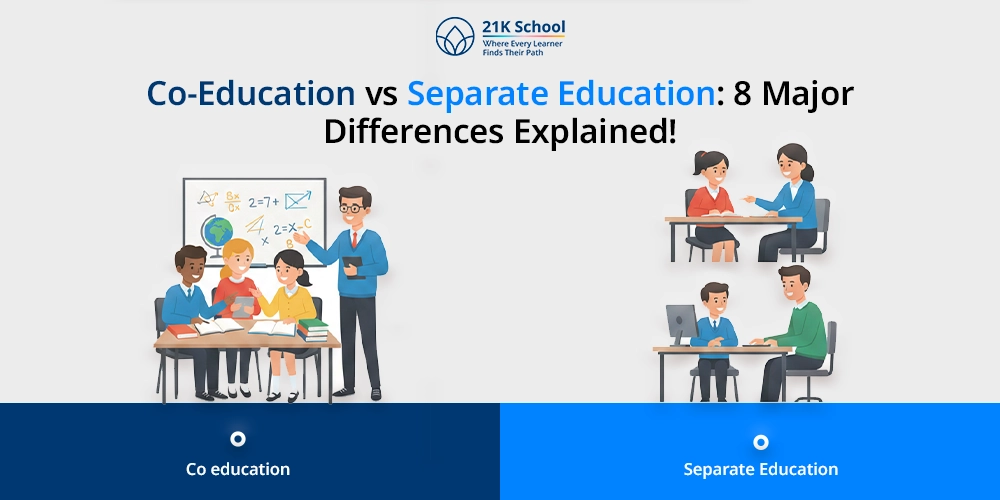
Co-education symbolizes a classroom where both girls and boys study, while separate education only offers a single sex to study in a school.
To know more about co-education vs separate-education and their individual advantages and disadvantages, we will be moving further in this article. So, let’s dive in.
Table of Contents
What is Co-Education?
A learning system that allows both genders including boys and girls to complete their education in the same settings or classroom is called co-education.
It is perceived as an advanced form of education, therefore it is popular in most of the countries.
The concept behind co-education is that men and women co-exist and function together in society. Therefore, they should also study together.
Mixed-sex education encourages gender interaction, thus making the students respect each other, cooperate, and understand one another.
It sets the learners to real-life scenarios and promotes social peace at a tender age.
Advantages of Co-Education
Co-education is accepted by most institutions due to the following benefits:
1. Promotes Social Advancement
Early interaction with other genders in co-education can bring social growth and confidence to have better communication skills with others.
It also brings clarity and emotional maturity in both the genders to deal with problems of their own and opposite gender.
2. Gender Equality
We can say that one of the primary benefits of co-education is gender equality.
The boys and girls who are studying together are taught to appreciate each other in terms of skills and opinions, thus breaking the gender stereotypes.
3. Cost-Effective
Co-education is also cost-effective.
This is because a single infrastructure for both genders can save on infrastructure expense, staffing, and management.
4. Chances of Healthy Competition
The other advantage is healthy competition.
There is a tendency of students to be motivated, perform their best, as well as engage in extracurricular activities when they are in a mixed gender setting.
Disadvantages of Co-Education
Co-education might show the following disadvantages:
1. Chances of Distraction
One of the serious drawbacks of co-education is that learners might get distracted, especially during adolescence.
The students can be distracted emotionally or socially, hence having less focus on studies.
2. Less Accepted Culturally
Co-education can be culturally and socially opposed in certain societies, particularly in regard to female education.
The parents might have concerns regarding discipline, security, or value education.
3. Aspects of Mis-management
Apart from this, the variations of the learning speed and emotional maturity between boys and girls are not managed well in a mixed educational environment.
What is Separate Education?
Separate or single-sex education is a system of education where girls and boys study in different schools or classrooms.
This has always been a system that is traditionally practiced in most cultures and is still favored in some cultural setups.
Despite the lack of evidence, supporters of separate education believe that men and women have different interests, learning styles, as well as developmental patterns.
Threfore, educating them separately can enable the teacher to address these differences and offer a more suitable learning atmosphere.
Advantages of Separate Education
Separate education might have the following advantages:
1. Greater Academic Focus
Greater academic focus can be one of the major benefits of separate education.
Absence of opposite gender removes chances of distraction. Thus, it enables the students to focus more on their studies.
2. Better Understanding and Education
Separate education can help teachers to design their teaching approaches based on gender-based learning requirements.
This can further enhance understanding and education.
3. Increased Confidence Within Girls
The other advantage can be increased confidence, especially within girls.
With a girls-only setting, students get to be more involved in discussions, leadership roles in schools, as well as in non-traditional subjects.
4. More Accepted Culturally
In conservative societies, separate education is acceptable culturally, as it provides parents with confidence about maintaining discipline in education and values.
Disadvantages of Separate Education
Now, let’s see some disadvantages of separate education as well:
1. Might Reinforce Gender Stereotypes
Gender stereotypes, reflecting that girls and boys are basically different and shouldn’t study together, may appear to be supported by separate education.
2. Lack of Communication Between Opposite Genders
One of the greatest disadvantages of separate education is lack of social communication between the genders.
In adulthood, this could make interactions with people of the opposite sex awkward.
3. High Cost Fundings
It is quite expensive to have separate educational setups, infrastructure, resources, and educators for each gender, and thus seems less practical.
13 Differences between Co-Education and Separate Education
We can conclude the discussion on co-education vs separate education with a clear distinction table and bullet points mentioned below:
| Basis | Co-Education | Separate Education |
| Meaning | Boys and girls study together | Boys and girls study separately |
| Learning Environment | Mixed-gender classroom | Single-gender classroom |
| Social Development | High social interaction | Limited interaction |
| Gender Equality | Promotes equality | May reinforce stereotypes |
| Academic Focus | Possible distractions | Better concentration |
| Teaching Methods | Common methods | Gender-specific methods |
| Confidence Level | Builds social confidence | Builds academic confidence |
| Preparation for Real Life | Better real-life readiness | Adjustment needed later |
| Cultural Acceptance | Less accepted in conservative societies | More culturally accepted |
| Cost & Resources | Economical | More expensive |
| Competition | Healthy mixed-gender competition | Limited competition |
| Discipline | Requires strict monitoring | Easier to maintain |
| Suitability | Modern societies | Traditional societies |
1. Meaning
- Co-Education: Co-education is a mixed learning setting where students from both genders study together.
- Separate Education: A separate studying environment is a set up where each gender learn and grow separately.
2. Learning Environment
- Co-Education: Co-education reinforces social integrity by enabling both genders to study in the same settings.
- Separate Education: To support academic focus, separate education offers separate learning environments for both the opposite genders.
3. Social Development
- Co-Education: Co-education learning system can enhance social skills of growing children and improve their approach towards opposite gender.
- Separate Education: In separate education, interactions with opposite gender is not supported, especially in academic premises.
4. Gender Equality
- Co-Education: Co-education may be established when there is equality among genders.
- Separate Education: It focuses on isolated learning, without much attention to build gender equality.
5. Academic Focus
- Co-Education: It can be distracting, especially for the adolescent students due to exposure to the opposite gender.
- Separate Education: Separate education might result in increased focus on studies because of least to no interaction with other gender.
6. Teaching Methods
- Co-Education: Co-ed classrooms employ general approaches of teaching and learning.
- Separate Education: In separate education, gender-based teaching methods are used for better clarity and comprehension.
7. Confidence Level
- Co-Education: Co-education develops social confidence as there is involvement of both the genders in education.
- Separate Education: Separate education can improve academic confidence of learners.
8. Preparation for Real Life
- Co-Education: Co-education is suitable preparation for society because in later life they won’t be awkward while interacting with any gender and even understand their perspectives.
- Separate Education: Separate education would necessitate continuous socialization and adaptation through different situations in real life.
9. Cultural Acceptance
- Co-Education: Traditional societies have less acceptance of co-education as they think this would deplete their culture, especially concerning girls.
- Separate Education: These traditional societies have more acceptance towards separate education.
10. Cost & Resources
- Co-Education: Co-education is cheaper since both girls and boys can study under the same infrastructure and with the same resources.
- Separate Education: Single-sex education is a bit more expensive in terms of resources and infrastructure for separate genders.
11. Competition
- Co-Education: Co-education encourages healthy competition among both the genders.
- Separate Education: Separate education might inhibit competition with exposure to the same gender.
12. Discipline
- Co-Education: Co-education might be tough to discipline and might require strong rules and guidelines.
- Separate Education: Since there is only one gender to maintain, it might be easier to discipline students in separate educational institutes.
13. Suitability
- Co-Education: Co-education can be appropriate in the context of contemporary values and fostering gender equality.
- Separate Education: Separate education might be appropriate for conservative families who believe that girls and boys are different.
Conclusion
Though there is increased acceptance towards co-education in societies, separate-education still exists and manifests in traditional upbringings.
Co-education is good to support gender equality, while separate education is seen to induce better focus in students.
Based on your preferences only, you can choose what kind of education would align with your child’s developmental needs. So, choose what’s best for you.

You may also want to read