


In students’ lives, measurement plays a major role in understanding the progress in education. Today, it is not limited to marks and scores.
Using rating scales in education is an ideal way to evaluate classroom participation, measuring student behavior etc.
To understand in detail lets go through the guide on the rating scale in education, an effective method to measure students’ growth.
Table of Contents
What is the Rating Scale in Education?
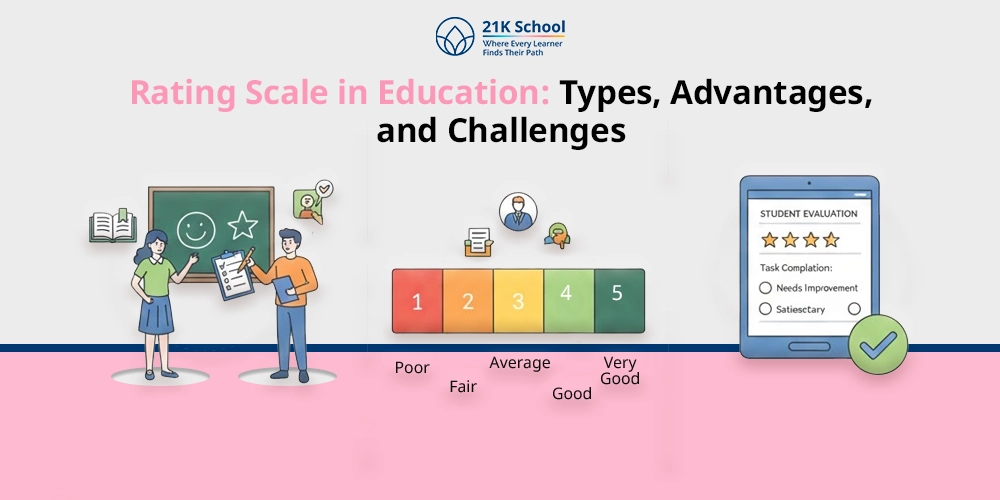
The rating scale in education is a tool through which students’ performance, behavior, skills etc are measured by assigning values or categories to responses.
Some simple examples of rating scales are:
- Teachers rate as “Excellent, Good, Average, or Needs Improvement” in students’ behavior in the classroom.
- Rating students’ progress on a scale of 1 to 5.
Types of Rating Scales in Education
To know more about rating scales, let’s explore their different types in education:
1. Numerical Rating Scales
Starting with numerical rating scales which are simple types use number responses. For example, teachers rate using any number between 1 to 5.
- 1 = Poor
- 2 = Fair
- 3 = Good
- 4 = Very Good
- 5 = Excellent
2. Graphic Rating Scales
Graphic rating scales are popular ways in which teachers use a visual line or continuum with labels at each end.
This rating scale is ideal for measuring behavioral and skill-based assessments
3. Descriptive Rating Scales
Descriptive rating scales include points that have detailed information/description making the rating criteria clear.
Here, teachers describe in a sentence instead of using one word. Understand through simple examples:
- Excellent: Actively participates and shows leadership
- Good: Participates regularly
- Average: Participates occasionally
- Needs Improvement: Rarely participates
4. Likert Scale
It is one of the effective rating scales often used in educational surveys and feedback forms. Through likert scale, teachers can evaluate attitudes, opinions, and perceptions effectively.
An example of likert scale is:
- Strongly Agree – Agree – Neutral – Disagree – Strongly Disagree.
5. Behaviorally Anchored Rating Scales (BARS)
Behaviorally Anchored Rating Scales (BARS) is a type of rating scale used in education. It includes both numerical ratings with specific behavioral descriptions.
- 5: Completes tasks independently and helps peers
- 3: Completes tasks with occasional guidance
- 1: Requires constant supervision
How to Use a Rating Scale in Education?
Rating scales can be used in different areas of education. For effective use of rating scales, check out these quick points:
1. Assessing student growth
To analyse student growth, teachers can use rating scales by tracking student’s progress in areas such as communication skills, teamwork, creativity, and discipline over time.
2. Program evaluation
Rating scales can also be used by schools and colleges to understand the effectiveness of programs, curriculum, and learning methods.
3. Teacher feedback
Teachers often provide feedback to improve students academically. Rating scales are an ideal way to provide accurate feedback.
4. Research
Rating scales can also be used for research purposes. It is useful to rate the results of particular research and surveys.
How to Create an Effective Rating Scale Survey?
To create an effective rating scale survey, one need to follow these steps:
1. Determine the appropriate scale
There are different types of rating scales used to fulfill different purposes. The first step is to determine the appropriate scale.
Whether there is a need for numerical for quick scoring or descriptive for clarity in results.
2. Implement suitable scales
Next, implementation of a suitable scale instead of multiple is important to avoid any kind of confusion or mislead.
3. Maintain consistency
Using the same scale in particular surveys helps maintain consistency throughout the process.
4. Balance response options
Individuals must provide a balanced number of positive and negative choices to avoid any biased responses.
5. One idea per question
One idea per question is effective to reduce the problem of unclear rating.
Advantages of Rating Scales in Education
Implementation of rating scales in education offers various advantages such as:
1. Easy to use and understand
Rating scales are easy to use by teachers and parents. This makes assessments quicker.
2. Saves time in assessment
Teachers often prepare detailed feedback for students’ assessments which requires time. However, rating scales are ideal to save time.
3. Avoid Error
To maintain fairness and avoid any kind of error or biased behavior, teachers can use rating scales in education.
4. Helpful for qualitative assessment
For qualitative assessment, rating scales is one of the most effective ways to calculate progress.
5. Supports continuous evaluation
Education requires continuous evaluation of students’ progress to align objectives for improvements. Rating scales are ideal yet easy ways to choose from.
Challenges of Rating Scales in Education
Rating scales in education have some common limitations that impact students negatively such as:
1. Risk of subjectivity
Evaluators often use the rating scale point differently which leads to inconsistency in results.
2. Misinterpretation
Sometimes, students get confused and misled by the points they get. This happens due to ambiguous language or poor explanation.
3. Limited Feedback
Rating scales often lack the descriptive, detailed and actionable advice for growth.
4. Lack of Depth
Rating scales in education often fail to capture the depth of understanding or the complexity of their thought processes.
Conclusion
One of the effective ways to measure students’ performance is rating scale. But, choosing the right kind is essential.
There are different kinds of rating scales each with different features that help to obtain results accurately. The detailed information provided in-depth knowledge of choosing the right scale.
Hope, the information helped teachers to use rating scales to record observations and students as a self-assessment tool.

You may also want to read
Types of Studies: Everything You Need to Know with Examples

- Last updated on: 18 Mar, 2026
- 7 min read