


Do you know what the objectives of pre-primary education are?
Pre-primary education plays a significant role in shaping early childhood development and is a platform leading to lifelong learning.
The physical, emotional, social, cognitive and moral development is targeted by the pre-primary education objectives with the help of play-based and activity-based learning.
The stage is helpful in the growth of the children, both in the domain of skill-based learning, positive attitudes and confidence, and also in preparing the children for formal education in an environment of nurture and joy.
Table of Contents
- What is Pre-Primary Education
- Importance of Pre-Primary Education
- Top 13 Objectives of Pre-Primary Education
- 1. Enhance Social Skills
- 2. Develop Basic Language and Communication Skills
- 3. Encourage Curiosity
- 4. Cognitive Development of Children
- 5. Support Emotional Security and Self-Confidence
- 6. Develop Fine and Gross Motor Skills
- 7. Encourage Creativity and Imagination
- 8. Introduce Basic Moral Values and Good Habits
- 9. Promote Independence
- 10. Develop Early Literacy and Numeracy Skills
- 11. Encourage Healthy Habits and Personal Hygiene
- 12. Provide a Safe and Joyful Learning Environment
- 13. Prepare Children for Formal Primary Education
- Final Thought
What is Pre-Primary Education
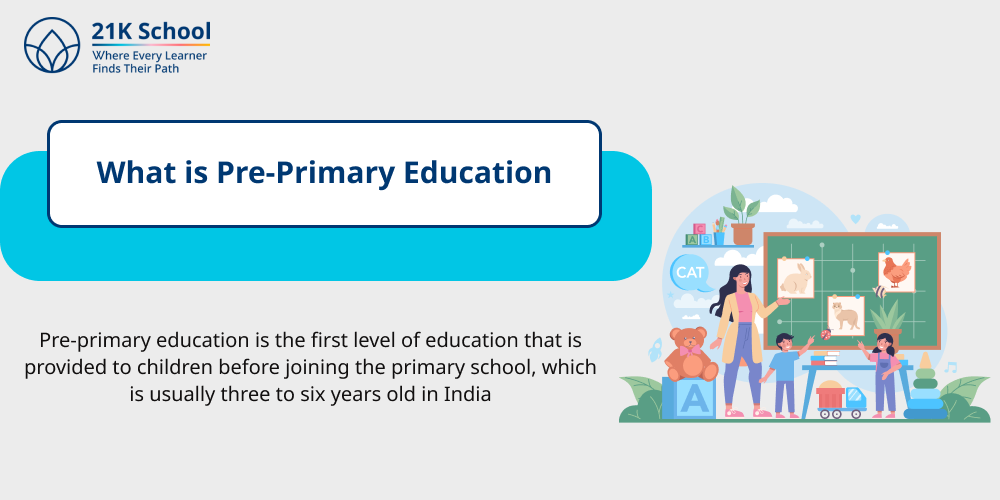
Pre-primary education is the first level of education that is provided to children before joining the primary school, which is usually three to six years old in India. It is founded upon the principle of comprehensive development through play, activities and interaction rather than through formal training.
The stage helps children to learn simple language, social, emotional and motor skills in a bid to be prepared to receive formal learning and successfully adjust to the primary education system.
Importance of Pre-Primary Education
Pre-primary education plays a crucial role in early development that creates a rock-solid foundation to school studies, socialisation, emotional development, and future academic achievements. The significance of pre-primary education can be seen below.
1. Foundation for Lifelong Learning
Pre-primary education forms the foundation of lifelong learning since it instils early learning behaviours, interest in learning and a good attitude towards learning. The brain in early childhood undergoes fast development; therefore, it is the most appropriate period to create basic knowledge and learning preparedness.
Good early nurturing enables children to understand future ideas with minimal difficulties, as well as adjust well to more advanced education.
2. Reduce Fear and Stress
Pre-primary schooling makes children slowly adapt to a structured place, other than their homes. With the help of teachers and a congenial environment, children overcome separation anxiety and fear of school.
Comfort and confidence with routines and group situations will be developed early, and study stress will be spread out, and the children will feel that they gain a sense of security when they start attending formal primary education.
3. Improves Future Academic Performance
Students attending pre-primary school tend to perform well in school as they grow up. Early introduction of the learning activities helps in concentration, listening skills, and preparation for organised lessons.
These initial experiences improve comprehension and recall skills. As such, children enter primary school prepared, empowered and capable of solving the academic issues more effectively.
4. Strengthen Social Adjustment Skills
Pre-primary education helps children to socialise with others (both peers and adults) in a formal environment. Such interactions make them understand how to cooperate, share, be patient and respect others.
Early nurturing of social adjustment skills empowers children to establish healthy relationships with others, cope in classrooms and work comfortably in other social settings.
5. Proper Personality Development
Pre-primary education fosters the growth of personality in a balanced manner, and emotional stability, confidence and positive behaviour are built.
The children are taught to speak out, to be well-disciplined and responsible in a home-like environment. When directions are initiated early, then attitudes, habits, and values are shaped, which make the character in the future.
Top 13 Objectives of Pre-Primary Education
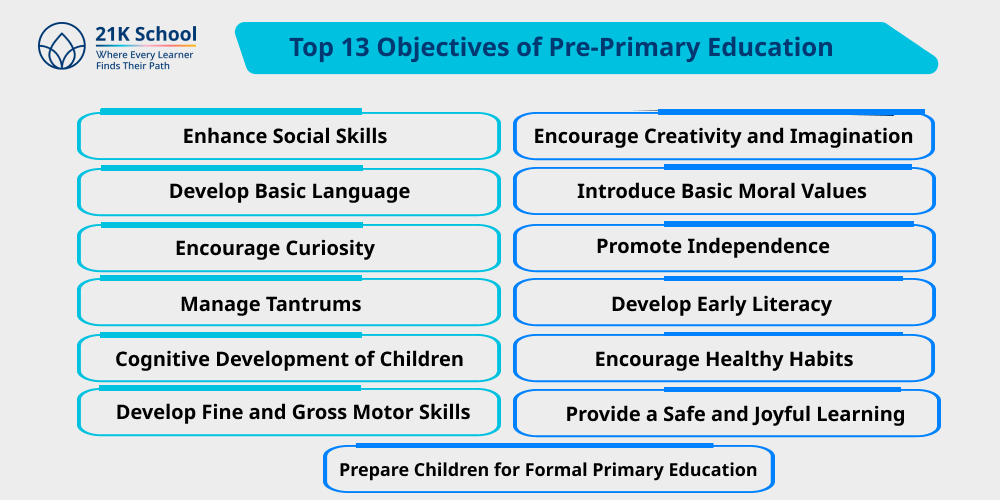
Pre-primary education aims at the overall child growth, development of skills, values, creativity and readiness to attend formal schools. The pre-primary education is aimed at these goals.
1. Enhance Social Skills
The types of social skills that are taught in pre-primary involve sharing, cooperation, patience and teamwork, which are very fundamental in life.
Group activities, playing, and interaction with other children teach children how to communicate, follow rules, resolve conflicts, and develop friendships. Such early social experiences equip children to socialise positively with others and be able to adjust to social setups both within and outside the school.
2. Develop Basic Language and Communication Skills
During the pre-primary level, the children are encouraged to learn listening, speaking and simple communication skills. Stories, rhymes, songs and discussions are used to widen their vocabulary and enhance pronunciation.
Such activities help children to be able to express thoughts, emotions and needs straightforwardly. Good language ability at an early age is the basis of reading, writing, and fluent communication at a later stage of education.
3. Encourage Curiosity
In pre-primary education, children have the curiosity that is nurtured since they are given a chance to learn about their surroundings in the process of playing, making queries and taking part in activities they undertake. Teacher-led activities in education are thought-provoking and imaginative.
Curiosity helps children to enjoy learning, improve their ability to observe, and cultivate their interest in learning new things, objects and experiences on their own.
4. Cognitive Development of Children
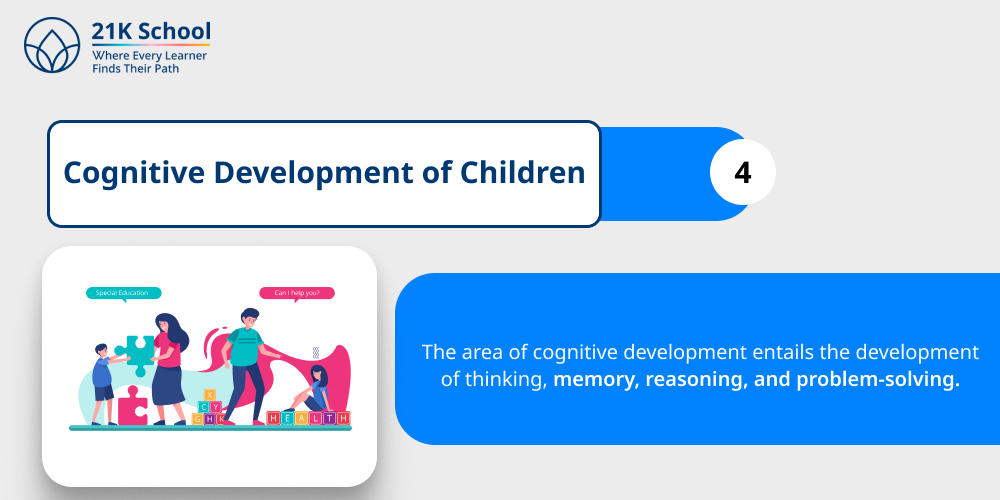
The area of cognitive development entails the development of thinking, memory, reasoning, and problem-solving. This is facilitated by pre-primary education through the use of puzzles, games, counting activities, and simple experiments.
Such activities make the children understand concepts, patterns and logical thinking. Early mental development enhances the mental capabilities that are fundamental in academic education at an advanced age.
5. Support Emotional Security and Self-Confidence
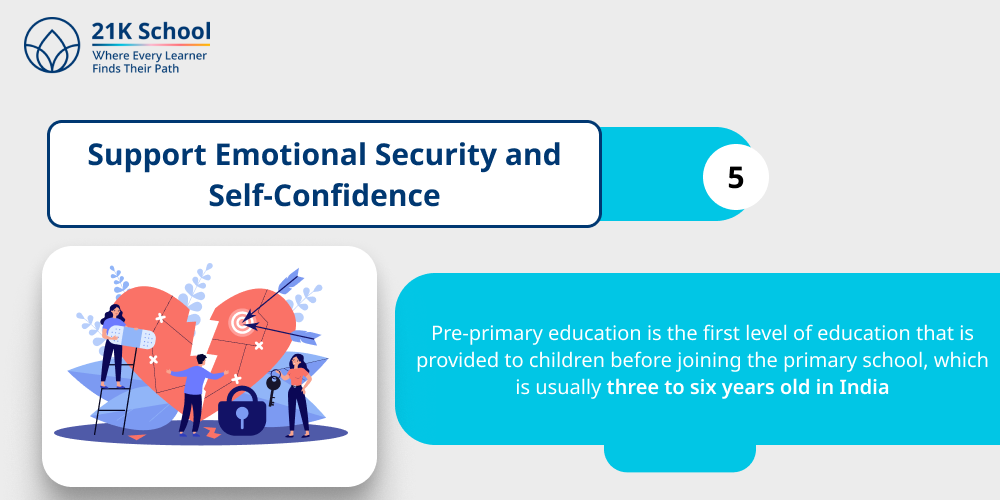
In pre-primary school, children are secure and feel valued since the atmosphere is affectionate and supportive. Positive reinforcement, support and encouragement help children to develop self-confidence and emotional stability.
Children will be able to become more engaged, more willing to communicate and experiment, and this will result in appropriate emotional development.
6. Develop Fine and Gross Motor Skills
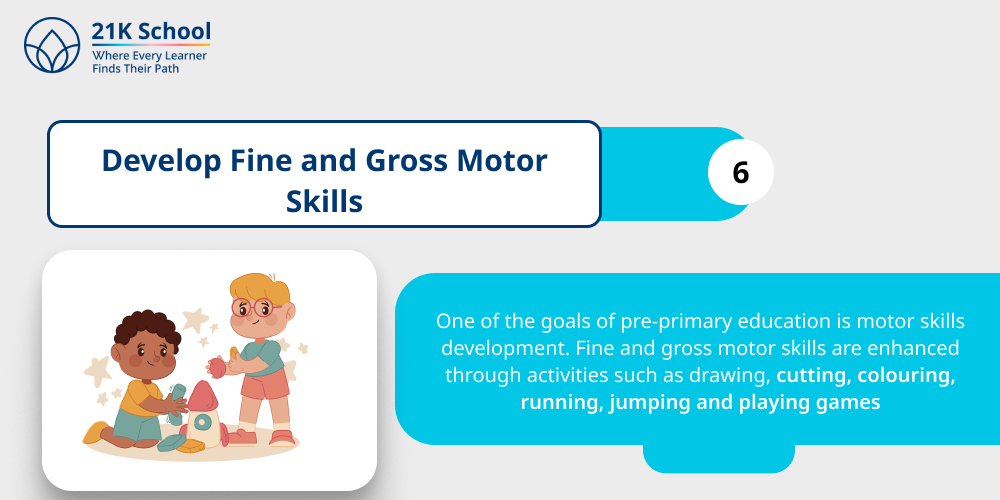
One of the goals of pre-primary education is motor skills development. Fine and gross motor skills are enhanced through activities such as drawing, cutting, colouring, running, jumping and playing games.
These are the skills which enhance coordination, balance and physical strength. Properly developed motor skills will assist children in carrying out their day-to-day activities and equip them for activities in the classroom and writing.
7. Encourage Creativity and Imagination
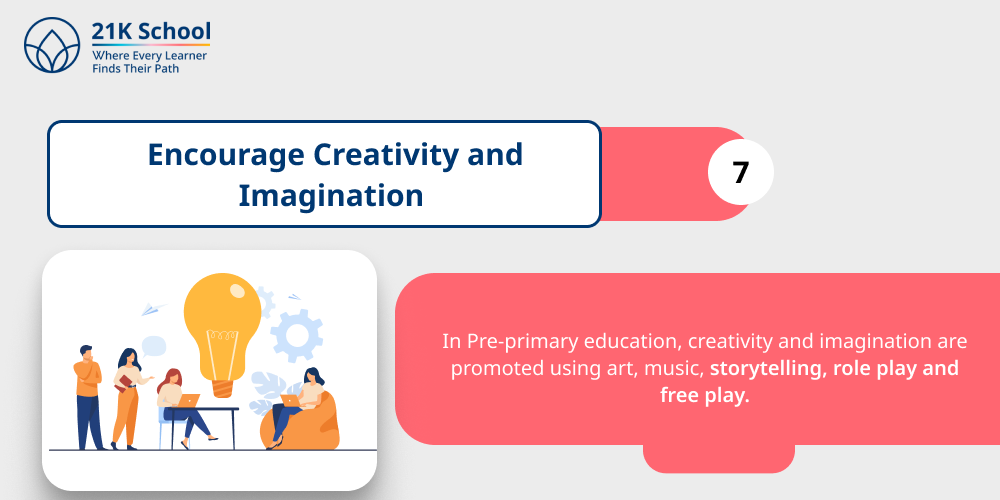
In Pre-primary education, creativity and imagination are promoted using art, music, storytelling, role play and free play. These activities enable children to share ideas, emotions and thoughts openly.
The creative experiences help in problem-solving and self-expression as well as originality. Promoting imaginative thinking is also helpful in nurturing emotional and flexible thinking among young children.
8. Introduce Basic Moral Values and Good Habits
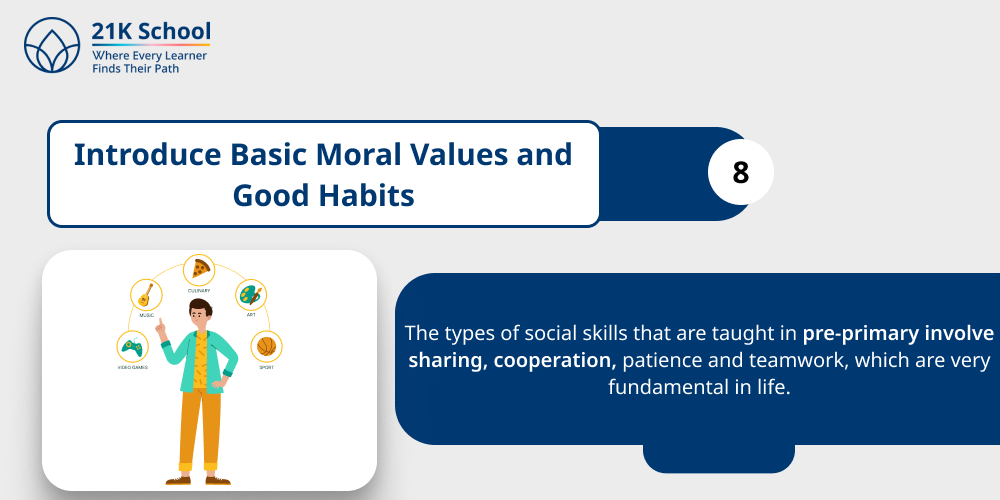
Simple ethics such as honesty, kindness, respect and cooperation are introduced to pre-primary level children. Teachers teach children by using stories, routines and behaviour modelling.
Good habits like discipline, cleanliness, and politeness teach children and allow them to develop good character traits and learn what behaviour is acceptable in society.
9. Promote Independence
In pre-primary school, the child is encouraged to develop independence as they learns self-help skills like dressing, eating, putting away their belongings and simple decision making. These projects develop trust and accountability.
The idea of independence is beneficial as it helps children to develop decision-making skills, as well as to be ready to cope with routine in the classroom and daily routine without being assisted all the time.
10. Develop Early Literacy and Numeracy Skills
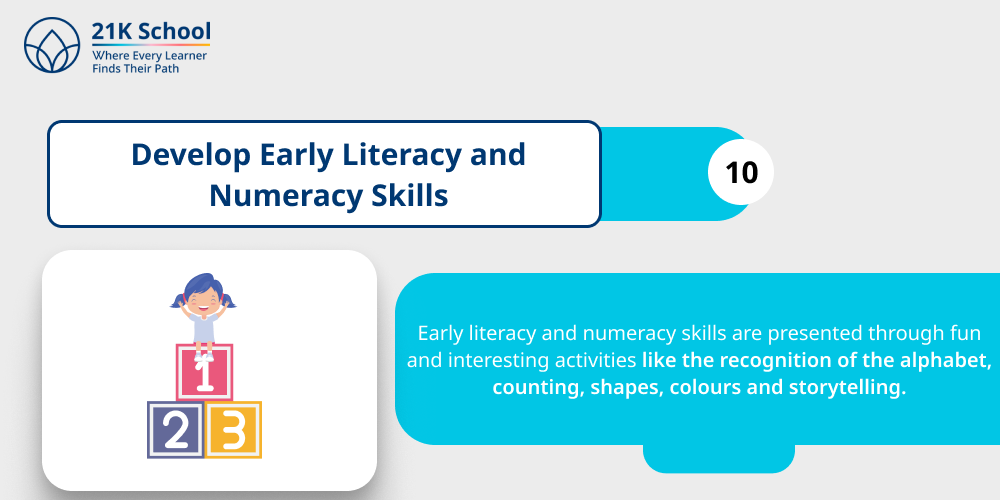
Early literacy and numeracy skills are presented through fun and interesting activities like the recognition of the alphabet, counting, shapes, colours and storytelling. These activities assist children in knowing the basic concepts of reading, writing and counting numbers.
Forming these preliminary skills will equip the children with the formal learning process and minimise challenges in primary education.
11. Encourage Healthy Habits and Personal Hygiene
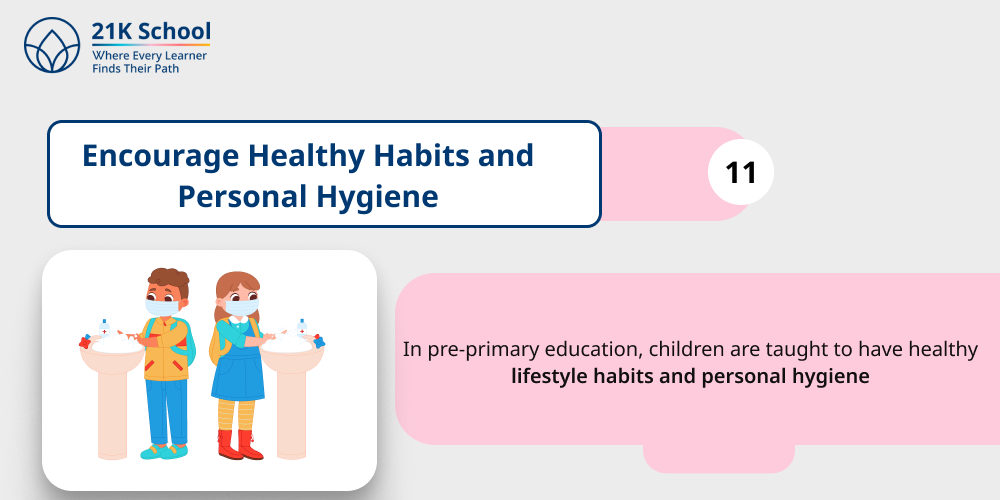
In pre-primary education, children are taught to have healthy lifestyle habits and personal hygiene. Handwashing, cleanliness, good eating habits and physical activity are some of the practices promoted on a daily basis.
Early acquisition of these habits will ensure that children stay healthy, avoid diseases, and generally lead healthy lives in school.
12. Provide a Safe and Joyful Learning Environment
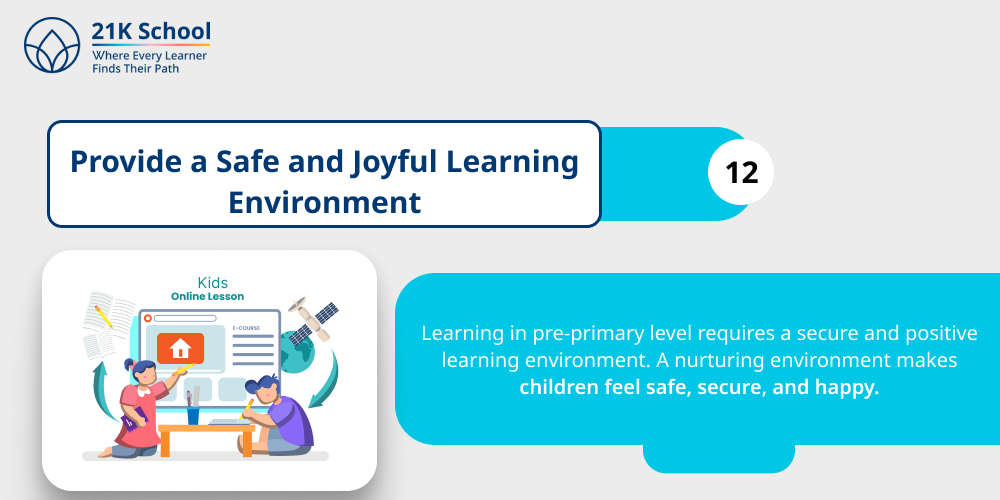
Learning in pre-primary level requires a secure and positive learning environment. A nurturing environment makes children feel safe, secure, and happy.
Children also engage in learning activities when they like learning and have positive attitudes towards school. This kind of environment facilitates emotional development and general learning experiences.
13. Prepare Children for Formal Primary Education
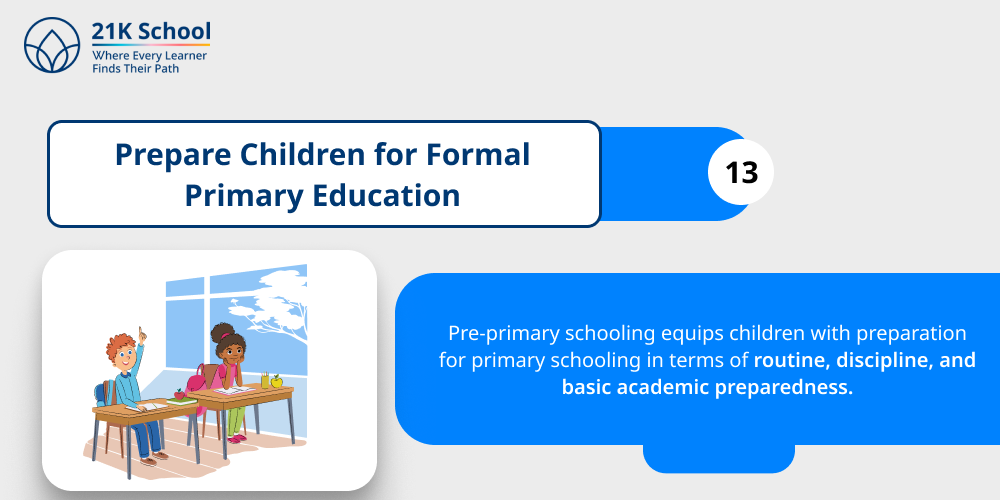
Pre-primary schooling equips children with preparation for primary schooling in terms of routine, discipline, and basic academic preparedness.
Children are taught to follow instructions, sit in a group and concentrate on activities. This gradual transition decreases the anxiety and makes children adapt easily to the formal classroom environment, which guarantees improved academic results during the primary school level of education.
Final Thought
The pre-primary education forms the basis of the development of the child, in terms of social, emotional, cognitive, and physical aspects. It equips children with the right tools to make it through to primary learning by emphasising activity-based learning, creativity, and other important habits.
Good pre-primary programs instil confidence, independence, and a desire to learn, providing children with the ability and thought patterns that they will need to succeed in their lives.
