

The most frequent question that CBSE students and parents ask is the number of marks required to pass in a subject with an assessment of 40 out of 40. In the Central Board of Secondary Education (CBSE) examination, it is significant that the student learns the pass marks.
CBSE establishes a qualifying mark, which the learners must obtain to pass an examination, considering that the maximum marks of an examination are 40. This understanding of needs will prepare the students in advance, and they will not get lost in exams.
It also clarifies the evaluation standards that should be applied in the CBSE schools in India.
Table of Contents
What are the Passing Marks Out of 40 in CBSE
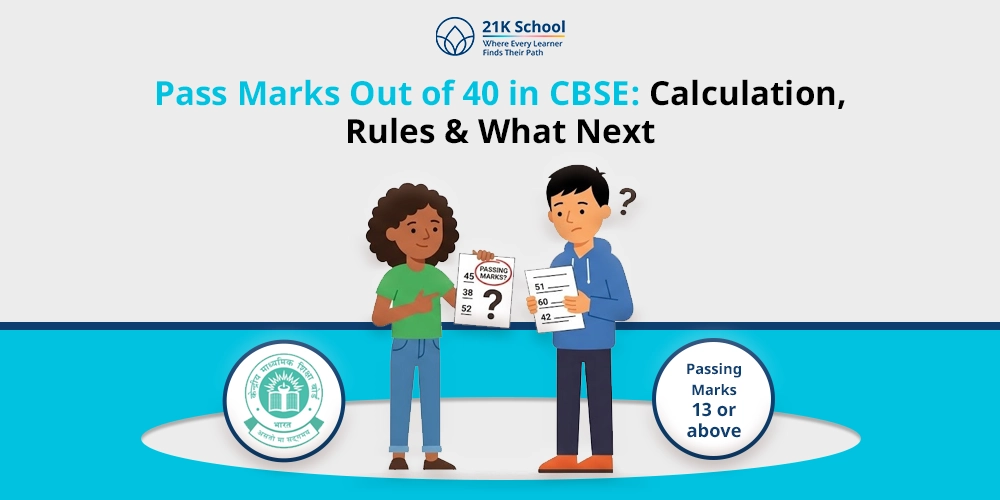
In exams set by the Central Board of Secondary Education (CBSE), students who undertake a subject are required to complete a minimum of 33% in the subject in order to qualify for the subject. CBSE is a subject with a passing mark of 13 out of 40 marks.
According to the CBSE rules, a student has to score at least 33% of the overall marks to pass. One must pass the paper with 13 or above marks with 40 marks.
The board and school policy regarding student assessment is that a student whose score is less than 13 is likely to be required to pass a compartment or supplementary examination.
Passing Marks out of 40 in CBSE Class 10
The rule is a little lenient in CBSE Class 10 since it considers the aggregate. In order to pass a subject, you require a total of 33% out of your internal and your theory paper.
But when we consider a 40-mark theory constituent (as it was usual in the years when the term-based exam was common):
Passed Marks: 13 out of 40 (or 33% rounded up).
Note: Since Class 10 is a combination of internal (usually out of 20) and theory (usually out of 80, or 40 per term), you just need to score a minimum of 33 out of 100 in the combination of the two.
What are the Passing Marks out of 40 in Class 9?
Class 9 is similar, only that the percentage is higher, and in most situations it is harsh on the theory paper, i.e., what your school has to say on the same.
Marks to Secure: 13.2 of 40, which is equivalent to 13 marks, and this ensures that you are safe.
The Requirement: The theory and internal examination are not united in most schools since there is a need to separate 33% on each, as opposed to Class 10.
How CBSE Calculates Passing Marks
CBSE sets the passing marks, whereby the students must score 33% of the total marks in the subject. This applies to both theory and practical components, whereby students must possess the minimum requirements to pass exams.
1. 33% Calculation Process
The CBSE is an extremely simple formula of passing since a student needs not less than 33% of the marks that can be achieved in a course to be considered passing. This is calculated as below when the result is written on a 40-mark paper.
33% of 40 = (33 /100) x 40 = 13.2
It implies that the calculated raw passing mark was 13.2, which is 13 in the instance of a 40-point paper.
2. Rounding Rule
The exams are graded in whole numbers; hence, a learner does not have to have a score of 14 to pass the 13.2 cut-off.
The board will count the passing score of 13 out of 40 points because it does not permit a student to obtain a fractional score and only requires a student to round up to the nearest whole value.
The 13 is the literal meaning of marking in plain language (out of 40 marks), and hence the mark of 13 indicates the real passing mark in CBSE.
CBSE Passing Criteria for Theory and Practical
Students have to achieve a minimum of 33% marks to pass in each of the subjects in CBSE. The criteria needed to pass are in relation to theory and practical aspects to qualify for the subject as a whole.
1. Theory
When it comes to theory papers, the students need to achieve at least 33% of the stipulated theory marks. It has a 13 as the passing mark in a subject with a theory paper of 40. The theory paper has a passing grade of 26 out of 80 in the course in which the theory paper is being taken.
Theory (External Exam): In order to be promoted, one has to secure at least 33% in the theory paper.
80 Marks Theory Paper: Passing mark is 26.4, which is mostly regarded as 26.
70 Marks Theory Paper (e.g., Science): To pass Marks required is 23 (23.1/70 is 23)
2. Practical
CBSE also requires the students to pass the practical exam on their own in a subject which involves a practical exam or a home examination.
The lowest mark that is taken into account in the practical element is also 33% of the maximum mark that is awarded to the practical element.
Practical/ Internal Assessment: Internationally, one needs to score 33% marks.
Practical/Internal Assessment: 20 marks, the minimum mark to pass is 7.
Practical/Project: 30 marks (minimum passing marks are 10).
What Happens If You Score Below 40?
At the Central Board of Secondary Education (CBSE), where the student fails to achieve the minimum number of marks which students must pass, a compartment category of marks out of 40 is created.
This gives the student the chance to rewrite the exam in the particular subject.
1. Compartment Exams
Compartment examinations are normally administered a few months after regular results are declared, and this way, the students have an opportunity to pass without necessarily completing the complete academic year.
2. Grace Marks Policy
In a few cases, CBSE may also award grace marks to a learner who failed to pass the examination by a very close margin.
These marks are given to help the students pass a subject whose performance in the subject is near the required grades. However, the number of grace marks is low, and they are pegged on official guidelines and assessment policies of the board during the preparation of results.
3. Re-evaluation Option
In case the students feel that their answer sheet has not been checked in the proper way, CBSE offers a re-evaluation or verification facility. In the process, the students will be able to ask the board to re-check their answer sheets in the case of possible errors in marking or missed answers.
After the review, the marks may be increased, decreased or remain the same depending on the results of the reviewer and the stipulated regulations of the assessment.
4. Improvement Exam Opportunity
CBSE can also make students take improvement exams at their own free will in case they desire to improve their marks in a subject that they have already passed. This option helps students to secure improved academic results in order to improve their future.
The improvement exam is normally taken in the next academic session, and the score in the improvement exam is taken as the final record in comparison to the first attempt.
Conclusion
In the Central Board of Secondary Education (CBSE) exam system, it is important in learning the criteria for passing the exam. Out of 40 marks in a paper, a student is required to have a minimum of 13 marks in order to pass the 33% mark.
CBSE also takes individual passing grades on the theory and practical aspects as and when needed. In case a student fails to attain the required mark, he/she can have an opportunity through compartment exams, grace marks, re-evaluation and improvement exams.
Being aware of these rules will ensure that students are aware of the rules so as to minimise cases of exam stress and also to equip themselves better to excel in their academic studies.

You may also want to read