

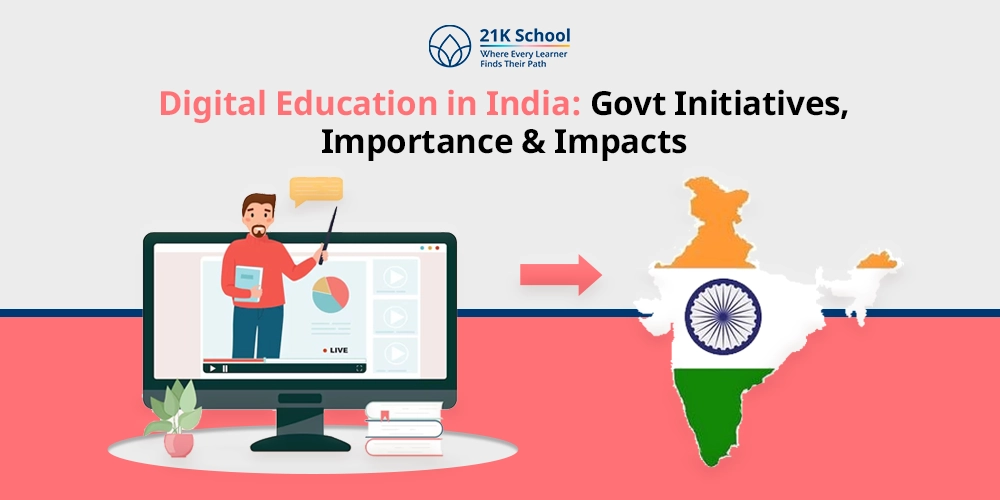
India has made great strides in the field of education since it has adopted the concept of digital education
Many Government initiatives are aligned with the campaign of Digital India and have made education limitless.
With all the online learning platforms and tools, students and educators can now access a large amount of learning content from the internet at a minimal cost or even free.
This has reached the students who weren’t able to access education from rural areas, villages and remote areas.
This article will present the growth of digital education in India, what steps has the government taken, and what the future holds regarding this.
Table of Contents
What is Digital Education?
Digital education is the application of digital technologies and online platforms to deliver the educational resources that guide the learning process and help in evaluating students’ performance.
It encompasses web-based classes, e-learning sites, virtual classes, digital books, learning applications, video instructions, as well as interactive courses.
Digital education, in contrast to traditional education, enables students to learn at any time and place, and even at their own pace.
It fosters student-engagement, independent learning, and promotes new teaching approaches like blended learning, flipped classrooms, and personalized learning courses.
Growth of Digital Education in India
Digital education in India has been spread and accepted remarkably in the last decade. Better internet availability, low cost smart phones, and government encouragement have contributed significantly to this growth.
This is why, India has become one of the most rapidly expanding online education markets in the current times.
The COVID-19 crisis further contributed to the acceleration of digitization. This was because schools, colleges, and universities were switching to online modes overnight.
Video conferences on Zoom, Google Classroom, Microsoft Teams, and other native applications such as SWAYAM and DIKSHA became the new norm.
Massive growth was also witnessed in EdTech companies which were providing courses ranging from school education to competitive exams and professional skills
5 Government Initiatives for Digital Education in India
Though the government in India has come up with many initiatives for digital education, the below mentioned are some of the most popular ones:
1. Digital India Programme
The Digital India Programme was launched in 2015, and it is aimed at making India a digitally empowered society and a great economy.
Within this initiative, there has been massive promotion of digital infrastructure, digital literacy, and internet services. In education, it has facilitated e-classrooms and online education in schools.
2. SWAYAM
SWAYAM is a national web-based online academic platform that provides free education from Class 9 to post-graduate level students.
It offers high quality content as it was developed by the Ministry of Education, which is taught in the best institutions like IITs, IIMs, and central universities.
Getting quality education is affordable and accessible because learners can get certified at a nominal fee.
3. DIKSHA
DIKSHA is a national online service to teachers and learners primarily in school learning.
It provides curriculum-based applications, lesson plans, teacher training courses, as well as assessment tools.
DIKSHA also includes various Indian languages to ensure inclusivity and regional significance.
4. National Digital Library of India (NDLI)
The National Digital Library of India is an online library of educational materials in books, research papers, journals, videos, and study materials.
It serves students both at school or doing research. It also offers thousands of learning materials freely, so that these students can learn faster, independently and undertake research.
5. PM eVIDYA
Introduced in the framework of the Atmanirbhar Bharat program, PM eVIDYA is used to coordinate all efforts in the digital sphere of education.
It covers the online channels, television channels, radio, and digital materials among students of various grades.
Its major characteristic is One Class, One Channel, which guarantees access to learning even to those students who do not have access to the internet.
5 Importance of Digital Education in India
Digital education in India has really reduced the learning gaps of different students from different areas. Other importance that it holds are:
1. Access to Quality Education
Digital learning eliminates geographic limitations and permits students in distant and less urbanized regions to obtain quality education from the best schools and qualified instructors.
It makes education democratic and brings educational equity.
2. Flexibility in Learning
Flexibility is one of the best benefits of digital education. The learners are able to study at their pace, watch recorded lectures, and manage their learning while managing other tasks.
This is more advantageous to employed individuals and lifelong learners.
3. Cost-Effective Learning
Online learning saves the expenses on travelling, accommodation, and physical infrastructure.
Education is affordable to weaker parts of the population since so many learning resources are available on the internet and the government websites, which are free or low-cost.
4. Skill Development
Online education promotes skill-based learning as it provides courses related to coding, data analytics, digital marketing, artificial intelligence, and other knowledgeable areas.
This makes education relevant to the industry and prepares children for the future jobs.
5. Teacher Empowerment
Digital tools equip teachers with better skills through access to training programs and innovative teaching methods.
Educators can enhance student-engagement in the classroom, monitor performance of learners digitally, and cooperate with their colleagues across the country.
3 Impact of Digital Education in India
Digital education in India has impacted skill development of students and teachers. Some other impacts include:
1. Digital Divide
With the rise of digital education in India, the issue of digital divide has also arisen.
The unequal access to internet, devices, mobile phones, and electricity shows that digital learning is still limited by the gaps that exist between urban and rural learners.
Research shows only 27.5% of students had access to digital devices when schools switched to online learning during COVID-19, and only 15.8% found the online experience good.
2. Training and Support
Digital education requires proper training of both teachers and students.
The absence of digital skills, support, and infrastructure can lower the efficiency of online learning systems, which can impact the quality of education.
3. Quality of Content
The production of quality and relevant digital content also becomes an issue in implementation of digital education in India.
Learning can be influenced due to poorly designed courses, language barriers, and having no interactive features.
Future Scope and Trends of Digital Education in India
The future of e-learning in India is bright. It is believed that emerging technologies including artificial intelligence, virtual reality, augmented reality, and adaptive learning systems are going to revolutionize the system of education.
Blended learning models that are based on online and offline approaches will become the new standard.
The digital education ecosystem will be enhanced by government policies, public-sector participation, and growing digital literacy.
Personalized lessons, assessment through data, and collaboration across the world will transform education delivery and consumption in India.
Concluding Comments
Digital education is the new realm of education that has transformed knowledge acquisition and its access.
The Government of India has been continuously working towards the campaign of Digital India, and thus has announced many initiatives for a better picture of educational outcomes.
COVID-19 became a breaking point where this need came into view for thousands of schools and other educational administrators which made quality education accessible for all.
If we want such educational reforms to be evident in our society, we need to promote digital education much more in India so that the issue of digital divide is also eradicated.

You may also want to read

What Is Workshop in Education? Types, Benefits & How It Works
- Published on: 08 Apr, 2026
- 10 min read