

Education is a foundation for student progress in both personal and professional level. It is an effective way to empower society.
Education is promoted by different institutes to secure students’ futures. To do so, the Government of India plays an important role by introducing popular initiatives to empower education.
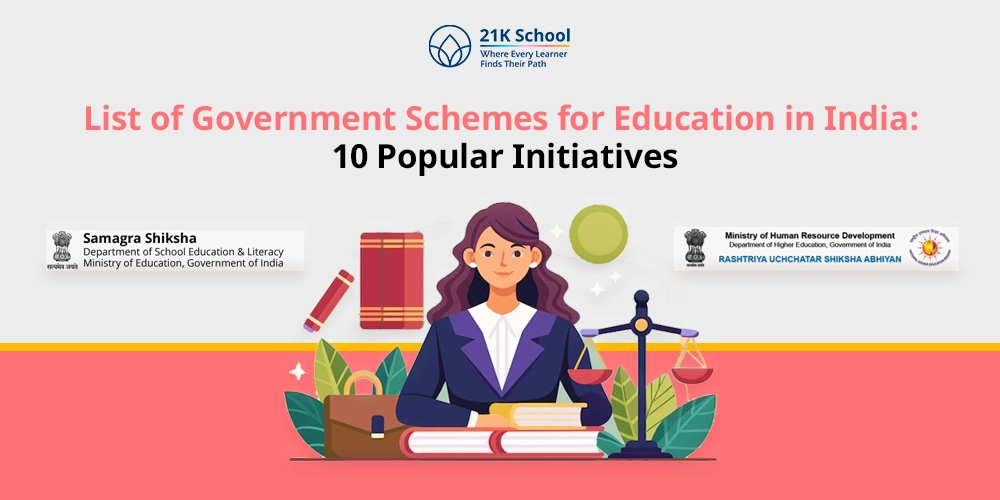
The list of government schemes for education in India helps in the improvement of students’ future, empowering communities, and creating a positive impact on society.
Here, we will explore a list of government schemes for education in India in detail. Let’s begin with the meaning.
Table of Contents
- What are the Government Schemes for Education in India?
- List of Government Schemes for Education in India: 10 Popular Initiatives
- 1. Samagra Shiksha Abhiyaan
- 2. PM POSHAN Shakti Nirman (formerly Mid-Day Meal Scheme)
- 3. Rashtriya Uchchatar Shiksha Abhiyan (RUSA)
- 4. Beti Bachao, Beti Padhao
- 5. PM e-VIDYA
- 6. National Means cum Merit Scholarship Scheme
- 7. Central Sector Interest Subsidy Scheme (CSIS)
- 8. National Fellowship for Scheduled Caste Students (NFSC) & OBC Students
- 9. Kasturba Gandhi Balika Vidyalaya (KGBV)
- 10. Sukanya Samriddhi Yojana
- Summing Up
What are the Government Schemes for Education in India?
The government schemes for education in India include a bunch of initiatives launched to promote education in the country.
In this way, students who struggle to learn due to various factors like financial constraints, location, lack of awareness can achieve desired learning goals in life.
The student government schemes for education in India are important:
- Increase school enrolment and retention
- Provide financial assistance and scholarships
- Promote higher education
- Reduce school dropout rates
List of Government Schemes for Education in India: 10 Popular Initiatives
The list given below of government schemes for education in India are aligned with national goals like universal education, students skill development, and the National Education Policy (NEP) 2020.
1. Samagra Shiksha Abhiyaan
Samagra Shiksha Abhiyaan is a popular scheme which covers students’ school education from pre-primary to Class 12th.
The primary objectives of the Samagra Shiksha scheme include:
- Holistic approach
- Enhancing learning outcomes
- Supporting the Right of Children to Free and Compulsory Education Act.
- Technology integration in education
Samagra Shiksha scheme works as a powerful base for improving the Indian school education system.
2. PM POSHAN Shakti Nirman (formerly Mid-Day Meal Scheme)
PM POSHAN Shakti Nirman, earlier known as Mid-Day Meal Scheme. The Mid-Day Meal Scheme is one of the most recognised efforts of the government in India which was launched nationally in 1995 as the NP-NSPE.
The MDMS provides cooked meals for grades 1 to 8. Nutritional standards of MDMS:
- 450 calories/12g protein for primary students.
- 700 calories/20g protein for upper primary students.
The primary objectives of the Mid-Day Meal Scheme include:
- Nutritional improvement
- Increase attendance and retention
- Address classroom hunger
- Promote social equity
- Foster good habits
3. Rashtriya Uchchatar Shiksha Abhiyan (RUSA)
Rashtriya Uchchatar Shiksha Abhiyan (RUSA) is a government initiative to enhance the quality of education of state institutions.
The scheme is ideal to increase access to education, ensure equity for marginalised groups, and promote research and innovation.
The key objectives of Rashtriya Uchchatar Shiksha Abhiyan (RUSA) include:
- Infrastructure development
- Faculty improvement
- Research and innovation support
- Equity and access in higher education
4. Beti Bachao, Beti Padhao
Beti Bachao, Beti Padhao abhiyaan is an effective scheme launched in January 2015 by Prime Minister Narendra Modi.
The scheme looks at declining Child Sex Ratio (CSR) and promotes girl child empowerment.
Key aspects of the Beti Bachao, Beti Padhao scheme include:
- prevent gender-biased sex-selective elimination
- survival/protection of the girl child
- promote female education
5. PM e-VIDYA
One of the popular digital education initiatives by India’s Ministry of Education in May 2020 is known as PM e-VIDYA.
The scheme comes under the Atmanirbhar Bharat Abhiyaan to enable multi-mode and equitable access to education.
Key components of PM e-VIDYA include:
- DIKSHA platform
- One class, one TV channel
- SWAYAM and SWAYAM Prabha
- Radio and podcast-based learning
6. National Means cum Merit Scholarship Scheme
The NMMS stands for National Means-cum-Merit Scholarship Scheme, an initiative by the central government of India for the economically weaker section.
The main aim of the scheme is to stop students from dropping out after Class 8 and provide needful guidance to complete secondary education (Classes 9 to 12).
To know more, go through popular types of scholarship in India.
7. Central Sector Interest Subsidy Scheme (CSIS)
Central Sector Interest Subsidy Scheme (CSIS) is another scheme for education in India in which students get interest subsidy on education loans for higher education.
Objective of the Central Sector Interest Subsidy Scheme (CSIS) scheme include:
- Students are able pursue higher education
- Maintain geographical imbalance
- Covers professional and technical courses
8. National Fellowship for Scheduled Caste Students (NFSC) & OBC Students
The National Fellowship for Scheduled Caste Students (NFSC) and OBC Students (NFOBC) funded by the Ministry of Social Justice and Empowerment.
It offers fellowships for higher education and research. Students who are pursuing M.Phil and Ph.D degrees in Sciences, Humanities, Social Sciences, Engineering can apply for the fellowship.
9. Kasturba Gandhi Balika Vidyalaya (KGBV)
Kasturba Gandhi Balika Vidyalaya (KGBV) is an Indian initiative launched in 2004-05.
The main objective of launching the scheme is to provide residential schooling facilities for females/girls from disadvantaged communities.
Under Kasturba Gandhi Balika Vidyalaya (KGBV) scheme students can avail quality and free education to marginalised, school dropouts, or never-enrolled girls from classes 6 to 12.
10. Sukanya Samriddhi Yojana
Sukanya Samriddhi Yojana is a small savings scheme in India which helps the girl child’s future education. The scheme was launched under the Beti Bachao, Beti Padhao campaign.
Key Features:
- High interest rate savings account
- Tax benefits under Section 80C
- Funds can be used for higher education and marriage
Summing Up
In the 21st century, education is a powerful way to overcome day-to-day challenges. But, due to various factors some part of society struggles to avail education.
To provide quality learning, the government of India launched various schemes aimed at promoting inclusive education, equitable, and future-ready education systems.
Through various schemes mentioned above the government of India focuses on the fact that no child is left behind due to financial or social barriers. Hopefully, the information helped to understand each scheme to avail the benefits.

You may also want to read