

If you are an NRI or an Indian who has completed your A levels, you might be wondering about your future pathway of education and career.
You might also be thinking if A level is relevant in India or not. And, if it is relevant, what A levels are equivalent to in India.
To answer all these concerns, we present to you this article that will portray A level equivalency in India and help you understand about A levels.
It also shows the Indian education structure after 10th grade, comparison between 12th grade and A levels, and their recognition across the world.
Table of Contents
- What is A Level Equivalent in India?
- What Are A Levels?
- The Indian Education Structure After Grade 10
- The Primary Equivalent: 10+2 (Senior Secondary Certificate)
- Comparison Between A Levels and Indian 10+2
- Recognition by Indian Universities
- Recognition by Foreign Universities
- Which Is Better: A Levels or Indian Class 12?
- A Level Schools in India
- Conclusion
What is A Level Equivalent in India?
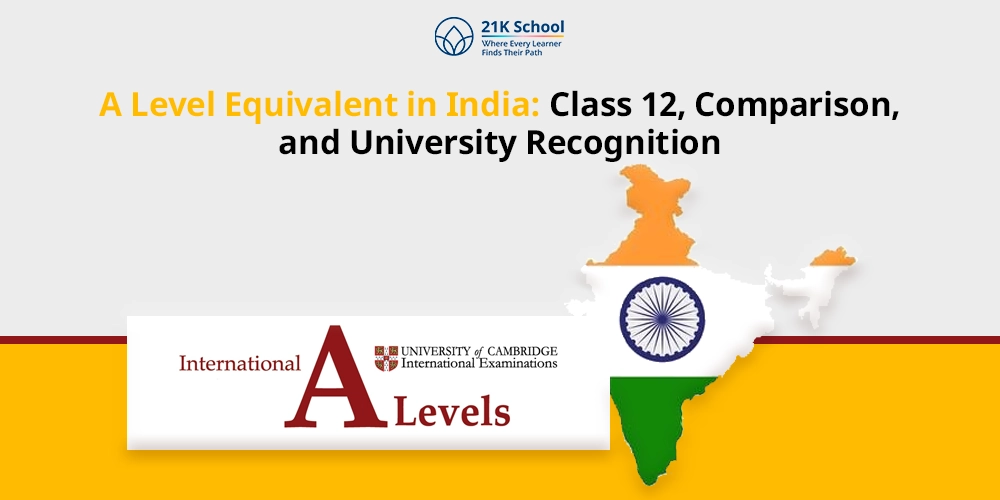
Indian Senior Secondary Certificate (also referred to as Class 12) is directly equivalent to A Levels in India. It is also referred to as 10+2.
In India, learners undergo ten years of general education and two years of higher secondary education (Classes 11 and 12).
The two years of study in this course are equal to the two years of A Level course considering the eligibility to higher learning institutions.
However, there are dissimilarities in academic recognition. The two systems also have numerous differences in the subject choice, specialization, scoring, and examination patterns.
What Are A Levels?
A Levels (Advanced Levels) are course-specific qualifications provided in the United Kingdom and British curriculum international schools. A Levels are normally studied by students in the last two years of secondary school (Year 12 and Year 13).
The main notable feature of A Levels is the opportunity to specialize in a subject.
Students usually choose three or four subjects depending on their desired major at the university.
For example, a student who wants to do medicine might opt for Biology, Chemistry, and Mathematics, and a student who is interested in economics might take Economics, Mathematics, and Business.
Examination is the major mode of assessment, and the courses may also have an element of coursework.
A Levels are internationally accepted and it is specifically aimed to help students prepare to study at university level.
The Indian Education Structure After Grade 10
Indian students who finish Class 10 commence senior secondary, which is followed by a choice of academic stream. The three main streams are Science, Commerce, and Humanities (Arts).
Combinations that are usually studied by science students include Physics, Chemistry, Mathematics (PCM) or Physics, Chemistry, Biology (PCB).
Business students specialize in courses such as Accountancy, Business Studies, and Economics.
On the other hand, humanities students can study History, Political Science, Sociology, Psychology, or Geography to build their interest in their careers.
Various boards in India work on the administration of senior secondary education.
The Primary Equivalent: 10+2 (Senior Secondary Certificate)
A levels are broadly equivalent to Class 12 in India, which is administered by many boards including:
1. CBSE (Class 12)
The Central Board of Secondary Education (CBSE) is the most established national board in India. It has a standardized and organized curriculum all over the country.
CBSE has put its focus on both Science and Mathematics and is closely associated with national competitive entrance tests. Evaluation is exam-oriented, and board exams are administered after Class 12.
2. ISC (Indian School Certificate – Class 12)
Indian School Certificate (ISC) is the exam offered by the Council for the Indian School Certificate Examinations (CISCE) at the Class 12 level.
The ISC is said to have a broader and detailed curriculum.
It lays much emphasis on the knowledge of English, analytical writing, and subject knowledge.
Many teachers think that the academic style followed in ISC is more like A Levels with regard to subject focus and analytical rigor.
3. State Boards
Every state in India also has its education board, e.g., Maharashtra state board or Tamil Nadu state board.
The type of curriculum and level of difficulty can be state-specific.
The State Boards usually align the syllabus with regional universities and national level tests. The academic rigor might vary from board to board.
4. NIOS (Open Schooling)
National Institute of Open Schooling (NIOS) is an institution that provides distance learning and flexibility to students who have no access to traditional schools.
NIOS offers senior secondary levels and a chance to be more flexible with the choice of subjects and exams. Many universities in India accept it.
Comparison Between A Levels and Indian 10+2
The comparison below offers a clear distinction between Indian 10+2 and A levels:
1. Subject Specialization
A Levels also give students an opportunity to concentrate on three or four subjects in greater depth.
In Indian Class 12, the students are expected to have five or six subjects (including compulsory English).
Thus, A levels have more focus on the subject whereas Class 12 in India has broader academic exposure.
2. Curriculum Depth
A Levels can be more detailed in their subjects, especially in Science and Mathematics.
ISC can reach a similar level in some subjects, in particular English and humanities.
CBSE Class 12 focuses on conceptual clarity although it might not be as specialized as A Levels.
3. Assessment Pattern
A Levels rely extensively on final examinations at the end of the two-year course, where AS levels count for the first year exams and some coursework can be incorporated.
Internal assessment is coupled with board examinations, though the ultimate board examination is very important in India.
Besides, academic pressure increases when Indian students take up competitive entrance exams at the same time.
4. University Preparation
A Levels have been designed to address the university entry requirements in the UK.
Indian Class 12 is a course of preparation for both board exams and competitive entrance to be an engineer, a doctor, or to qualify for central university entrance.
As such, the Indian system is associated with balancing various academic requirements.
Recognition by Indian Universities
Class 12 qualifications from CBSE, ISC, State Boards, and NIOS are accepted in Indian universities.
Most Indian universities also accept A Levels. However, under some circumstances, students have to seek an equivalence certificate from the Association of Indian Universities (AIU).
In the case of professional courses such as engineering or medicine, there could still be some extra entrance examinations, irrespective of the qualification.
Recognition by Foreign Universities
A levels are highly recognized and accepted by universities in the United States, the United Kingdom, Canada, and Australia.
The Indian Class 12 CBSE and ISC are recognized internationally as well.
Most of the universities in the UK allow entry of Indian students who have scored high marks in their Class 12 examinations, which are considered equivalent to A Levels.
In the United States, Indian Class 12 results are assessed as a part of a holistic admissions process which could encompass standardized tests, essays, and extracurricular accomplishments.
Grade requirements vary by institution and program, but both qualifications are globally recognized.
Which Is Better: A Levels or Indian Class 12?
Whether A Levels or Indian Class 12 is better depends on the student’s academic ambitions and choice of university.
A Levels can be more applicable for students who intend to complete higher education in the UK or those who want to study fewer subjects but with a high level of specialization.
Indian Class 12 can be more suitable for those students who plan to study in India particularly for competitive professions that demand entrance tests.
ISC can be perceived to be more academically demanding like A Levels, whereas CBSE tends to be the choice of those students who intend to enter national competitive exams.
Finally, both of the two directions are scholastically sound and acceptable internationally.
A Level Schools in India
A Level subjects are taught by various international schools in India following the Cambridge or Pearson Edexcel British curriculum. Such schools are typically located in large metropolitan cities such as Delhi, Mumbai, and Bangalore.
They serve affluent families and Indian students who intend to study in foreign countries.
A Level schools are focused on the specialization of subjects and preparation for the university according to the international standards.
Conclusion
A level is simply equivalent to Class 12 of Indian boards including CBSE, NIOS, ISC, or State boards.
After qualifying, students choose their higher education pathway and get admitted in their chosen universities.
A level is a qualification offered by Cambridge Assessment International Examinations (CAIE) and Pearson Edexcel, while Class 12 exams are conducted by CBSE, State boards, NIOS, and ISC.
While their assessment and grading system differs, their aim remains the same.

You may also want to read