

Working in the educational sector is a responsibility. Whether you are a student, an educator, a researcher, or anyone from an education background.
You are expected to work with honesty, fairness, respect, trust, and responsibility.
It is necessary both when you work by yourself, and also while evaluating someone else’s work.
With the increased exposure to artificial intelligence in education, students have become more reliant on digital tools.
This can hamper their personal growth and cognitive development that can build their career ahead.
To understand more about academic integrity, the following article continues to talk about academic misconducts, their cause, and how we can work ethically.
Table of Contents
What is Academic Integrity?
Academic integrity is basically a commitment to serve truthfully and ethically to the educational sector.
Not just the students should take that responsibility but also other stakeholders of schools, management, publishing houses, and research.
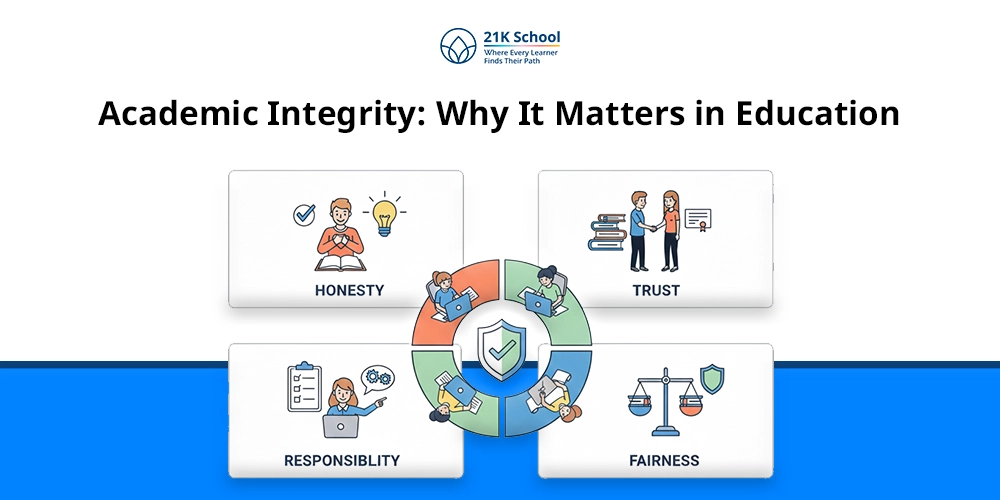
Academic integrity serves a value system having trust, honesty, fairness, responsibility and respect for the work given and work delivered.
It implies that you should be writing your own answers in the exams conducted, give original content when you are into research, follow all regulations stated by educational firms, and state proper citations, if referring to other’s content.
This would take a collective effort of everyone to make academic integrity viable in this generation.
Why Does Academic Integrity Matters?
Academic integrity is a valuable component of maintaining academic authenticity and transparency.
This leads to some of the best practices including the following:
1. Protecting the Value of Education
Academic honesty can protect the sole reason for acquiring real knowledge and skills.
In case students commit acts of dishonesty, they can get through tests or other assignments but fail to get to the essence of learning.
This damages their individuality and also their confidence in their academic qualifications in the long term.
A degree-certificate or academic performance can portray actual competence, so the maintenance of integrity makes academic qualifications worthwhile.
2. Ensuring Fairness
Fairness is a fundamental concept in any learning institution.
This creates a situation where the system seems unfair when some students cheat and others do not.
Persons with integrity might feel demotivated upon finding that nobody stops the act of dishonesty.
Academic honesty is meant to have everyone on the same playing field where the grades should be totally based on real merit and efforts.
It brings trust between students, teachers, parents, and institutions to promote the culture of justice.
3. Promote Critical Thinking
Academic honesty makes students good at critical thinking.
They do not copy or rely on some unauthorized assistance, instead they learn to analyze the information (backed by research), and develop their own ideas.
These are skills that are required in academic success and for solving real life problems, involving innovation as well as decision-making.
Integrity helps the learners to gain deeper insights along with intellectual maturity.
4. Safeguarding Research Quality
Accuracy, transparency, citations, and ethical practices are critical in research.
The integrity of knowledge is undermined when researchers lie to create reports. This way plagiarism occurs while falsifying the result.
This kind of malpractice may be misleading to future research and also destructive in terms of the global scientific record.
Academic integrity alone guarantees that research is done in a righteous manner, so that it protects its reliability and credibility.
Principles of Academic Integrity
The main principles that every student or teacher should remember for ethically practising assessments are:
1. Honesty
Academic integrity is based upon honesty.
It is the honesty of the work, the ability to grant credit to other people,the elimination of any kind of dishonesty, and the recognition of challenges.
Honest students avoid submitting any duplicated assignments, give correct information in research, take stand against unfair means being practiced, and do not cheat in exams.
2. Trust
A healthy academic community thrives when there is trust among all members or stakeholders.
The environment becomes more supportive and collaborative, thus fostering a positive learning environment.
Trust promotes communication, knowledge sharing, impartiality, and respect.
It is also important that academic institutions are able to trust the authenticity of work given by the students.
3. Responsibility
Responsibility refers to being able to own our individual actions and be answerable for our mistakes.
Students need to know about the repercussions of engaging in malpractices to make better ethical decisions.
Good learners use their time effectively, adhere to set rules, and consult others rather than find their way out with dishonest methods.
4. Fairness
Fairness would ensure that all people are following the same rules and getting equal opportunities.
This is why educational institutions need to have periodic assessment and a transparent grading system.
Also read about the NIOS grading system to find if it offers transparency.
Fairness also implies that students should not benefit through cheating or committing actions against the rules obeyed by others.
5. Respect
Respect denotes the culture of appreciating the efforts of other individuals and rewarding their contributions, so that their intellectuality is appreciated.
It also involves adhering to classroom guidelines and instructions of teachers.
Students exhibit respect by attaining student-discipline and valuing the learning environment.
6. Courage
Courage is the readiness to do something right, even in a hard situation.
These students are among those who resist peer-pressure, tell the truth, and report unethical conducts instead of being comfortable.
Being able to maintain integrity is not an easy task. It is even more difficult when dealing with competitions or stressful scenarios.
Common Forms of Academic Misconduct
Some of the most common ways in which learners and so called researchers and learners execute academic misconducts are as follows:
1. Plagiarism
Plagiarism is the process where the learner takes another persons’ ideas and work without adequately crediting them.
This involves duplicating the contents from websites, AI-curated work, paraphrasing those content, or crediting another party.
A plagiarism that is accidental is still regarded as a violation of academic ethics.
2. Cheating
Cheating is a shame to justice and academic honor.
It involves the act of utilizing unauthorized methods for undertaking exams or assignments.
These might include copying from classmates, taking cheat-notes, using the internet during tests, or even talking to people during exams.
3. Fabrication and Falsification
Fabrication is coming up with wrong data, or source of information, while falsification can be defined as the manipulation or a change in the existing data.
Both types of malpractice are particularly prohibited in research where precision is essential.
These unreasonable behaviors distort knowledge and have long term effects on constructing a reliable research community.
Although group work is prevalent, certain assignments will need a person to work independently.
Unauthorized cooperation occurs when students cooperate to execute individual activities, thus sharing their ideas and effort, making the evaluation biased and impractical.
This may be in the form of sharing answers or discussing exam questions forged in advance.
5. Contract Cheating
Contract cheating is carried out when a student seeks the services of someone to do their assignments or exams.
This may involve hiring or requesting other people to give exams in their place.
Contract cheating can lead to severe academic repercussions including expulsion, and in some jurisdictions, legal action may be taken against service providers.
6. Impersonation
Impersonation occurs where one impersonates another student to give an examination or even do coursework.
It may include the use of deceitful names or passing over logins.
Analysis of impersonation compromises the quality of academic assessment and is considered an extreme vice.
7. Violation of Research Ethics
Violation in research ethics involves causing harm to the participants, disregarding the consent, misusing confidential information, or performing unethical experiments.
Research ethics safeguards the dignity and rights of both the involved parties, and therefore necessary legal actions and academic punishment may occur in case of violation.
8. Misuse of AI Tools
Due to increased use of AI, students can copy AI-generated answers and essays.
Misusing AI includes passing the work written by AI as your own, generating fake citations, cheating in exams with AI, and using AI to ditch learning.
You can utilize AI for guidance, or brainstorming, but not to actual effort.
Causes of Academic Dishonesty
The cause of academic misconducts include the following:
1. Pressure to Succeed
High academic expectations from parents, and teachers can drive students towards unethical shortcuts.
The need to avoid failure or the urge to achieve good grades usually leads to being dishonest.
This mere avoidance of shame can lead you into a guilty trap of performing good but still being unconfident of your actual learning skills.
2. Procrastination
The students who leave the assignment for the last moment often are in a hurry, might depend on cheating to complete it.
The avoidance and poor planning contributes to this temptation of depending on shortcuts.
When you are continuously scrolling on your phone, it might skip your mind that you have to complete your assignments.
So start with writing a daily target and then by the end of the day, make sure to complete each one of them effectively.
3. Poor Time Management
Stress can be caused due to lack of organizational skills or making straight priorities.
These overwhelmed students then decide to take easier solutions that might be unethical.
Learning time-management skills are beneficial for the academic purpose and also for being successful in life.
4. Lack of Awareness
Many students do not know anything about the rules of plagiarism, styles of citation, or what is considered as academic misconduct.
They can unwillingly break an ethical standard without adequate guidance.
Some research investigates to find that higher institutions need to provide students with more awareness about consequences on plagiarism and exam cheating to lead to healthy exam conduction.
5. Lack of Confidence
Students who lack confidence in their ability to perform may cheat since they feel that they can not do well.
This behavior is associated with low self-esteem or academic insecurity from the past.
They also might fear losing their friends and be frightened of parental scolding due to repetitive failures in the previous exams.
6. Easy Access to Technology
Technology renders readily accessible information and online sources, leading to easy means of cheating.
From AI tools and websites anyone can find ready-made essays, exposing them to more misconducts.
AI tools and Google websites should be entirely for guidance and not copy-pasting the exact information.
Early awareness about cheating and its repercussions can easily improve the scenario for learners and not depend on it.
7. Peer Influence
Students can also cheat by being under their peer influence.
There can be many situations where a decent student starts to depend on cheating when exposed to the wrong group of friends who cheat regularly.
These unethical decisions may be caused by peer pressure and a fear of being left.
At such a young age, learners can’t be sure of what’s good or worse for them, therefore educators and parents should guide them assertiveness and love.
8. Ineffective Teaching
In cases where there are no engaging teaching methods, students can become lost.
They might fail to get the content clarity of what they are reading, and may find shortcuts rather than asking someone to assist them.
But when they are given a suitable learning environment, these students slowly become confident about the questions asked and their retention.
9. Ineffective Assessment Methods
Tests which are based on extreme memorization or high-competition may lead to cheating.
Misconduct is also caused by poorly constructed tasks, not designed to encourage critical thinking.
Assessments should be exciting instead of horrifying to learners, so that they take it as revisions and perform best in their final exams.
Strategies for Promoting Academic Integrity
Here are some of the best strategies that would be apt for promoting academic integrity in students including awareness:
1. Understand the Rules
Learners should be made acquainted with the policies, plagiarism rules, and expectations from academic institutions.
Teachers can clear all the assignment rules and other related doubts beforehand so that the learners adhere to the necessary academic standards.
2. Develop Good Study Habits
Good study habits can easily prepare learners for academic integrity.
There would be less study stress if we follow a well-thought study-routine, dividing the work into smaller tasks, and avoiding too many last-minute commitments.
Stability and commitment helps one to complete their job with honesty.
3. Improve Research and Writing Skills
Regularly practicing how to paraphrase, reference, collect credible information, and make crisp notes will aid students to create original work.
Once you are equipped enough with the right writing skills, confidence and competence can be improved through workshops or online courses.
4. Use Technology Responsibly
Technology can be our best assistance if used wisely while curating our own original work.
So many of these smart AI tools work excellently to offer guidance.
Like, you can refer to information easily, find the source links conveniently, ask AI tools to analyse long texts and PDFs, or even paraphrase a few lines to maintain the originality of the content.
When you utilize these tools mindfully, they can be your helper throughout the learning process.
5. Ask for Help
If you feel stuck at a point, it is natural to seek help. Though this help could be from a human being rather than just AI tools or the internet.
Your teachers, friends, colleagues, and mentors can help you out with the things they know already and you don’t.
Depending on shortcuts, including cheating,can be a bad idea when trying to make your own research paper or publishing content.
6. Uphold Personal Ethics
Sticking to your personal ethics and values make you feel firm when faced with challenges in giving exams or doing research.
It is really vital that people know their values and stick to them without shrinking their boundaries.
These personal values build a positive personality who is authentic and proud of themselves.
Conclude It All
Academic integrity is critical to the quality of research, fairness and credibility of education among students.
It builds trust and stimulates critical thinking, which moulds individuals’ professional ethics.
Although it is easy to be tempted by pressure from surroundings, new technologies, poor time management, and competition, leading to dishonesty.
Still, knowledge of the principles of integrity and implementing them honestly can make students able to make better decisions.
Ensuring academic integrity goes well beyond the prevention of bad behavior. It teaches an obligation to learn smarter and become a valuable member of society.
Students who adopt honesty and responsibility are able to upgrade their personal skills as well as benefit their academic growth.

You may also want to read