


Have you ever thought about what time is best for effective study?
The selection of time to study is a crucial step towards effective learning. The amount of energy, concentration and motivation in every student varies during the day, and this implies that the optimum time to study may vary in individuals.
Some students study best during the quiet and peaceful hours of the early morning, and some students have their concentration enhanced in the afternoon or towards the end of the evening.
Knowledge of these individual productivity patterns can assist students to memorise more information, maintain consistency and eliminate study stress while studying. When the students learn when their mind is at its best, they are capable of doing things more effectively, and they find the learning method enjoyable.
Table of Contents
What is the Best Time to Study?

The most appropriate time to study is, however, the time when the students have their full attention, their minds are alert, and they are not distracted. To most students, early mornings provide new energy and increased memory levels for studying.
Others prefer the afternoon time since their minds are very active, and this time is after the meals. There are those who like the late evenings or nights when there is less distraction and noise.
Here is the 13 best tips to study in noisy environment.
However, many students noted that their brains in best at specific periods of the day. As per them, the optimum time of study is:
10:00 AM -2:00 PM: It would be best to think and solve tasks in an analytical way.
4:00 PM -10:00 PM: Good for retaining memory and in creative learning.
4:00 AM -7:00 AM: Ideal to be clear and focused and not have any distractions.
Important Note: These patterns are quite different depending on your personal chronotype, age, sleeping schedule, and lifestyle.
Have a look: How to Study for Exams Effectively
Which is the Best Time to Study (Morning, Afternoon, or Night)?
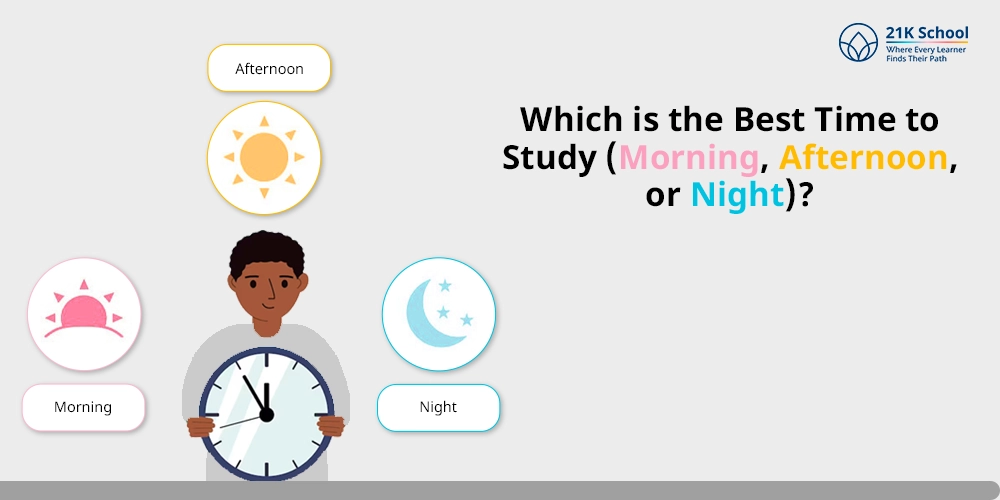
The best solution is to try various times to determine which one fits you better in regard to personal energy and learning style, and then maintain a study routine. The following are the best time to study.
1. Morning

Many students can focus in the morning due to proper sleep. Not only are they able to comprehend ideas easily and solve problems with ease, but they also remember things. There is also more activity and freshness in the morning among the students, and therefore best time to study.
Why studying in the morning is good:
- Better Focus and Mental Clarity: Mornings help the brain to remain fresh and sharp; therefore, it can concentrate, acquire novel ideas and conceptualise better since the brain is refreshed and better positioned to learn.
- Higher Energy Levels: Body and mind being revitalised after the entire night of sleep, students are more active in studying and are able to remain alert and absorb information better in the morning.
- Fewer Distractions: The early mornings are not accompanied by a lot of commotion and no digital distractions or even social distractions; students are able to study in peace and can have a longer concentration span.
2. Afternoon

The information that they have learned before can be easily incorporated by many students during this hour. It has been indicated in numerous studies that the most effective hours to study are the 2 pm to 5 pm. They also develop critical thinking skills and analytical skills, which are more effective at this age.
Why studying in the afternoon is good:
- Better Analytical Skills: Cognitive functions, which are reasoning, problem-solving and decision making, are best performed during the afternoon, and one can thus handle subjects that are difficult in a better manner.
- Peak Brain Function: The brain is at its optimal at the afternoon and is alert and active, and therefore, the understanding, concentration and output are better, and it is the appropriate time to study any complex or analytical subject.
- Effective Revision Time: The afternoon is an ideal time to check on the morning lessons and reinforce memory and clarify hard points, as the information still remains fresh.
3. Night

This is similar to the afternoon since the night is also quieter and students can concentrate and remember everything they have learned during the daytime. In addition, it is said that post-studying sleep also helps to remember.
Why studying at night is good:
- Less Distraction: Nighttime is less distracting, and there is less distraction by the family and friends or the environment, and the students are able to focus more on their studies.
- Enhances creativity: It has been established that a good number of students are more productive at night. The free environment may be employed to develop novel ideas and creative thinking.
- Enhanced Focus: The reason behind this is that the brain has more time to focus on the positive learning environment at night, hence learning and understanding difficult matters without straining.
How to Find the Best Time to Study?

The most optimal time to study is individual, and it depends on your energy levels and chronotype. In order to determine your peak times, you can test out various times, mornings, afternoons or nights. The methods to determine the most appropriate time to study are the following.
1. Analyse Your Day

Knowing your routine is the initial step towards the best study time. Keep a daily diary of your mood, alertness and productivity.
When you have identified these patterns, you are then able to schedule your study according to the time of day when your mind is more active and receptive to learning.
2. Focus on Your Peak Hours

All of us have a specific time of the day when we are mentally alert and active. Students should focus on their best time, and they can use this time to study; this will be very beneficial in terms of learning.
When you learn at a faster rate, you are able to solve problems more easily, or you are able to remember things more effectively.
Undertaking studies during such durations enhances productivity and minimisation of the study time. You are sure to be more retained, better understood and have better grades when you use your own peak hours.
3. Make a Consistent Routine

Always prepare your brain to learn at a particular time. The establishment of the habit of studying every day will help to improve concentration, discipline, and long-term memory. The brain gets used to a certain time to study and, thus, concentration becomes easy.
Constant habit also minimises procrastination and the stress of studying. With the passage of time, regularity develops robust learning patterns and enhances performance in schools without the need to work hard.
4. Identify Distraction

The best time to study also involves having an idea of the time when distraction is minimal. Select a time when you are less disturbed by the surroundings and your mind is not bothered by outside hindrances.
Distractions must be kept to a minimum since they help to save time and focus. Lack of distraction you bring when studying will make you take in the information more quickly, and the longer you remember it, thus making your study process more fruitful.
5. Measure your Attention Level

There is a fluctuation in the level of attention. On some occasions, you will find that you are attentive and awake, and at other times, distracted or drowsy.
Attention can be tested by means of such simple measures as monitoring productivity, solving quick mind tasks, or checking the period of time you devote to studying without distraction.
6. Experiment with your Adaptability

The time that is best to study is not fixed, and each student is unique. Experimenting study at various times, such as in the early morning, afternoon or night, to figure out which one suits you best. Know when you learn best, remember the best and feel at ease.
The best alternative time to study might vary with the exams, volume of work or lifestyle. Adaptability will aid in knowing your body clock and a schedule of study that will make you most effective in your studies.
Effective Study Tips for Different Times of the Day

Effective study requires not only the study methods but also the study time. All periods of the day are different in terms of benefits to learning.
The way you know about your energy level, focus patterns, and daily time table means that you will be able to select the right strategies in the morning, afternoon or night. The study tips during the different times of the day are its follows.
1. Morning Study Tips

- Have a Balanced Breakfast: A healthy breakfast increases energy, enhances concentration, and helps the human brain. Breaking a healthy meal in the morning helps students to be more alert, think clearly and concentrate more on the study period.
- Beginning with Morning Routine: This is the routine that you can frequently indulge in before you start studying; a morning that may be spent practising stretching, planning your day, or doing exercises that are not too taxing. It lessens student stress, makes you alert, and you start studying with a clear and motivational mind.
- Complete Difficult Topics: In the morning time one should work on difficult topics since the mind is fresh and clear. Dealing with difficult issues initially enhances productivity and makes the remaining day easier to deal with.
2. Afternoon Study Tips

- Be Active After Lunch: Light exercise after lunch helps to keep oneself awake and helps to stimulates blood flow. A brisk stroll or stretch will rejuvenate your mind, and this will enable you to remain focused in the afternoon study period.
- Establish Small Goals: Divide your tasks into small, achievable goals. This will keep you motivated, ease the overload and make you sustain constant progress throughout the afternoon when you might experience high and low energy levels.
- Study in Natural Daylight: The closer to natural daylight, the better the eye power and the alertness. The appearance of the sun boosts the mood and concentration, which form the optimal condition in terms of productive afternoon learning sessions.
3. Night Study Tips

- Keep Hydrated: Continue taking water at night when studying to ensure that one is focused and not easily tired. It is not only that proper hydration will make you more alert and enhance memory in later hours, but it also helps the brain to work as a whole, enabling you to think and perform better.
- Practise Meditation: A brief meditation time before studying helps calm your mind, relieves exam stress and makes you clearer in your thoughts. It assists you in getting into a relaxed concentration that can help you study productively during the night.
- Establishing a Relaxing Routine: The pre-education process should be light dimming, performing gentle stretches, listening to soft music and deep breathing. This will put your brain into a relaxed mood and your performance at a time of focusing at studying will be high during a night of studying.
Conclusion
The time of the day you choose to study should be based on your learning rhythm, energy and routine. You can study in the mornings, afternoons, or even the night, but the point is to study at the time that you are the most alert and not distracted.
Through proper study techniques and consistency, students can be more focused, more attentive and have better grades in exams. The optimal study time is only the time which suits the students.

You may also want to read