

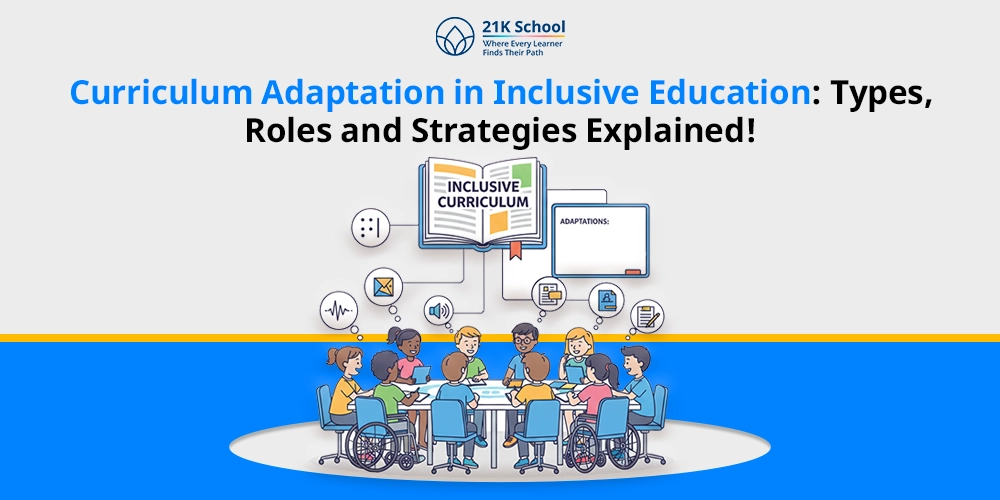
In present times, educational resources and assessments have been changing as per the needs of students, which brings inclusivity and acceptance in the classrooms.
Teachers now understand the benefits and reasons for inclusive education, and also work towards it.
From changing the curriculum content, media, assessment methods, and teaching techniques, everything is planned uniquely.
In this article, we will find everything about curriculum adaptation in inclusive education beginning from its meaning, types, benefits to the limitations and strategies used.
Table of Contents
- What is Curriculum Adaptation in Inclusive Education?
- 7 Common Types of Curriculum Adaptation in Inclusive Education
- 5 Importance of Curriculum Adaptation in Inclusive Education
- 5 Easy Strategies for Curriculum Adaptation in Inclusive Education
- Role of Teachers in Curriculum Adaptation in Inclusive Education
- 5 Benefits of Curriculum Adaptation in Inclusive Education
- 5 Common Challenges in Curriculum Adaptation in Inclusive Education
- Concluding It
What is Curriculum Adaptation in Inclusive Education?
Curriculum adaptation in inclusive education is a process of intentionally changing curriculum content, teaching methods, learning activities, and assessment process to address the different needs of students.
The main learning objectives typically stay unchanged, while the means of access, interaction, and ways of learning by the students are modified.
Curriculum adaptation aims to ensure that students stick to the general curriculum while also experiencing its flexibility and sensitivity.
Depending on the needs of a person, adaptations can be both short run and permanent as well as small scale and major ones.
They assist in addressing the differences between the present and anticipated learning outcomes of a student without belittling them.
This can also assist in deriving motivation and engaging these learners in their learning.
7 Common Types of Curriculum Adaptation in Inclusive Education
Curriculum adaptation can take place in the following 7 ways to bring inclusivity in education:
1. Quantity
This is an amendment which entails an adjustment of the amount of work that is expected to be done by the student.
It can be seen when a student is given fewer tasks or questions while still focusing on the main learning objectives.
Quantity adaptations can also make the learning process efficient without making the work feel cognitively overloaded.
2. Time
Some learners might require additional time when giving exams and trying to analyze the questions and then answer them.
Changes in time for these students can support their needs of processing and executing in papers.
This could also reduce their exam-stress, anxiety, and overall results of such children.
3. Level of Support
Each student need different level of support which can be added as a part in curriculum adaptation.
Children can get this assistance with the help from technology, peer learning, teacher guidance, instructional aids, or educational images.
Once students become well at their work, these support can be gradullay removed to teach them self-learning and self-dependency.
4. Input
Children have varied capabilities due to which the methods of presenting information (inputs) should also vary.
To support various learning styles, teachers can depend on visual images, audiotapes, or digital equipments rather than just depending on textbooks and lectures.
5. Difficulty
The difficulty of tasks should change as per the ability of a learner. This can be called as difficulty adaptation of curriculum.
This can involve simplification of language, division of tasks into smaller steps, or offering structured templates.
6. Output
Output adaptations reflect how students can present their attained learnings or skills.
Students can also give oral presentations, create models, draw diagrams, or respond using some technology, instead of writing on a paper.
This gives students the opportunity to express their knowledge in areas that they are inclined to.
7. Participation
Participation adaptations deal with in what way and how much one is involved in classroom activities.
It implies that a student, instead of just being present in the group for namesake, can actually express their talents in a way that they want.
An instance can be a group of 4 people in a science exhibition.
Here if a boy doesn’t know much about science experiments can still show his speaking skills while presenting the project to the judges.
5 Importance of Curriculum Adaptation in Inclusive Education
Curriculum adaptation is being emphasized because of the following importance:
1. Ensures Equity & Access
Adaptation of curriculum makes sure that the learning opportunities are equally distributed to every student.
It understands that equity is not about treating everybody at the same level but giving an individual what he or she requires to excel.
Adaptation eliminates obstacles that restrict participation and comprehension in learning.
2. Boosts Engagement & Motivation
Students are motivated when they have access to relevant and engaging learning exercises.
Curriculum adaptation can enable the learners to feel at ease and motivated to perform.
This confidence brings on the learners active participation in the learning process.
3. Improves Learning Outcomes
Differentiated curricula contribute positively to academic success since it functions in accordance with the abilities and needs of learners.
The approach to teaching and grading should be responsive and flexible to allow the students to learn the concepts in a more flawless way.
4. Fosters Social Inclusion
Inclusive classrooms encourage communication between various students.
Curriculum modification enables students who have different abilities to be involved meaningfully during common activities.
This facilitates collaboration, empathy, and mutual respect amongst them.
5. Supports Independence
Independence is achieved through curriculum adaptation by giving the right help in the right amount.
This also includes withdrawing the support gradually to enable the students to be independent, able to solve their problems, and have self-regulation.
Skills are necessary in the process of lifelong learning and self-development.
5 Easy Strategies for Curriculum Adaptation in Inclusive Education
You can follow the following strategies for incorporating curriculum adaptation in classrooms:
1. Universal Design for Learning (UDL)
UDL is an active strategy which designs lessons in such a way that they are accessible to learners from the very beginning.
It focuses on various modes of representation, participation, and expression.
UDL minimizes the number of individual adaptations as it introduces flexibility within the lesson planning.
2. Differentiated Instruction
Differentiated instruction is an instructional process that incorporates teaching approaches depending on the level of readiness and interests of the students.
Different tasks, grouping strategies, and pacing may be employed by teachers to address the needs of different students.
3. Use Varied Inputs
Visual methods, video, storytelling, and technology are some of the teaching aids that can facilitate the delivery of information to learners.
This is beneficial to different students with varying learning styles and abilities.
4. Simplify/Modify Content
There are several ways to change the content presentation for students.
Here, teachers can simplify language, summarise key points or divide lessons into smaller bits.
Editing content can make students concentrate on important learning outcomes without being overwhelmed.
5. Scaffolding
Scaffolding is a guided and structured support given to the learners with the help of prompts, models, examples, or step-by-step instructions.
With added competence, students are given lesser support that reinforce independence as well as confidence in them.
Role of Teachers in Curriculum Adaptation in Inclusive Education
Teachers play a central role in a successful curriculum adaptation.
Their responsibilities include learning the needs of individual learners through observation and evaluation.
Then they need to find practical solutions for each kid by cooperating with their respective parents and other specialists.
To promote inclusivity in the classroom, they need to plan flexible lessons depending on the varying needs of each student.
During the process of teaching, teachers can even change the teaching methods or assessments, when they notice some progress or failure in previous methods.
While they work with counselors and other field administrators, they should remember that every student is capable of succeeding if the right support is given to them.
This way, they can bring the idea of inclusion into real-life classrooms.
5 Benefits of Curriculum Adaptation in Inclusive Education
The most-talked 5 benefits of curriculum adaptation could be the following:
1. Greater Autonomy
Adapted curriculums enable students to be in charge of their learning.
Students can gain self-confidence and independence when they know that they have the needed support and assistance from their teachers and other professionals.
2. Deeper Understanding
The teaching and assessment techniques can be flexible to enable students to interact with concepts in meaningful ways.
This means more understanding as opposed to memorizing.
3. Enhanced Social-Emotional Growth
Interactive classes having adapted curriculum can facilitate a feeling of belongingness, understanding, and socio-emotional learning.
Students are taught to embrace diversity and help each other.
4. Rich Learning Environment
The adaptation of the curriculum is beneficial to all the learners including the children with special needs.
Different teaching methods make the classrooms dynamic and interactive which positively impacts the learning of all.
5. Proactive Design
Curriculum adaptation promotes proactive planning as opposed to reactive mode of responding to academic challenges.
Educators expect difficulties and plan the lessons considering diversity in advance.
5 Common Challenges in Curriculum Adaptation in Inclusive Education
Curriculum adaptation in inclusive education becomes challenging when faced with the following limitations:
1.Negative Attitudes
The resistance to inclusion or the incorrect insight about student capabilities may become obstacles to curriculum adaptation.
Low expectations and lack of opportunity may be caused by negative attitudes towards learners.
2. Lack of Training
The inadequate training in many teachers can be a problem in incorporating inclusive practices and adaptation to the curriculum.
It might be difficult to use effective adaptations in the curriculum without the needed professional development.
3. Time Constraints
Adapted lessons planning and implementation would need more time.
The high workload and large classes sometimes discourage the opportunity to individualize instructions, given by teachers.
4. Inappropriate Assessment
The standardized assessments might not be a good way to measure students’ capabilities in integrated classes.
The absence of flexible ways of assessment can be a setback to a good curriculum modification.
5. Lack of Inclusive Methods
Another possible restricting factor to the application of inclusive teaching methods can be limited access to resources, assistive technologies, and institutional support.
The implementation needs to be supported systemically.
Concluding It
Curriculum adaptation can do wonders for students with different abilities.
It ensures to serve every student without making them any less. It involves changes in the quantity, time, inputs, difficulty levels, and rate of learning.
Due to this, students can participate in most classroom activities and prove themselves to the outer world.
Curriculum adaptation can be executed well if we can properly make use of differentiated learning and personalized assistance for each learner.

You may also want to read