

Have you ever questioned the fact that teaching and learning are two different things?
Education may be described as the interrelated and varied teaching and learning. Teaching can also be considered as the impartation of knowledge and guiding the learners through giving them an environment where they can learn.
But learning is the process of assimilation of information that is absorbed and put into practice. Despite everything being taught and nothing being learned, it becomes difficult for students to apply their learned skills.
This perception of the difference between these processes will help the educators to come up with the practical plans, and the learners will be actively involved in the making of the plans, which will make educational outcomes more meaningful.
Table of Contents
What is Teaching?
Teaching may be defined as the act of imparting knowledge, skills, values and experience to help the learners acquire a certain understanding and implement the new concepts.
It is an art of designing the lessons, delivering the concepts and facilitating the discussion processes, evaluating the progress and creating a conducive environment — integrating technology in education — which supports the learning method.
The teaching process also entails not only the presentation of the information, but also inspiring the learners, making the mode of presentation appropriate and preparing the learners to achieve the aims in education.
What is Learning?
Learning is a process through which people acquire new knowledge, skills, behaviour or attitude. It involves having the capacity to understand knowledge, make associations and practise and translate what one has learned into real-life practice.
Learning may occur through or as a type of education, experience or observation, and may typically lead to either a shift in ideas or behaviour.
As opposed to teaching, learning is a personal, inward process, and it grants one a chance to develop, change and learn how to handle the issues in a better way.
Key Differences between Teaching and Learning
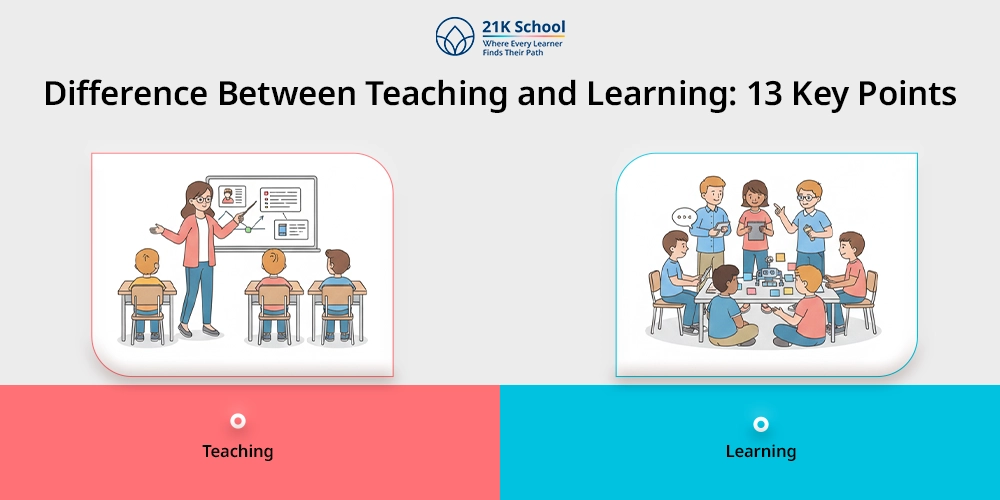
Although teaching and learning are two concepts that are directly related to each other, they are not similar. Teaching is directed to provide knowledge and educate the learner, where learning is directed to knowing, applying and internalisation the knowledge. The following are the differences between teaching and learning.
| Aspect | Teaching | Learning |
| Meaning | Teaching is the provision of knowledge, skills, and guidance. | Learning is the process of getting knowledge, comprehending and using it. |
| Role | The educator or instructor is the facilitator and the guide. | A learner/student is an active participant in order to acquire knowledge. |
| Process | Planning, teaching, presentation, scaffolding and assessment are the processes of teaching | Learning is the process of accepting, working with, rehearsing, contemplating and applying the information to real-life scenarios. |
| Purpose | Teaching is aimed at sharing information, building skills and facilitating learning. | Learning aims of assimilating, interpreting and applying knowledge to develop. |
| Types | The teaching methods include formal, informal, online and classroom teaching. | Cognitive, experiential, reflective, collaborative, self directed learning are types of learning. |
| Activity | Instructional explaining, demonstrating and assessing in the first place. | Experiential listening, practising, analysing and applying mostly. |
| Approach | The teaching approach is a teacher-centred methodology or a learner-centred methodology. | Learning approach is learner-centred and it supports learning and growth among learners. |
| Feedback | By providing feedback about the learning, the teacher can keep track of the learning and enhance it. | Learning helps the learner to provide feedback and correct the perception and performance. |
| Adaptability | The teachers change the strategies to meet the needs of learning in teaching. | Students adapt to the strategies in learning to facilitate knowledge. |
| Goal | The goal of teaching is to make sure the learners get and comprehend the material. | The goal of learning is to become a master, competent and internalise knowledge. |
| Dependence | In teaching, students are relying on the instructor as a resource. | In learning, students will be expected to be active learners and build knowledge. |
| Evaluation | According to the performance of the learners, the assignments or tests. | Learning is evaluated through self-reflection, evaluation and action. |
| Outcome | Providing good teaching and more involvement of the learners is the outcome of teaching. | Learning acquired, abilities acquired and change of behaviour are the outcomes of learning. |
1. Meaning
Teaching: Teaching can be said as the art of passing the knowledge, skills and instructions to the learners in a systematic way.
Learning: Learning however, is the internal process of absorbing and knowing and applying information.
2. Process
Teaching: It involves the organisation of lessons, the delivery of lessons, the leading of discussions and the leading of activities, as well as testing of understanding in a manner that aims to attain learning are attained.
Learning: A learning, in its turn, is an inner process, when learners are offered information, process and analyse it, practise, reflect on the experiences and use the knowledge in significant ways.
3. Role
Teaching: In teaching, the teacher plays a primary role who is the instructor, guide and facilitator who organises the content and directs the learning processes.
Learning: In the learning, the learner will be at the centre stage because they will be engaged in the exploration, questioning and making sense.
4. Purpose
Teaching: Teaching is a process that is geared towards taking knowledge, skills, among other structured learning opportunities that will help the students to progress either academically or professionally.
Learning: Learning is aimed at internalising, interpreting and applying knowledge in the development of self-resolution, problem-solving and building critical thinking skills.
5. Types
Teaching: Teaching can be of many forms, one of which is formal teaching in the classroom; there is also online teaching, practical teaching and informal teaching.
Learning: Learning takes place in different forms, and they are cognitive learning, experiential learning, reflective learning, social learning and self-directed learning.
6. Activity
Teaching: The teaching activities include explaining the concepts, showing how to do things, asking questions, assigning and evaluating the knowledge.
Learning: Learning activities are concerned with listening, observing, practising, analysing, thinking and application of knowledge to reality.
7. Approach
Teaching: Teaching methods are teacher-centred, learner-centred, collaborative learning and technology-integrated, depending on educational goals and philosophies.
Learning: Learning orientation deals with how individuals learn, either through the visual, audio, kinesthetic, reflective or experiential learning, which forms the basis of student-centred learning.
8. Feedback
Teaching: In teaching, the teacher would most of the time provide formative assessment feedback to help the learners know their errors, to perform and keep time.
Learning: Feedback on learning is obtained, perceived, and considered by the learners to make corrections to their knowledge and acquire better collaboration skills.
9. Adaptability
Teaching: The flexible feature of teaching makes the teaching lessons active and accommodating. The instruction strategies, learning rate and content are varied by the teachers in order to accommodate the needs of various learners.
Learning: The facet of flexibility in the learning process contributes to personal development. The adjustments involve learning techniques, getting help, rehearsing and creating new ideas of studying among the learners.
10. Goal
Teaching: The objective of teaching is to be able to make sure that learners are equipped with the knowledge intended, they learn the main concepts and are guided properly through the material in the learning.
Learning: On the other hand, learning is intended at mastery and competence whereby learners internalise the knowledge and skills and apply them in autonomous situations and acquire the ability to reason critically and solve problems in real-life situations.
11. Dependence
Teaching: The students usually need the guidance of the teacher in teaching, learning materials and the direction of the teacher. The teacher performs the explaining, organising and understanding, and therefore the learners become dependent on the outside assistance.
Learning: Learning alters this dependency as it puts the learner in charge and they must be active, inquisitive, questioning and make their own interpretation.
12. Evaluation
Teaching: In teaching, the performance of the learners is evaluated by the use of tests, assignments, quizzes, and assessments to evaluate their level of knowledge as well as progress.
Learning: Learning evaluation, in turn, is concerned with self-evaluation, reflection and knowledge-based practice — essential elements of self-regulated learning.
13. Outcome
Instruction: The outcome of the instruction comprises good teaching, improved clarity, systematic directions, as well as involvement of the learners.
Learning: Learning yields a result, which is gained knowledge, gained skills, changed behaviours and increased understanding — outcomes that contribute to lifelong learning.
Bottom Line
Learning is inseparable from teaching and vice versa, and is completely different. Whereas in teaching the issue is on injecting knowledge and instilling the learners, in learning the issue is on understanding, applying and transforming the knowledge.
These differences can be identified to come up with more effective types of education. There must also be deliberate teaching by the teachers and active learning by the learners, and coordination of the processes will make them grow meaningfully and develop sustainably.

You may also want to read