

Do you know what the current female literacy rate in India is?
The literacy level of women in India is also a high indicator of social and economic development. It also demonstrates the level of women’s education among the women population, and it creates concern over gender inequality, poverty and the availability of education.
Educated women contribute towards good family welfare, health and national development. Despite the fact that a steady positive trend in female literacy is recorded in India over the years, the gap between rural and urban areas and different social categories is still great.
Table of Contents
What is Female Literacy?
Female literacy is the ability of women and girls to read and write as well as understand simplified written messages. It is among the key indicators of the educational empowerment of women within a society.
The insinuation of a literate women population is social development, as educated women will have the opportunity to make informed choices, be concerned about their families, enhance health and hygiene, as well as initiate economic development.
What is the Current Female Literacy Rate in India
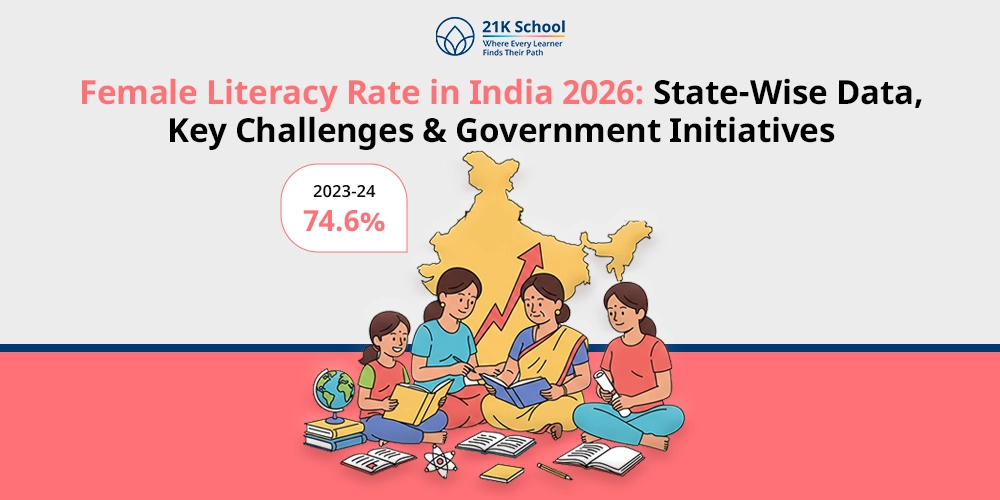
The current statistics of the Periodic Labour Force Survey (PLFS) 2023-24 show that the level of literacy among women in India is approximately 74.6% among women 7 and above. This remains slow progress relative to the last decades, which represents advancement in the accessibility of education and governmental support of education among girls.
Women’s literacy has grown by 21% since the 2011 census, with 59.3% in the 2011 census playing against 74.6% of the 2017 census. However, the rural literacy levels are very low in contrast to the urban literacy levels, and there is an indication of disparity.
Nevertheless, the disparity in gender is also high, as there is approximately a 87.2% male literacy rate. The imbalances can also be observed in the region of rural and urban areas, which is why further attempts to reach universal female literacy in the country could not be ignored.
Top 5 States with the Highest Female Literacy Rate in India
In India, states have experienced where female education has actually improved, and the literacy level of females has already gone beyond or even surpassed 90%. These states can be considered as an indication of the effective policy of education, social consciousness and cultural support of the education of girls, as the example of the other half of the country.
1. Mizoram (98.2%)
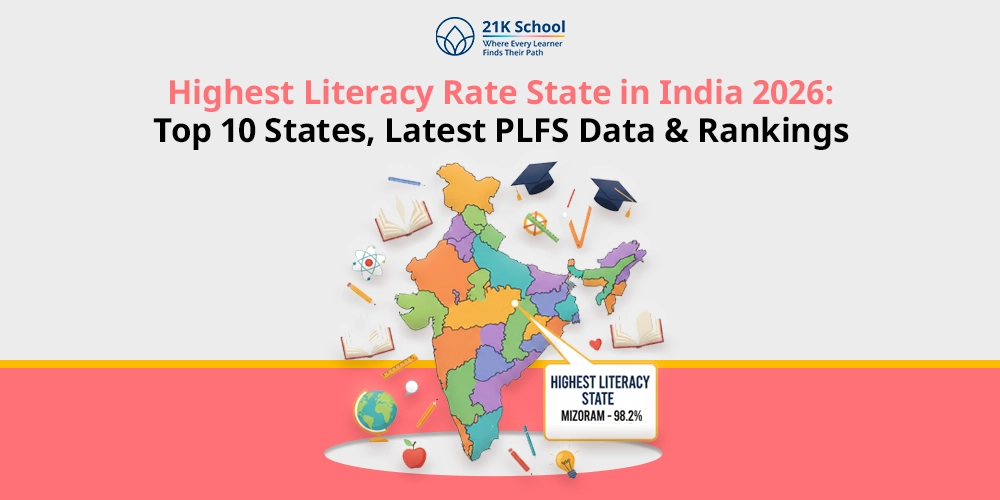
India has the most literate state, which is Mizoram, and the literacy rate of women is 98.2%. Community intervention, missionary activity and high educational standards, and low gender inequality have contributed to the fact that the women have almost universal literacy.
2. Lakshadweep (94.8%)
The literacy rate amongst women in Lakshadweep is 94.8%. It has attained this by its small population, quality education systems and great knowledge on the essence of not only girls but boys as well as concerns education.
3. Kerala (94%)
In Kerala, the literacy rates of females are 94% already, and that is attributed to the reforms in education over the years, the policy of universal school education, and proper social development. Girls are well aware of health and education, hence enrolled and retained.
4. Tripura (91.6%)
The literacy level of the Tripura females is 91.6%. It has also brought education accessibility, especially in government welfare or school-based programmes, and the elimination of the gender gap and focus on tribal education has seen many girls receive an education.
5. Goa (93.6%)
This has been facilitated by the increased infrastructure, urbanisation, governmental programmes and the cultural education of the women in Goa and has culminated in the literacy of the women of Goa, where the overall literacy level is around 93.0%.
Top 5 States with the Lowest Female Literacy Rate in India
The state has made a vast disparity in the literacy of the Indian female population, and, in some areas, the level of literacy is lower because of the social, economic and cultural factors.
The lowest percentage of female literacy is recorded in the present states, which justifies the fact that there is a disenfranchisement of women with regard to equal access to education.
1. Andhra Pradesh (~66%)
As per the PLFS 2023–24, Andhra Pradesh records the lowest overall literacy rate at 72.6% Wikipedia, with female literacy significantly lower — estimated at around 66%. Challenges include problems of poverty in rural regions, school dropouts and child marriages
2. Rajasthan (~68%)
Rajasthan continues to have one of the lowest female literacy rates in the country at 68%. Gender disparities are large especially in Rajasthan, where girls face significant obstacles including early marriage.
3. Bihar (~68%)
Bihar has 68% female literacy now, but it remains among the states with the lowest literacy in India. It is due to inadequate school infrastructure in rural areas, socio-cultural preference for educating boys, and high rates of girls dropping out of school early.
4. Uttar Pradesh (~70%)
Uttar Pradesh, has around 70% female literacy rate. It is due to economic constraints and lack of safety infrastructure being major deterrents to girls’ schooling.
5. Madhya Pradesh (~70%)
PLFS 2023–24 highlights Madhya Pradesh’s female literacy rate at 70% and as among the states lagging behind the national average. It is driven by poverty, teacher shortages, and infrastructure gaps.
Importance of Female Literacy in India
An educated woman contributes better to improved health, reduced poverty, economic development, and empowerment that results in improved families and a progressive society.
The literacy of Indian women plays an important role in social and economic development. The educated women will invest in better health, poverty, and economic growth, and empowerment to establish better families and a progressive society.
1. Economic Growth
Women’s literacy also leads to economic growth since women can participate in the labour force and start their own business, and be more productive. Educated women will be able to work in professional life, earn and labour to the family income.
Their presence will ensure that the industrial sectors and service industries are stronger, and the domestic economies are also stronger, a process that, of course, makes educated women the front-runners in economic development and national growth.
2. Reduced Poverty
Educated women are able to control the resources at home in a more fitting manner, earn and make sound financial means. Literacy provides them with the power to promote the education of children and ensure that intergenerational poverty is eliminated.
Literate women who have religion stand a better chance of better living situations, economic positions and prospects that lessen the overall poverty rates within the communities and the society in general.
3. Better Health
Women’s literacy enhances the well-being of the family and society. Women who are educated are more informed in matters about nutrition, hygiene and health practices, therefore, resulting in healthy pregnancies, the mortality rate of children is low and the family well well-being.
Literacy also helps women to visit the health facility and take preventive measures, to create awareness on diseases, nutrition and sanitation, all of which are of benefit to the society.
4. Empowerment
Literacy enables women to be empowered socially, economically and politically. Educated women are assertive, they acquire self-esteem, make good decisions, protect their personal rights also and take part in the government.
They oppose gender inequality, establish family and community decisions and motivate the upcoming generation. Strong female figures make significant contributions towards the creation of a more just, more just and more progressive society.
Government Initiative to Increase Female Literacy in India
The Indian government has embarked on several programmes that can improve the literacy levels of women and accord them equal opportunities to study, just like girls.
The aim of the designs of such programmes will be to mirror the disparity between the genders to instigate enrolment and retention of schools, and provide the poor with increased accessibility to good school education in the country.
1. Beti Bachao Beti Padhao
On 22 nd January 2015, Beti Bachao Beti Padhao was initiated to not only tackle the issue of low child sex ratio but also to educate girls, hence sensitising people on the role of educating girls.
It eases the process of school enrollment, decreases the gender gap and obliges the families to make more effort in educating girls in order to offer them the same chances throughout the entire India.
2. Samagra Shiksha Abhiyan
Samagra Shiksha Abhiyan was launched in the year 2018. In this programme, all the school education programmes are included to limit access, quality and equity. It honours universal enrolment, retention, as well as achievement of girls, particularly in the marginalised communities.
It increases female literacy levels as well as reducing the number of female dropouts within the country by providing infrastructure, instruction of teachers and providing financial aid.
ULLAS is a programme that emphasises literacy among adults and particularly women. It has favourable schooling programmes for adult women who are illiterate and assists them to acquire only the basic skills of reading, writing, and counting.
The programme is empowering, personalising socialisation and the capability of women to cope with life on a day-to-day basis and family life.
4. Sukanya Samriddhi Yojana
Sukanya Samriddhi Yojana is a part of the Beti Bachao Beti Padhao initiative. The effect of such a savings scheme is that parents invest in the future of their girls, like in future education and the cost of marriage.
Money is used to motivate the families to school the girls and this indirectly promotes female literacy and narrows the gender gap because economic motivational instruments are linked with education.
5. Kanyashree Initiative
In West Bengal, a scheme named Kanyashree, which is aimed at assisting girls in secondary and higher education, is in place.
It improves the literacy of women, strengthens the youthful women and spurs social and economic developments within the state by giving cash rewards to go to schools and discouraging young marriages.
Conclusion
The level of female literacy as per the PLFS 2023–24 is 74.6% for persons aged 7 and above, while male literacy stands at 87.2%.
The rural female literacy has also been realised and has increased to record levels of more than 70 as compared to 57.9% in 2011, and considerable gains have been realised.
It is easy to understand the female literacy rates in India and the key reasons behind their low ranks.

You may also want to read