

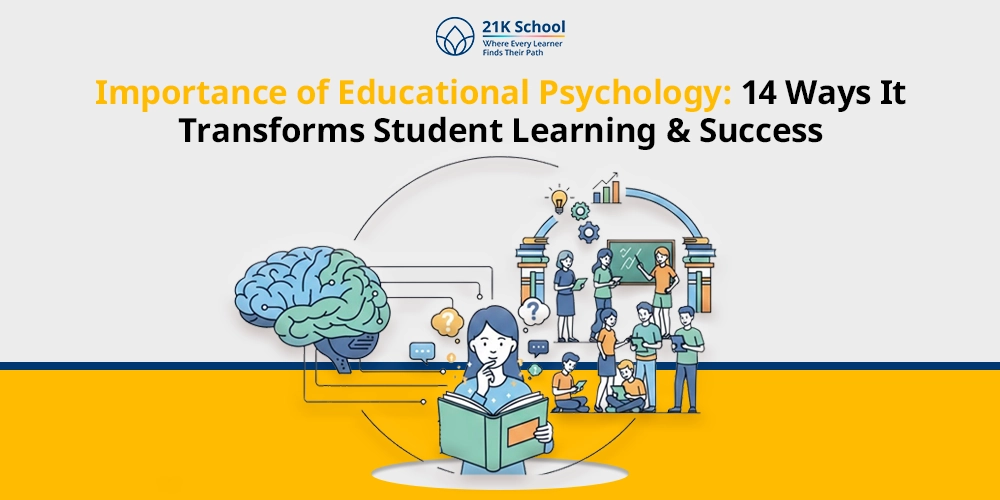
Schooling is not only based on textbooks and tests, but it is also about students and their needs. Educational psychology introduces the idea that every student is different and requires to be provided with the right directions.
It underlines the connection between learning and teaching and it is concerned with the mental, emotional, and social development. Educators can develop a conducive and positive learning environment by knowing how students behave, what interests them, and what they can do.
Educational psychology improves the quality by analysing the learning methods, motivation, intelligence, and individual differences. It is also useful in detecting learning problems and coming up with suitable measures that can assist every learner to enable education to be relevant, inclusive and efficient for students of any age.
Table of Contents
- What is Educational Psychology?
- Top 14 Importance of Educational Psychology for Students
- 1. Helps Students Understand Their Own Learning Style
- 2. Improves Problem-Solving Skills
- 3. Enhances Memory and Concentration
- 4. Builds Self-confidence and Self-awareness
- 5. Encourages Positive Behaviour and Discipline
- 6. Develops Social and Communication Skills
- 7. Supports Emotional Growth and Resilience
- 8. Promotes Critical and Creative Thinking
- 9. Increases Motivation to Learn
- 10. Helps Set Personal Academic Goals
- 11. Guides Effective Time Management
- 12. Reduces Learning Anxiety and Stress
- 13. Encourages Independent and Active Learning
- 14. Improves Overall Academic Performance and Success
- Importance of Educational Psychology for Teachers
- 1. Increase Teaching Efficiency
- 2. Recognises Individual Differences
- 3. Improves Classroom Management
- 4. Encourages Positive Behaviour
- 5. Supports Age-Appropriate Teaching
- 6. Enhances Lesson Planning
- 7. Identifies Learning Difficulties
- 8. Provides Targeted Interventions
- 9. Boosts Student Motivation
- 10. Promotes Engagement and Participation
- 11. Fosters Emotional Development
- 12. Builds Inclusive Classrooms
- 13. Strengthens Teacher-Student Communication
- 14. Guides Assessment and Feedback Effectively
- Best 5 Methods of Educational Psychology
- Conclusion
What is Educational Psychology?
Educational psychology is the branch of psychology that attempts to gain an understanding of how students learn and behave within learning environments. It analyses the learning, motivation, intelligence, personality and differences in the learners.
This issue can help teachers develop a teaching plan and teach children more efficiently, plan their classes, and help in cognitive development of children.
Educational psychology is also applied in identifying a problem in learning and providing solutions that will assist an individual in academic performance to be more effective, meaningful, and student-centred learning at any level of education.
Top 14 Importance of Educational Psychology for Students
Educational psychology is important as it helps teachers and students to examine the problems of learning, behaviour and development of students in order to help the teachers improve their instruction methods, classroom management, student motivation in education and overall learning and personal development.
1. Helps Students Understand Their Own Learning Style
Educational psychology helps students identify their learning style, whether it includes visual, auditory or kinesthetic learning.
Awareness of personal learning styles will assist them in applying effective study skills that would facilitate learning and memorise information helping in studying for exams effectively. Cognitive knowledge enables the students to make the best out of their learning, complete their tasks confidently and achieve more academic achievements independently.
2. Improves Problem-Solving Skills
Learners acquire problem-solving skills through learning to analyse, make sound decisions, and think critically. Educational psychology promotes approaches such as dividing problems into small steps, alternative exploration and knowledge application.
Enhancement of problem-solving improve academic scores, logical thinking, faster learning and creativity, which will equip the students to conquer problems in school and life in general.
3. Enhances Memory and Concentration
Educational psychology offers methods to enhance attention span, concentration, and memory. Visualisation, repetition and active student engagement are some of the strategies used to assist students to remember things and to stay focused.
Improved memory and attention level improve learning outcomes, performance in exams, and the cognitive level and enable the students to understand the complex subject with ease and confidence.
4. Builds Self-confidence and Self-awareness
Understanding strengths and weaknesses with the aid of educational psychology gives students the chance to be self-confident. They understand the individual capacities, modes of learning, and emotional reactions, which makes them manage themselves better.
By having more self-awareness, students achieve more realistic goals, cope with challenges in a positive manner and become more actively involved in the learning process to ensure personal growth, resilience and motivation in academic success.
5. Encourages Positive Behaviour and Discipline
Educational psychology imparts self-discipline, rule-following, and appropriate behaviour in the right way in the academic environment. Students are taught how to control impulses, following instructions and cooperation with peers.
Discipline and positive behaviour not only offer a learning environment that is both focused and friendly, but they also minimise conflicts as well as help the students to adopt habits that help them not only at school but also in real life.
6. Develops Social and Communication Skills
Students can enhance communication and interpersonal skills through group activities, discussions and cooperative learning. Educational psychology focuses on understanding emotions, empathy, and positive expression.
Good social and communication skills enable students to develop relationships, work in teams, overcome conflicts, and be able to convey ideas in a clear manner, which will train them to work in academic groups and in the future, in social interactions.
7. Supports Emotional Growth and Resilience
Students learn to cope with emotions, study stress and cope with hardships. Educational psychology helps them to be capable of recognising feelings, managing reactions, and becoming more decisive.
Emotional development result in the attainment of mental well-being and success in learning and life in general because it allows students to accept failures and embrace endurance and a positive attitude towards learning.
8. Promotes Critical and Creative Thinking
Creative and critical thinking skills help students to analyse, evaluate, and creatively come up with new ideas. Educational psychology stimulates questioning, problem-solving techniques and exploration.
By promoting creative thinking and logical reasoning, students can become autonomous thinkers who can find innovative solutions, gain deeper insights, and know how to use the acquired knowledge and skills in different areas and in real-life scenarios.
9. Increases Motivation to Learn
Intrinsic and extrinsic motivators of students, including curiosity, rewards or personal goals, are identified in educational psychology. Interest, persistence and effort can be maintained through strategies adopted by the teachers and the students.
Learning motivation is high, resulting in active participation, increased engagement and routine learning behaviours, which, consequently, positively affects academic performance and enable the students to achieve short and long-term educational goals.
10. Helps Set Personal Academic Goals
Students learn how to plan, prioritise and have realistic learning objectives. Educational psychology offers tools for self-evaluation and monitoring of progress.
Goal-setting enhances concentration, responsibility and a feeling of accomplishment, which motivates students to work progressively toward academic milestones. The presence of clear goals will assist the learners to be motivated, gauge improvement and acquire lifelong learning habits.
11. Guides Effective Time Management
Educational psychology teaches time management skills that enable students to be punctual, strike a balance between studying and having leisure and meet deadlines.
Planning, giving priority, making timetables and dividing the work into small manageable elements enhances productivity and lessen the stress. Time management helps students to achieve more, concentrate more and maintain consistency in their academic performance.
12. Reduces Learning Anxiety and Stress
Educational psychology can offer some coping mechanisms for fear, pressure, and nervousness in the learning processes. Relaxation, positive reinforcement, and structured instructions are some of the techniques that assist students in coping with study stress.
A reduced level of students stress will result in greater focus, confidence, and interest, and the learners will be able to be fully involved in classroom activities fully and achieve better performance academically.
13. Encourages Independent and Active Learning
The students are encouraged to be active learners, curious, and self-motivated. Educational psychology promotes self-directed learning and curiosity that may allow students to be responsible in their education.
Independent learning aids in the development of problem-solving skills, confidence and creative thinking and active engagement makes knowledge understandable and memorable long-term.
14. Improves Overall Academic Performance and Success
Educational psychology enhances the performance of students by combining teaching methods, motivation techniques, emotional control, and problem-solving.
Students possess more understanding and memory, and learn competencies across various domains. Such thorough practice leads to academic achievement, personal growth, and preparedness for new study tasks and life situations.
Importance of Educational Psychology for Teachers
Educational psychology teaches teachers how students learn, behave and develop in order to teach them effectively, manage them in the classroom, motivate them, and offer personalised needs to facilitate their better academic and emotional development.
1. Increase Teaching Efficiency
Educational psychology assists teachers in gaining insights into the learning and processing of information by students. Through the use of effective teaching strategies, lesson organisation, and dynamic learning, the teacher can provide teaching in a more efficient manner.
This saves wastage in time, promotes improved learning, and enables teachers to concentrate on the needs of students, hence making teaching more productive and effective for all learners.
2. Recognises Individual Differences
Learning abilities and styles, as well as the interests of students, are unique. Educational psychology assists teachers in recognising such differences so that they can instruct them in a different manner.
Differentiation in teaching will be understood by an understanding of individual needs that will enable each student to approach the content successfully. The practice will promote inclusive learning, development of confidence and enable high-achieving and struggling learners to perform and succeed.
3. Improves Classroom Management
Educational psychology can provide information regarding the behaviour, motivation and social interaction of the students. These principles enable the teachers to bring order and reduce disruptions and create a good ambience in the classroom.
Correct management in the classroom would lead to a sustained learning process, student safety and increased teacher time on instruction, which would create improved overall effectiveness and attention by the teacher in pedagogical management.
4. Encourages Positive Behaviour
Some of the ways in which the teachers can promote positive behaviours include reinforcement, rewards, and clear expectations. The manner in which positive behaviour is achieved and how negative behaviour can be reduced is expounded through educational psychology.
Through fostering cooperation, respect and self-discipline, the teachers can provide a conducive classroom environment in which students are inspired to engage in learning, do so conscientiously and acquire good social and emotional intelligence with academic growth.
5. Supports Age-Appropriate Teaching
Educational psychology assists teachers in gaining knowledge about the developmental stages and abilities. Then the lessons can be developed based on the cognitive, emotional, and social maturity of the students.
Age-based instruction does not over challenge or under challenge students, keeping them on their feet, reducing the frustrations and creating meaningful knowledge in addition to encouraging healthy growth and learning skills at every level.
6. Enhances Lesson Planning
Student learning knowledge helps an educator to plan lessons properly. Educational psychology helps in the decision as to what to teach, how to teach and what to be taught, depending on the various learning styles.
Lesson planning will be considered well, giving purpose, fluent development and student participation. When lessons are properly organised, comprehension and memorisation and performance in the classroom are enhanced and therefore learning is not only a worthwhile experience but also productive for all students.
7. Identifies Learning Difficulties
Educational psychology also provides teachers with the tools that identify challenges in learning at an early stage. Teachers can determine academic, emotional or behavioural issues by observing behaviour, analysing performance and through assessment.
Through early identification, early intervention will ensure that students are provided with support, modifications, or special needs to overcome the challenges, which will eventually enhance their learning processes and avoid future hardships.
8. Provides Targeted Interventions
Once the learning challenges have been identified, educational psychology will help teachers implement the interventions which are specialised early interventions. This can include modified teaching methods, more practice or individual attention.
Special needs of the students are addressed in order to provide specific interventions, improve understanding, build confidence, and help the targeted student to improve in order to keep up with peers. Individual care will ensure that individual learners are able to excel in academics despite the odds.
9. Boosts Student Motivation
Educational psychology defines the nature of intrinsic and extrinsic motivation of students. Encouragement, goal-setting, praise, and rewards can be used by teachers to motivate students to work and strive.
The motivational knowledge can be used to retain interest, a positive attitude towards learning and increase participation, such that students stay dedicated to their studies and attain academic and personal objectives.
10. Promotes Engagement and Participation
Educational psychology helps educators to devise interactive lessons, practical activities, and group activities which are attention-grabbing.
Interaction increases knowledge, ability to think, and memorisation, and the students are more interested in the learning process and acquire confidence, teamwork and communication skills.
11. Fosters Emotional Development
Educational psychology pays attention to the problem of emotions in the process of learning. Teachers can help the students to recognise and deal with feelings, stress, and become hardy. Emotional support helps build self-confidence, reduces exam stress and also encourages positive interactions.
Teachers can facilitate emotional growth, which will allow them to establish a classroom atmosphere in which students feel safe, valued, and motivated to improve personal growth and academic performance.
12. Builds Inclusive Classrooms
Students are different in terms of background, abilities, and learning requirements. Educational psychology provides teachers with the capacity to establish inclusive classrooms that can support these differences.
Inclusive strategies make all students feel respected and supported and lead to equity and cooperation. Through diversity and appreciation, teachers would be able to establish a place where all learners receive equal chances to achieve academically, socially and emotionally.
13. Strengthens Teacher-Student Communication
Learning about cognitive and emotional development would assist a teacher in communicating better with students. Educational psychology informs about the ways to explain concepts, deliver instructions and give feedback in a clear and empathetic manner.
Effective communication is a way of instilling trust, understanding, and participation such that the students feel encouraged, supported, and have confidence to share their ideas, as the overall teaching and learning experience is enriched.
14. Guides Assessment and Feedback Effectively
Educational psychology enlightens one on how to measure the learning outcomes fairly and accurately. Teachers are able to create relevant assessments, analyse scores and make helpful comments.
Positive feedback also puts emphasis on the positive aspects, taps areas of improvement and directs the students towards success. Through assessment based on psychology, teachers are able to facilitate development, enhance confidence and overall academic performance as well as individual performance.
Best 5 Methods of Educational Psychology
Different teaching psychology approaches are based on observational, experimental and reflective approaches to the study of learning and behaviour, whereby they aim at helping teachers to learn more about the students and also improve their teaching practice.
1. Introspection Method
The introspection technique involves the examination of the thoughts, feelings and mental experiences of a person. Students or teachers reflect on their emotions, thoughts and reactions to learning situations.
This methodology helps in understanding processes that are internal in the mind, but it is also subjective and depends on the sincerity, consciousness and whether the individual is in a position to examine themselves well during the fun learning activities.
2 .Observation Method
The observation technique observes the learners through closely monitoring their conduct in either natural or controlled learning environments. When the teachers are conducting classroom sessions, they monitor the concentration, interest, socialisation, and reactions of students in the classroom.
This is the direct and realistic approach that gives data concerning the behaviour, but must be done with skill, patience, and objectivity to eliminate personal prejudice and incorrect interpretations.
3. Clinical Method
The clinical approach is based on the research of individual students, in particular, learners with learning or emotional issues. It relies on interviews, case studies, tests, and personal history to get deep into understanding the difficulties.
The approach has been used in diagnosis and guiding purposes, but it is time-consuming and is appropriate only in individual or small group research.
4. Development Method
The development methodology studies the behaviour and learning alterations in different age groups. It helps in the interpretation of the physical, mental, emotional and social development between childhood and adulthood.
This is a technique employed by the teachers to formulate age-based teaching strategies. It requires time, observation and close comparison of the development stages.
5. Experimental Method
The experimental method examines learning through the use of controlled experiments. Variables are manipulated intentionally in order to see their impact on behaviour or learning outcomes.
The approach gives scientific and precise findings, which are useful in validating theories of education. Nevertheless, it can be unnatural and does not pay attention to real classroom scenarios.
Conclusion
Educational psychology is very important in present-day education as it helps to bridge the gap between teaching and learning.
It assists teachers to comprehend the behaviour, learning styles, as well as developmental requirements of students, which allows them to come up with effective pedagogies, classroom management as well as assist all learners.
Motivation, engagement, and academic achievement can be improved by the application of psychological principles by teachers through techniques, attitudes, and practical activities that will make the educational process more personalised, inclusive, and meaningful to each learner.

You may also want to read