

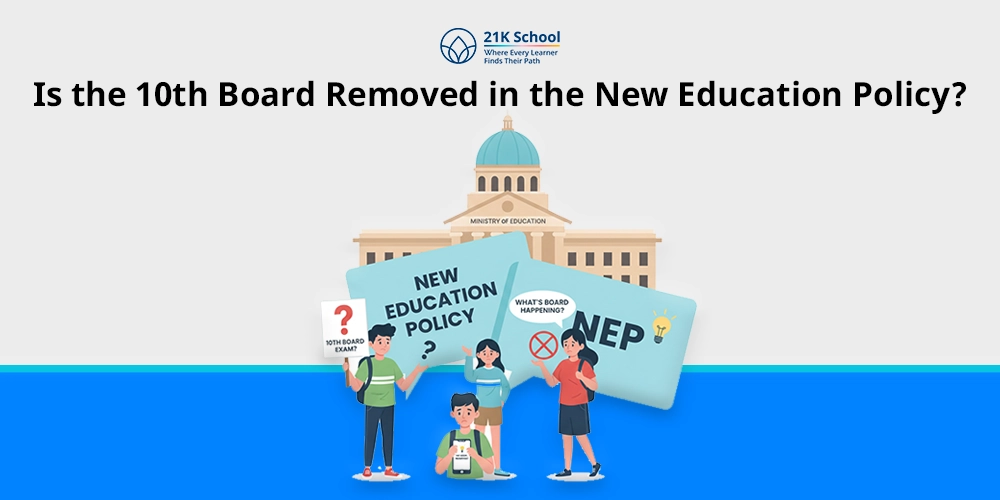
One of the major changes in the Indian education system that occurred in almost thirty years was the introduction of the National Education Policy (NEP) 2020, which offered freedom of choice, learning that was based on skills, and less emphasis on examinations. The biggest question that is being posed with regard to NEP 2020 is whether NEP has eliminated the Class 10 board examination or not.
The answer to this question is no. NEP 2020 has not eliminated the Class 10 board exams, but it attempts to change the format and the content of the exams. The policy enhances conceptual, critical and experiential learning as compared to rote learning and standardised tests.
The board exams will not be eliminated, and they will be adjusted to explore the test and basic knowledge in a more amiable way among the students. The reason behind this transition is to make education wholesome, fun and less pressurising the students, and to make the students capable of confronting challenges in life.
Table of Contents
What is the New Education Policy (NEP) 2020?
One of the notable reforms that was suggested by the Government of India and will change the education system in July 2020 is the New Education Policy ( NEP ) 2020. It is also concerned with the practical, flexible and skill-based learning as compared to the memorisation-based learning.
The policy substitutes the existing 10+2 system with the new system of 5+3+3+4 curricular arrangement and encourages the use of the native language or the local language as the language of instruction until Class 5.
NEP 2020 encourages the use of innovation, criticalism, and technology integration into the learning process. It promotes free access to good education, liberation in the choice of subjects and elimination of rigid streams in the areas of Science, Commerce and Arts.
Is the 10th Board Removed in the New Education Policy (NEP) 2020?
The Class 10 board examination is not being scrapped by NEP 2020. The policy aims at reforming and not abolishing the examination system. NEP 2020 states that board examinations at Class 10 and 12 will remain simplified and more flexible, and practical knowledge as opposed to rote learning.
A dual examination system will also be introduced by the CBSE, and the students will now do two examinations per year, since the 2025-26 academic year. The first compulsory examination will be in February-March 2026, and the second optional examination will be in May 2026.
The outcome of the first exam will be announced in April, whereas the second exam in June. On the whole, NEP 2020 will be devoted to the study that will be more accessible and meaningful and allow students to acquire the actual skills and confidence rather than be afraid of examinations.
Key Changes in Board Examinations Under NEP
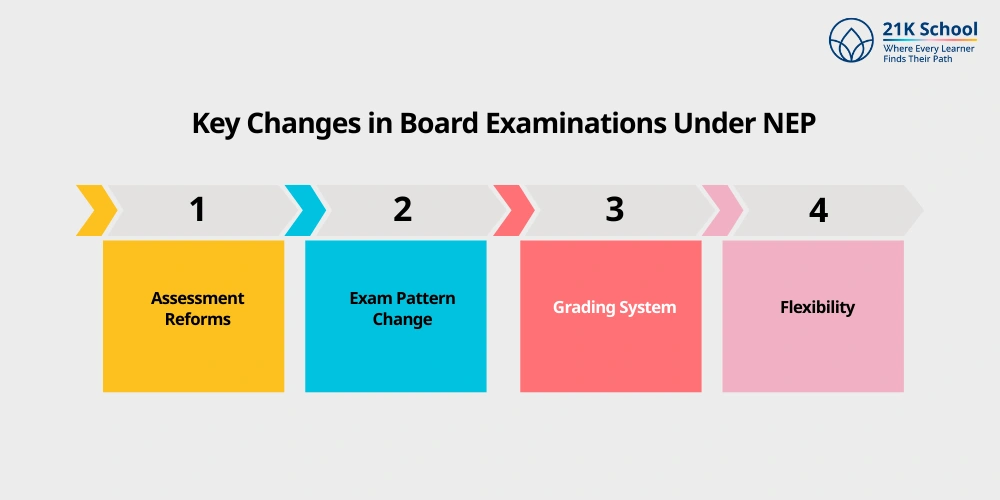
The new education policy has not eliminated the 10th board, although under NEP, many changes have been introduced. Key modifications to board examination included in the National Education Policy (NEP) 2020 are that the exams are to be held twice a year, competency-based education, and not rote learning, broader subject options and varying subject levels. Some of the major changes under NEP as regards to board examination include the following.
1. Assessment Reforms
NEP 2020 is also concerned with the transformation of rote learning to competency. The policy encourages ongoing and extensive evaluation during the academic year, rather than keeping to one end-of-year assessment.
The exams will determine the amount of knowledge on the concepts and skills to implement the knowledge and problem-solving through critical and creative thinking.
Although the examinations by the board will be conducted twice a year, internal assessments will still be conducted only once in an academic year. This change is meant to ensure that learning is more meaningful and the fear and pressure that go hand in hand with board exams are minimised.
2. Exam Pattern Change
Class 10 and Class 12 board examinations will remain the same, though their format will change drastically. Since 2026, students will be examined on the first obligatory exam between mid-February and early March, and an additional optional exam will be in May for those who want to raise their grades.
The question papers will contain a combination of objective questions (MCQs), analysis questions and descriptive questions which will measure comprehension as opposed to memorisation. This new trend guarantees that students are committed to learning concepts as opposed to getting ready to get marks in exams.
3. Grading System
The NEP 2020 recommends the introduction of a grading system with a more holistic and multidimensional report card instead of depending on a standard grading system, which relies on marks as its foundation.
Instead of giving marks or percentages only, the report card will include some information on the academic performance of a student, together with the strengths and competencies, values and activities that the student engages in extracurricular activities.
There will also be self-assessment and peer-assessment components in the report card, and this will enable the students to be aware of their strong and weak areas. This system promotes holistic growth and overall development as opposed to emphasising performance in terms of grades in tests.
4. Flexibility
Academic flexibility is one of the most important reforms in NEP 2020. There will be no more limited streams students have to follow, such as Science, Commerce, or Arts. There are various streams that they can select subjects according to their interests and career objectives. An example is a student may learn Physics as well as Economics or Fine Art.
This is flexibility, which allows students to discover their abilities and get an education which suits their skills and interests. It promotes interdisciplinary education and equips learners with different career opportunities in a highly globalised world.
What is the Dual Board Examination?
A Dual Board Examination suggested by NEP 2020 is one of the most obvious reforms that led to the flexibility, student-centric, and less stressful character of the board examinations. In this system, the students will get a chance to undertake board exams not once a year but also.
CBSE already made demands regarding the application of this system since the subsequent academic year of 2025-26, and the first examinations were to be held in February 2026.
The dual examination system offers two possibilities to students:
Main Examination: This is the first regular board exam, which must be attended by all students in Class 10, and takes place in February-March.
Improvement Examination: This is a second optional examination in May, which is offered to students who want to score better or perform better. Those students who succeed in the first test have a chance to increase their score in the second examination up to three subjects (Science, Mathematics, Social Science and Languages).
Learners who perform better in compartments may also be found in the second exam, in which they can clear their subjects in the Compartment Category.
1. Eligibility and Limitations
However, the examination system has some eligibility which students need to check. The following rules should be comprehended by the students:
- Class 10 students are required to take the first exam (February-March).
- Passing students are able to increase their grades on up to three subjects during the second exam (May).
- Compared to the results, students are allowed to take the second exam to clear their subjects.
- Those students who do not pass three or more subjects in the first exam have to wait until the next academic year.
- Internal assessments are done once and have no possibility of repeat.
- No third opportunity will be given in the same academic year.
2. Important Note
Traditional supplementary examination is being eliminated with the introduction of the dual examination system. The second exam is now an improvement tool for those who passed as well as an opportunity to clear subjects for those who had compartment results.
They should also consider that the price of the examination may increase to cover the extra expense of conducting the exam, but CBSE is attempting to keep the prices as low as possible.
As it should help the student to be more confident and understand their subjects better, NEP 2020 must allow a less stressful, more flexible, and learner-centred assessment process.
Conclusion
Neither is the Class 10 board examination abolished in the New Education Policy (NEP) 2020, but substantially changed to make learning and evaluation more versatile, hands-on, and student-centred learning.
By introducing new practices such as competency-based assessment, new exam trends, holistic marking, and academic flexibility, the policy will help to minimise examination pressure, encourage conceptual knowledge and real-life competencies.
The Dual Board Examination system will appear in the 2025-26 school year, which means that the students will now have an even playing field to do their best without the one-high-stakes test that will put them out of commission.
CBSE and ICSE have declared two sessions of examination starting in 2026. The boards of different states, such as Maharashtra, Tamil Nadu, Karnataka, Jharkhand and Punjab, are in the process of preparing or checking the viability of implementation, with the adoption plans being different, depending on the infrastructure and the readiness.

You may also want to read