

“Learning by doing” can be simply understood as the basic approach that says you can learn the best by actively involving yourself in the process itself.
It re-emphasizes the saying “What we have to learn to do, we learn by doing” of Aristotelian philosophy (particularly from Nicomachean Ethics).
“Learning by doing” is also called “experiential learning”, which is based on real experience and active participation of students.
It might also involve imagination and creativity to solve a problem or reach the desired goal while performing hands-on activities.
This article will introduce you to the basics of learning by doing. It will also let you know how this approach originated in the first place, its benefits, challenges, and examples.
Table of Contents
What is Learning by Doing Method?
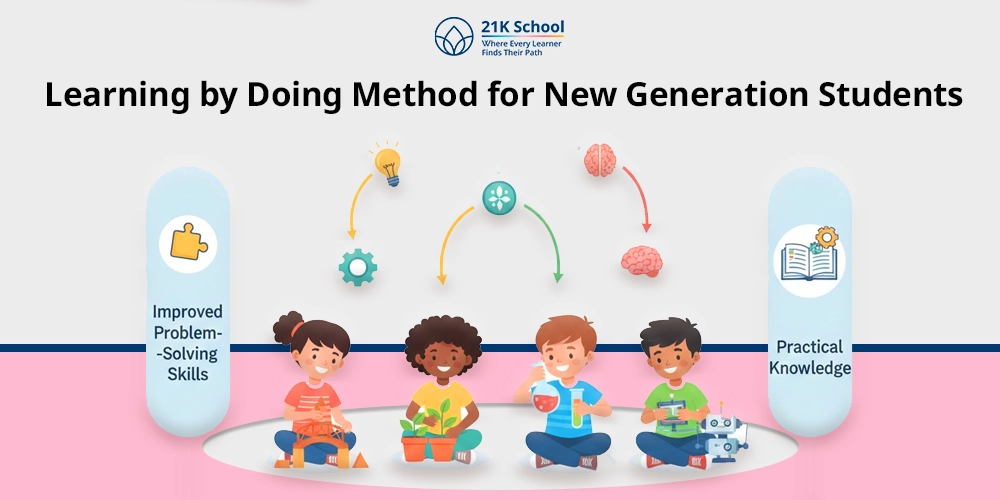
Learning by doing is a method of learning among students who learn through experiences. They perform activities and participate actively to learn better.
These students become equipped with improved problem-solving skills and practical knowledge that stays longer in the minds of learners.
This approach assumes that learning is best created when students participate in the learning process and get real-world exposure.
Under this method, the learner will be treated as an active individual instead of a passive receiver of information.
The teachers act as facilitators or mentors who create learning experiences to stimulate exploration and discovery.
The approach has been popular in project-based learning, laboratory, vocational training, internships, and experiential learning courses.
Philosophical Background of Learning by Doing Method
Learning by doing method is designed around the philosophical foundations called progressivism and pragmatism.
John Dewey, an American philosopher and educational reformer, was the one to argue on this changed approach of learning.
Learning by doing was based on four pillars of knowledge which were experience, hands-on learning, action, and practical results.
The early precursor for these thoughts was Aristotle who said that we learn skills by practicing them.
John Dewey was of the opinion that education must be closely related to real life.
He asserted that children learn best when they are involved in meaningful activities that are relevant for life.
Dewey did not approve of the usual ways of rote learning and passive listening. According to him, education essentially consists of experience coupled with reflection.
The constructivist theory supported by the findings of Jean Piaget and Vigotsky states that learning happens due to the experiences and reflection on them.
Learning by doing only re-established those beliefs and brought them into practice through genuine curiosity among learners.
6 Key Principles of Learning by Doing Method
Learning by doing method is based on the assumptions mentioned below:
1. Learning through Experience
This principle underlines that the actual learning takes place through direct experience. Learners do not just read or listen, but they take action and perform.
Experiences enable learners to relate the new information with real life occurrences, hence making learning significant, practical, sustainable, and meaningful.
2. Problem-Solving Approach
Learning by doing can assist students to face challenges and find their own solutions when in groups or individually. Learners tend to acquire critical thinking, reasoning, and creativity by solving real-life problems.
It is also one of the strategies that help students to become good decision-makers.
3. Integration of Theory and Practice
Learning by doing brings the theoretical concepts into practice through experiential exposure.
Because of this, students tend to retain concepts for a longer period of time and use it in practical situations when needed.
4. Learner-Centered Education
Practical activities involved in learning by doing emphasizes on understanding and catering to the needs and abilities of learners.
Students engage themselves in hands-on activities and learn the concepts that suit their learning styles.
They are encouraged to ask questions and take responsibility for their own learning without depending too much on teachers.
This helps in building the qualities of self-esteem and self-dependence in learners.
5. Reflection and Evaluation
Experience is transformed into learning through reflection on what, how, and why things happened during learning.
Students assess their performance after finishing the activities, analyse their mistakes, and reflect on the learning part.
This assists in the continuous improvement and enhanced knowledge of learners.
6. Active Participation
Students participate actively in learning activities of learning by doing method.
Since the activities involve group projects, discussions, experiments, field trips, and much more, students feel intrigued to be involved in such activities.
This further builds their interactive skills and confidence in what they have learnt.
Features of Learning by Doing Method
The following are the properties of learning by doing method that make it unique:
- Activity-oriented learning
- Student-centered approach
- Experiential and practical learning
- Experiential approach to learning
- Focus on problem-solving
- Development of life skills
- Teacher as a guide
- Experience and reflection on learning
Examples of Learning by Doing
Some realistic examples associated with learning by doing are given below:
- Science experiments
- Project-based learning
- Role play and drama events
- Field trips and educational visits
- Activities in mathematical labs
- Computer-based learning
- Art and craft activities
- Gardening and plants activities
- Group discussions or debates
- Vocational and skill-based training
7 Advantages of Learning by Doing Method
Learning by doing method is beneficial due to its following advantages:
1. Better Understanding and Retention
The experiences and hands-on learning involved in learning by doing method boosts the understanding in learners.
This further improves the retention levels of learnt information without depending much on memorizing facts.
2. Development of Practical Skills
Learning by doing method of education is developed to teach practical skills to learners by providing real experiences and knowledge about subjects.
It offers meaningful learning like problem-solving skills, teamwork, technical knowledge, and communication abilities to students.
3. Increased Motivation and Interest
When students touch and learn through practical exposure, they develop interest to perform and learn much more.
This motivation teaches these students to continue learning while actively participating in all activities and learning new concepts.
4. Encourages Critical Thinking
Learning by doing can motivate learners to think and analyze real-life issues.
It trains learners to build critical thinking skills to find the practical solution for these issues that are important as lifelong learning.
5. Promotes Creativity and Innovation
When learners learn through so many learning by doing activities, they automatically enhance their creative thinking.
They also acquire more innovative ideas while solving real-world issues involved in experiential learning.
6. Builds Confidence and Independence
As students are allowed to solve problems by themselves, learning by doing method boosts the confidence level of students and makes them feel self-sufficient.
These qualities assist learners to stand on their own when faced with difficulties in real life.
7. Enhances Social Skills
Learning by doing also involves group activities through which children learn to build social skills in themselves through mutual interaction and respect.
5 Limitations of Learning by Doing Method
The following points are some of the challenges that might hinder the implementation of learning by doing method in regular classrooms:
1. Time-Consuming
Learning by doing is more time-consuming than the conventional methods of teaching. Planning activities, project conductions, and reflection may take greater time and effort.
2. Resource-Intensive
The learning by doing process typically requires more resources and funding. Shortage of adequate infrastructure could be a hindrance in its implementation.
3. Difficult to Manage Large Classes
It is difficult in large classrooms to manage activities and provide individual attention for each student’s experiential learning.
4. Requires Skilled Teachers
Approaches like learning by doing demands for skilled teachers who can plan and execute multiple activities for learners. They should also be capable enough to assess learners based on their capabilities and assist them in improving themselves.
5. Assessment Challenges
It is a bit challenging to assess students based on their practical skills as these don’t involve pen-paper tests.
Educators and administrators have to come up with novel ways to measure the learning outcomes based on real skills instead of theories.
Concluding Comments
Learning by doing method is a powerful way of learning concepts by actually performing activities and learning practical skills required in life.
Instead of focusing on theoretical knowledge, it emphasizes the development of essential life skills that are required for smooth functioning of life.
It also solves the problem of forgetting chapters and its content after giving exams, as this approach improves retention.
If institutions and educational organizations invest thoughtfully in the implementation of learning by doing method, educational outcomes would improve significantly.

You may also want to read