

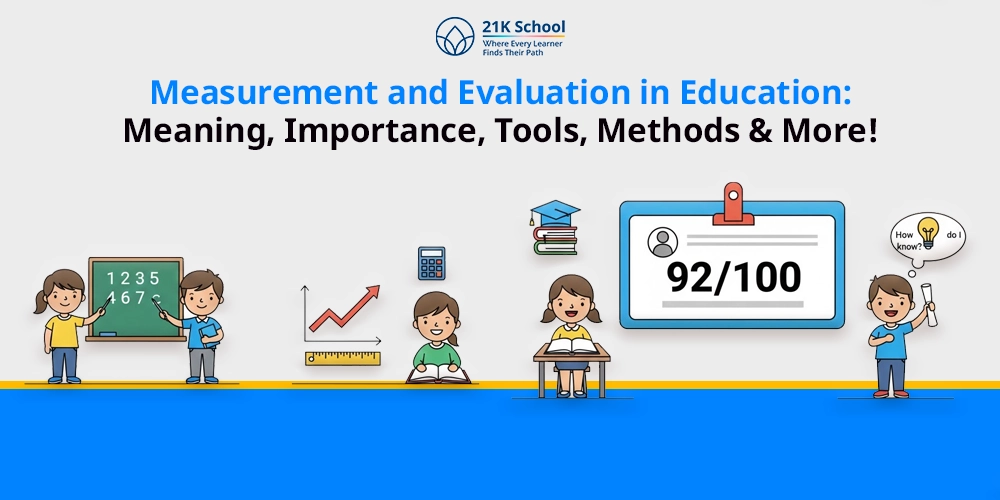
In today’s student-centric education system, each step is measured and evaluated to achieve effective results.
Understanding students’ progress helps teachers and parents create an effective learning environment in future. To fulfill this requirement measurement and evaluation in education is essential.
Measurement ensures collection of data to obtain accurate outcomes for further use. While evaluation is all about understanding the present situation and constructing future strategies.
To understand in-depth, let’s get into a detailed understanding of measurement and evaluation in education starting with their meanings.
Table of Contents
- What is Measurement in Education?
- What is Evaluation in Education?
- Importance of Measurement and Evaluation in Education
- 6 Methods and Tools of Measurement and Evaluation in Education
- 4 Key Role of Teachers in Measurement and Evaluation in Education
- 4 Common Challenges in Measurement and Evaluation
- Measurement vs. Evaluation in Education
- Conclusion
What is Measurement in Education?
Measurement in education simply means calculating students’ performance in numerical terms. In this procedure, the main purpose is to determine “how much a student knows or can do.”
Some common examples to understand measurement effectively are marks of a class test, attendance percentage, number of correct answers etc.
Measurement helps both parents and teachers to understand the educational growth of students.
What is Evaluation in Education?
Evaluation in education is a comparatively broader term in which individuals use measurement data to understand and make a judgement about the present situation to provide effective feedback.
Evaluation is measured in both qualitative and quantitative terms which help in decision making to improve in future.
There are many types of evaluation in education and each has a specific purpose and will be used at different intervals in the teaching-learning process.
Some common examples include providing feedback on test results or guiding effective strategies for improvement.
Importance of Measurement and Evaluation in Education
To understand measurement and evaluation in education, one must consider its importance:
1. Enhancing student learning outcomes
Implementing measurement and evaluation in education enhance students’ learning outcomes by collecting required data on particular students to provide effective feedback for improvement.
In this way, students understand their strengths and weaknesses to work accordingly.
2. Improving teaching effectiveness
One of the reasons why measurement and evaluation in education is important is to improve teaching effectiveness.
Teachers can analyse poor or moderate performance to suggest effective teaching methods to improve results in future.
3. Diagnose Learning Difficulties
Measurement and evaluation are often used in education to diagnose learning difficulties of students.
For example, if a student is weak in reading the English language, the teacher can measure and evaluate the right remedy to support obstacles – free learning.
4. Supports educational planning
By analysing the accurate data through measurement and evaluation teachers and schools can effectively plan curriculum to fulfil student’s needs.
In this way, students are able to learn in a positive environment with appropriate methods and tools.
5. Promotes quality education
Both measurement and evaluation promotes the quality of education by providing the exact requirements of students to achieve academic growth.
It is an ideal way to maintain the academic standard and educational objectives.
6 Methods and Tools of Measurement and Evaluation in Education
To gather data and conduct the evaluation, the following 6 methods and tools can be used education:
Methods
1. Testing
Testing can be done by using written or oral questions. It is the most common technique of measurement.
2. Observation
Observation includes watching student’s behaviour, action, skills, participation etc to provide an effective environment for learning.
3. Interviews
Interviews are one-to-one interactions in which the interviewer tries to understand the mindset, thinking, and attitude of students.
4. Self-Reporting
In self-reporting, students evaluate their own day to day performance to understand the progress. It is an effective method for self-awareness and accountability.
5. Work Products
To collect accurate information for measurement, teachers can collect assignments, projects, presentations, and practical work.
6. Professional Discussion
Professional discussions between teacher and student helps to understand the current situation, thoughts, and reasoning ability.
Tools
- Checklists
By maintaining a checklist teachers can monitor students strengths and weaknesses in particular skill behaviour, learning outcome and active participation.
- Rating Scales
Rating scales are one of the ideal ways to quickly understand the level of performance of students from poor to excellent.
- Questionnaires/Surveys
Teachers can create a questionnaire to fill or take a survey in several intervals to understand students progress.
- Tests (Question Papers)
A well-designed test/question paper which helps to measure overall development including knowledge, comprehension, application, analysis, and evaluation can be beneficial.
- Observation Schedules
Teachers can also pre-plan the observation to analyse day today activities under specific standards.
- Physical Devices
Through physical devices such as stopwatch, measuring instruments, and lab equipment, teachers can evaluate practical skills.
4 Key Role of Teachers in Measurement and Evaluation in Education
Teachers in students’ lives play a key role by analysing, measuring, and evaluating their performance in the best way possible. The primary roles of teachers in measurement and evaluation are:
1. Designing fair assessments
Teachers understand the need of students to improve their academic results. Understanding the requirements help them to design fair assessments in upcoming sessions.
In this way, both teacher and student prepare for future learning objectives, ensuring fairness, and accountability for results.
2. Providing constructive feedback
Designing fair assessments is not only activity teachers perform. They also provide constructive feedback which helps to understand the current scenario.
Through constructive feedback students can understand their strengths, weaknesses, and how to improve with time.
3. Using evaluation results for improvement
Implementing measurement and evaluation in education, teachers get effective results, which directly help students to improve their learning towards academic success and achievements.
4. Supporting inclusive education
Teachers support inclusive education which means regardless of their abilities, disabilities, backgrounds, or needs, learn together in the same classrooms.
The main purpose of the objective is to remove barriers, adapt teaching methods, and provide necessary support for quality education.
4 Common Challenges in Measurement and Evaluation
Measurement and evaluation in education offers various advantages to parents, teachers, and students. But benefits also come with some challenges such as:
1. Overemphasis on marks
Focusing only on numbers like marks, scores, and achievements often neglects students’ creativity, critical thinking, and practical application.
Education should be based on students’ holistic development, so they can learn what they really like.
2. Subjectivity in evaluation
Some common criteria which can impact the evaluation results can be a challenge. For example:
- personal bias
- inconsistent grading
- lack of clear criteria
3. Stress and exam anxiety
High-stakes testing can negatively impact a student’s mental health or fear of failure.
4. Cultural and individual bias
Standardised assessments may not reflect cultural diversity or individual learning styles. This leads to inequitable outcomes/results.
Measurement vs. Evaluation in Education
Check out the below table on measurement vs. evaluation in education for effective implementation:
| No. | Aspects | Measurement in Education | Evaluation in Education |
| 1. | Nature | Quantitative | Both quantitative and qualitative |
| 2. | Purpose | To collect data | To make decisions and work on feedback |
| 3. | Scope | Narrow | Broad |
| 4. | Outcome | Scores, marks, numbers | Grades, feedback, value judgments |
| 5. | Examples | Test scores, percentages, scales. | Deciding if a student passed or teaching techniques are effective. |
Conclusion
In today’s education system, measurement and evaluation are two transformative pillars which have an ability to enhance learning outcomes, teaching quality, and educational opportunities.
Measurement is essential to provide accurate numerical data and evaluation makes it meaningful for students.
Balance in both can make a big difference to improve teaching, learning, and policy making in this changing world of education.

You may also want to read