

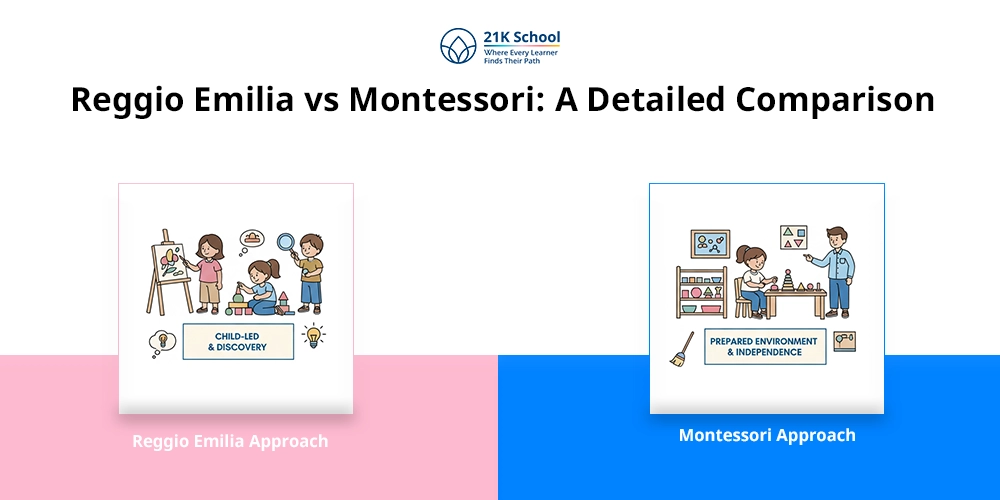
Have you ever wondered what the difference is between the Reggio Emilia and the Montessori approach?
An appropriate approach to early childhood education can produce a huge effect on the learning of a child, and the Reggio Emilia and Montessori education can be regarded as the most successful strategies of early childhood education today.
Even though both of them adhere to the principles of child-centred learning, as well as being both based on the principles of respect towards the individuality of a child, their differences are quite significant in terms of the way they consider the process of learning, imagination, independence and the role of a teacher.
This knowledge can help parents, educators and caregivers to choose an approach that is most effective to meet the needs and learning style of a child.
Table of Contents
What is the Reggio Emilia Approach?
Reggio Emilia is a pedagogy and educational philosophy which concerns primary and preschool education. It is a student constructivist self-managed confrontational curriculum that makes use of self-directed experiential learning within relationship-based circumstances.
The approach was introduced after World War II by creative pedagogist Loris Malaguzzi and the parents of the villages of the locality of Reggio Emilia, Italy. This strategy is referred to as the city strategy.
In this approach, the teachers act as learners and guides as they are very attentive to children and direct projects which are formed as a consequence of questions. The main arguments of this ideology are cooperation, community involvement and a close relationship between the teachers, children and families.
What is the Montessori Approach?
The Montessori approach is a student-centred learning approach of pedagogy, which was formulated by Maria Montessori and which is founded on the concept that the child can learn best through exploration and self-motivated practice.
The Montessori instruction rooms give children the choice of what they would like to do in their prepared environment that is abundant in materials, which help build the aspects of independence, concentration and practicality in their lives.
It also considers the rate of learning of an individual child, hence they are offered a chance to advance in the respective developmental stage.
Difference Between the Reggio Emilia Approach and the Montessori Approach
The notable difference here is that Montessori has created an independent and self-correcting learning resource, whereas Reggio Emilia uses a project-based learning curriculum with the child’s interest as well as a teacher as an active partner. The main differences between the Reggio Emilia Approach and the Montessori Approach are the following.
| Aspect | Reggio Emilia Approach | Montessori Approach |
| Curriculum | There is no fixed curriculum. The interest of children becomes the learning, which is investigated in projects based on long-term, long-lasting research. | Adheres to a progressive, systematic curriculum that uses definite learning materials in practical life, sensory development, math, language and culture. |
| Study Method | Engages in collaborative, exploratory and creative projects which develop according to the ideas of children. | Engages in self-directed, practical tasks in which children are engaged in work with specially designed Montessori materials. |
| Teachers Role | Teachers are co-learners, spectators, and facilitators who are involved in the discoveries of children. | The role of teachers is to be the guide who prepares the environment, initiates materials, and withdraws to allow children to learn by themselves. |
| Assesment | The assessment is made based on constant documentation, photos, journals, displays and observation of the teacher. | Assessment is not conducted through tests, but on an individual basis of the child in terms of their development with materials and their comprehension of concepts. |
| Learning Style | Prioritises innovative expression, communication, cooperation, and inquiry learning. | Emphasises self-study, concentration, organisation and skill mastery by repetition. |
| Grouping | Children are usually given the task to work in small groups, promoting social interaction and teamwork. | Mixed-age (usually 3-year intervals) classes where children are given individual or partner work, ensuring the children learn with one another. |
| Collaboration | There is also high collaboration between children, teachers and parents. Learning revolves around group projects. | Teamwork occurs, but is not given much emphasis. The values of independence and personal choice are given priority. |
| Parental Involvement | Parents are regarded as the key players in the learning process, and they are actively involved in the school activities and documentation. | Parent involvement is not as active but is more supportive as opposed to collaborative. |
1. Curriculum
Reggio Emilia Approach: Reggio Emilia curriculum is entirely child-based based and it revolves around the interests of children; after which it is constructed by a long-term, open-ended project. It is continually evolving as per the revelations and ideas of children.
Montessori Approach: The Montessori curriculum is well-organised, and it is offered linearly. There is learning content, which builds up a growth of abilities over a duration of time, and a child can learn at his/her own pace.
2. Study Method
Reggio Emilia Approach: Reggio Emilia is a project, as well as a discovery of orientation or exploration, whereby the children generate ideas with the help of art, games, conversations and experiments that are hands-on. It is an interactive and innovative mode of learning and does not have a definite destination.
Montessori Approach: Montessori, in its turn, is based on a self-directed learning approach; students have a choice of what they would want to do and learn in an environment prepared and learn using self-assembled, meaningful materials.
3. Teachers Role
Approach Reggio Emilia: Reggio Emilia has a teacher acting as a co-learner, and a teacher may question children and pay close attention to them, which may create an impact on the development of a project. The latter memorise and promote groupthink.
Montessori Approach: Montessori teachers are silent educators in their turn, and they help, prepare the environment, present the materials, and leave children alone to do everything themselves.
4. Learning Style
Reggio Emilia Approach: Reggio Emilia also encourages imaginative, inquiry-based learning, and as such, children learn by being creative, communicating and exploring.
Montessori Approach: Montessori is another practice which supposes institutionalised independent learning where children choose the activities, work independently and learn to concentrate and practise.
5. Grouping
Reggio Emilia Approach: Reggio Emilia also encourages small group work in which children are supposed to work together on common projects and exchange their ideas. This is a team-based environment that provides the development of communication skills, teamwork and problem-solving skills.
Montessori Approach: Montessori classrooms are characterised by mixed ages, typically years old grouping, where children learn individually or in pairs. Older children nurture the younger children, and it leads to a natural learning community through peer-to-peer learning.
6. Parental Involvement
Reggio Emilia Approach: Reggio Emilia is an approach that considers the parents as important collaborators in the learning of children. They are involved in classroom activities, discussions, project creation and structuring and a superb school-community.
Montessori Approach: Montessori, in its turn, puts the stress on parents; being rather facilitative at home, yet not in school, it has to make an effort in the field of cooperative learning.
7. Collaboration
Reggio Emilia Approach: One of the ideas of the Reggio Emilia philosophy is collaboration, and the collaboration between children, teachers and parents takes place. The way of pursuing the projects is collective, whereby communication and the exchange of issues are encouraged.
Montessori Approach: Montessori does not emphasise teamwork but independence. Although the children do get an opportunity to socialise and, in some instances, work together, the learning is, in large part, not just self-directed but personal.
8. Assessment
Reggio Emilia Approach: Reggio Emilia assessment is a continuous and qualitative form of assessment that relies on documentation in the form of photos, videos, teacher notes and exhibits of children’s work. In this way, the learning process is captured with a focus not on measuring results.
Montessori Approach: Montessori assessment is also observational, yet centred on the development of a child with the materials and concept mastery. Teachers monitor the level of tasks performed by a child in a self-sufficient and correct manner.
Conclusion
Reggio Emilia and Montessori approaches provide similar yet very enriching and child-centred experiences in learning, although they are very different in their structure, approach to teaching and classroom setting.
Reggio Emilia encourages creativity, collaboration and exploration in the form of projects, Montessori encourages lifelong learning, order and mastery in the form of self-directed work.
The choice of the approach to be taken ultimately depends on the personality of a child, their modes of learning and the environment in which the child stands the greatest opportunities of performing best. The awareness of such differences will allow the parents and educators to make a more informed and confident decision.

You may also want to read
What is CBSE? Full Form, History, Structure & Key Benefits
- Last updated on: 02 Jan, 2026
- 12 min read