

Have you ever had debates that occur on the topic of the reservation system in education?
What was enacted to be a boon for unserved societies of our nation has become a question of equality in present scenarios.
Reservation simply means that a part of seats or quota is designated to people who have been deprived of adequate resources. Then why are the critics uprising?
In this article, we will diligently look at the reservation in the education system and how it works, the positives, negatives, and everything.
Table of Contents
- What is Reservation in the Education System?
- How Reservation Works in The Education System?
- Reservation Percentage in india
- Historical Background of Reservation in Education
- 5 Objectives of Reservation in Education
- 5 Main Types of Reservation in the Education System
- 5 Advantages of Reservation in the Education System
- 5 Disadvantages of of Reservation in Education
- Impact of Reservation on the Education System
- Concluding Thoughts
What is Reservation in the Education System?
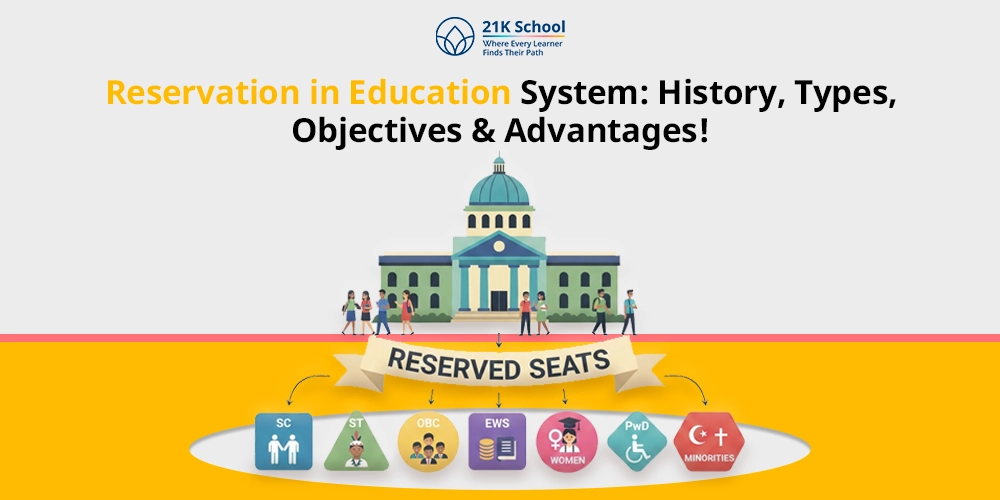
Reservation in the education system is a constitutional and legal policy where seats in the education institutions are allocated to certain socially and economically marginalized groups.
These categories are Scheduled Castes (SC), Scheduled Tribes (ST), Other Backward Classes (OBC), Economically Weaker Sections (EWS), women, persons with disabilities, and the minorities.
Reservation is not designed to erode merit but rather to provide an equal opportunity to people who have been historically deprived of education and other opportunities.
The policy makers of reservation were aware of the fact that social and economic disadvantages might restrict an individual to compete on equal terms.
Consequently, the admission is done on the basis of social justice and affirmative action to make education a source of empowerment.
How Reservation Works in The Education System?
Reservation is used for admissions to government-aided educational institutions and also government jobs on a quota basis.
There is a set percentage of the seats that are allocated to the deserving categories.
Students who make claims of reservation have to provide viable caste, income, or disability certificates.
The competitors of the reserved seats are the reserved category candidates.
Different cut off marks are used to have the most reasonable selection.
Scholarships, hostels, fee concessions, and remedial coaching are also granted to scholarships on a case-to-case basis.
Whereas in public institutions reservation is obligatory, in private institutions it is only an aspect that must be observed in some situations as governed by law.
The policy is enforced on different levels starting at the level of school education and ending at the professional education levels.
Reservation Percentage in india
The reservation percentage distribution in India shows that approximately 60% of seats are reserved for different underprivileged sections of society.
The distribution looks like:
- Scheduled Castes (SC): 15%
- Scheduled Tribes (ST): 7.5%
- Other Backward Classes (OBC): 27%
- Economically disadvantaged Groups (EWS): 10%
- Persons with Disabilities (PwD): 5% (horizontal one category to another reservation)
Historically, the Supreme Court imposed a 50-percent total reservation limit so that there would be equality and merit.
But, with the EWS quota introduced by 103rd Constitutional Amendment (2019), conditions provided an opportunity to exceed this limit.
Historical Background of Reservation in Education
The history of reservation in education goes back to the caste-based system of social organization in India where the lower castes and the tribal population were denied access to an educational system over centuries.
To enhance social dominance and inequality, education was seen as the right of the upper castes.
In the late 19th and early 20th centuries, educators like Jyotirao Phule, Periyar E.V. Ramasamy, and Dr. B.R. Ambedkar, as the social reformers, started to advocate strongly for educational equity.
Some princely states such as Kolhapur and Mysore pioneered early reservation policies.
The framers of the Indian Constitution after the attainment of independence felt the need for affirmative action.
Article 15(4), 15(5), and 46 gave the state authority to advance the interests of backward classes in the field of education.
The Mandal Commission also supported the idea of reservation by suggesting that OBCs be given a reservation of 27 percent that was announced in 1990 and implemented in 1992. It changed the educational landscape of India.
5 Objectives of Reservation in Education
The main objectives of reservation in education system include the following:
- Overcoming Historical Injustice: Reservation aims at the reparation of social discrimination and educational deprivation for centuries among the marginalized groups.
- Social Equality & Educational Justice: It strives to have a fair platform for everyone by offering equal opportunity of education to the unfortunate societal structures.
- Economic Empowerment: Education can help the people to obtain superior jobs and escape the poverty cycle.
- Inclusive Representation: Reservation facilitates implementation of all social groups in education which enhances democratic values and its social cohesion.
- Strengthening Democracy: Reservation in Indian context is aimed at providing equal representation of each section of the society and disproves of social injustices done for centuries.
5 Main Types of Reservation in the Education System
Reservation is subdivided into a few types that can be mentioned as the following:
1. Caste-Based or Community-Based Reservation
This is the reservation of SCs, STs and OBCs according to historical exclusion and social backwardness.
2. Economic-Based Reservation
EWS reservation policies can deal with economic disadvantage of the people who are weaker economically and belong to unreserved categories.
3. Gender-Based Reservation
In order to have gender equality, such as in technical and professional training, some states set quotas for women.
4. Reservation for Persons with Disabilities
This guarantees the right to education to physically, sensorially, or intellectually challenged persons.
5. Minority-Based Reservation
The religious and linguistic minorities are given special provisions in defense of their educational and cultural rights.
5 Advantages of Reservation in the Education System
Besides all the debates and conflicts, reservation has a special position in the Indian education system due to following advantages:
1. Promotes Equal Access to Education
Reservation can assist the marginalized students to join institutions that they could not access before.
2. Reduces Social Inequality
It can reduce inequality in education between the advantaged and the privileged groups.
3. Enhances Diversity
Reservation has the ability to ensure that the academic environment is diverse that facilitates learning and turns to mutual respect.
4. Encourages Social Mobility
Through education, people are able to change their socio-economic status for the better.
5. Corrects Historical Injustices
Reservation acts as a social reparation for the injustices done in the past.
5 Disadvantages of of Reservation in Education
No matter how fascinating and uplifting reservation looks, it still has some drawbacks that lead to the originating debates over time. These include:
1. Debate Over Merit
Opponents believe that merit is debased by reservation. This is because selection and merit is based on unequal access to resources.
2. Perpetuation of Social Divisions
Another concern is that the reservation that is based on caste might strengthen the caste identities in the society.
This would again create biasness and scenarios of unequal opportunities.
3. Creamy Layer Issue
Prosperous members of the reserved groups can abuse benefits.
They believe that there are many learners who are from underprivileged sections but have attained a good position and wealth to access all the resources.
Still, the unreserved sections remain unqualified with lesser resources and high performance expectations.
4. Limited Reach
Reservation wouldn’t be enough to solve the bad school quality and ignorance in unprivileged sections for education.
5. Political Misuse
Electoral advantages at times run on expanding the reservation policies.
It has become only a topic for running election propagandas across the country, without focusing on real development of minorities or ignored sections of society.
Impact of Reservation on the Education System
Reservation has increased admission of marginalized students considerably.
It has diversified campuses and provided first generation learners.
Still, issues like school pressure, social discrimination, and school dropouts continue to exist.
In order to make maximum effects, quality education, financial aid, mentoring, and skill development programs should be backed up by reservation.
Concluding Thoughts
Reservation in education systems came as an imperative action at the times of independence in India.
All the renowned personalities who were aimed at making a constitution which was free of any type of discrimination, presented the idea of reservation.
This ensured that the unprivileged sections of our country could also have the opportunity to uplift and empower through equal access to education.
But as time passed, people saw many benefits and demerits of the reservation system, which provoked critics to debate around it.
These criticisms can be decreased only with general awareness and improvement in the quality of schools.

You may also want to read