

Have you ever wondered which grade level corresponds to each age in the American school system? Determine the structure of the American school system when it comes to the preschool level to the high school.
The American school system is divided into grade levels based on the age of children and, as such, presents a well-organised school system.
It begins with preschool, kindergarten, elementary, middle and high school, and thus each level is characterised by age-related development in academics, socially and emotionally.
It is the awareness of these school ages and grade levels which can help the parents, teachers, and students make their decisions, to establish the learning directions, and also provide a smooth transition of the levels of education.
Table of Contents
What is the American School System?
The School system that is offered in the United States, and one that has been offered to students since an early age or even at a higher school level, is the American School System. It usually begins at pre-school and kindergarten, elementary school, middle school and high school.
The initial level (preschool) is dedicated to the academic, social and emotional growth and includes not only the core classes, such as Math, Science and Language arts, but the extracurricular activities as well.
School Age and Grade Levels by The American School System
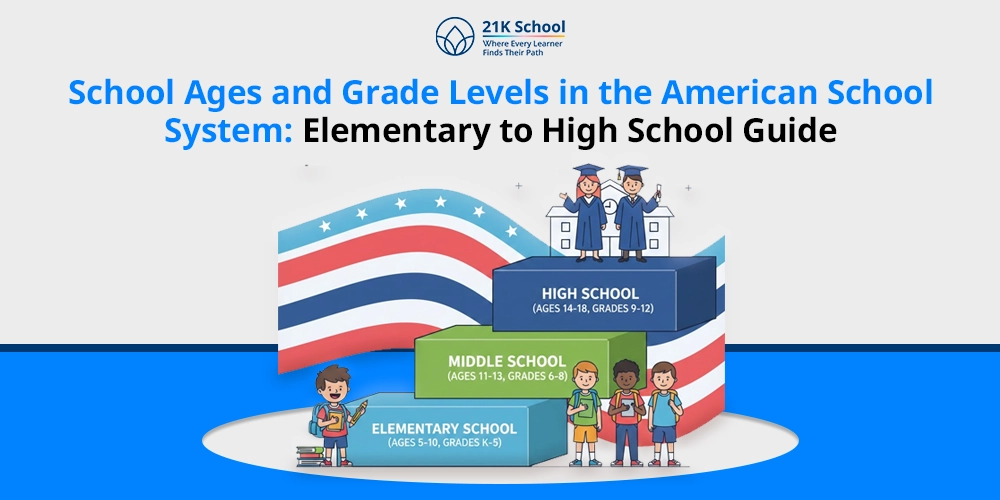
The American school system classifies education according to age, thus creating a level of school which starts with early school up to high school.
Each of the levels, elementary, middle, and high school, has its age-related academic, social and emotional development, which assists the students in acquiring basic skills, gathering knowledge and foresight in further learning and problems of life.
School Age and Grade Levels in Elementary School
In the U.S., Elementary school is normally covered by kindergarten through Grade 5 or 6 and is attended by children between 5-11 years. It is founded upon the elementary abilities in reading, writing, Mathematics, and Science, social growth, imagination and resolving straightforward issues through the classroom tasks and instruction procedure.
The following is a breakdown of the grades and approximate ages of the elementary school:
- Kindergarten: 5 years old
- 1st Grade: 6 years old
- 2nd Grade: 7 years old
- 3rd Grade: 8 years old
- 4th Grade: 9 years old
- 5th Grade: 10 years old
School Age and Grade Levels in Middle School
The middle school is normally between Grade 6- Grade 8, and for children between the ages of 11-14 years. It is an intermediate stage between high school and the elementary level, which is focused on critical thinking, independence, and additional information on the issue.
Variation in the content, group work and extra-curricular activities assists in enhancing the academic, social and emotional development of the learners.
The following is a breakdown of the grades and the approximate age related to Middle school:
- 6th Grade: 11 years old
- 7th Grade: 12 years old
- 8th Grade: 13 years old.
School Age and Grade Levels in High School
High school is between the ages of 14 and 18, with 9th to 12th Grades. It concentrates on college and career readiness, high academic education and personal development.
The students are taking courses concerning specific subjects, they are participating in extracurricular activities and learn such skills as leadership, responsibility and independence in making decisions.
The following table is a breakdown of the grades and approximate ages of High School:
- 9th Grade: 14 years old (Freshman)
- 10th Grade: 15 years old (Sophomore)
- 11th Grade: 16 years old (Junior)
- 12th Grade: 17 to 18 years old (Senior)
How does the American School System Work?
The American system of education is defined by grades and age and provides some sort of tracks to high school. Children of 3-4 years are the ones most likely to attend kindergarten or preschool, then elementary school (Grades K-5/6), middle school (Grades 6-8) and high school (Grades 9-12).
It offers the general courses: Math, Science, Language Arts and Social Studies, Elective and extra-curricular activities.
In the majority of the situations, the following level would be decided based on age and academic results, and assessment by the teacher in order to carry the students to the second level, which would be higher education or workforce.
| School Level | Age | Grade Level |
| Elementary School | 5 years | Kindergarten |
| 6 years | 1st Grade | |
| 7 years | 2nd Grade | |
| 8 years | 3rd Grade | |
| 9 years | 4th Grade | |
| 10 years | 5th Grade | |
| Middle School | 11 years | 6th Grade |
| 12 years | 7th Grade | |
| 13 years | 8th Grade | |
| High School | 14 years | 9th Grade |
| 15 years | 10th Grade | |
| 16 years | 11th Grade | |
| 17-18 years | 12th Grade |
Conclusion
The American school system presents an already determined child development process, beginning with the stage of preschool, then high school, academic, social and emotional development level, which varies according to age.
The fact that students will be part of grades will help in the acquisition of simpler skills, which can be gradually built and the chances of being further graduated to the level of higher education or other professions.
The familiarity with the grade levels and school ages will assist the parents, teachers and students to make their plans, facilitate learning and offer an effective shift to every level of learning.

You may also want to read