

Every child is different, that’s why each one uses a different learning style to fulfil their educational needs.
To learn effectively, some children love to listen carefully as auditory learners, while others read a lot. However there are many effective ways one can choose in their academic journey.
There are some children who learn best by doing things.
Have you ever heard about tactile learning? It is a popular approach used by many kids which engages the individual body and mind together.
To know in-depth let’s go through a detailed guide including meaning, benefits, examples, and activities of tactile learning.
Table of Contents
- What is Tactile Learning?
- Tactile Learning Style in the Classroom
- 5 Characteristics of a Tactile Learner
- 5 Benefits of Tactile Learning in Child Development
- 5 Best Tactile Learning Strategies for Parents and Teachers
- Tactile Learning Examples
- Popular Tactile Learning Activities
- 4 Key Difference Between Tactile and Kinesthetic Learning
- Conclusion
What is Tactile Learning?
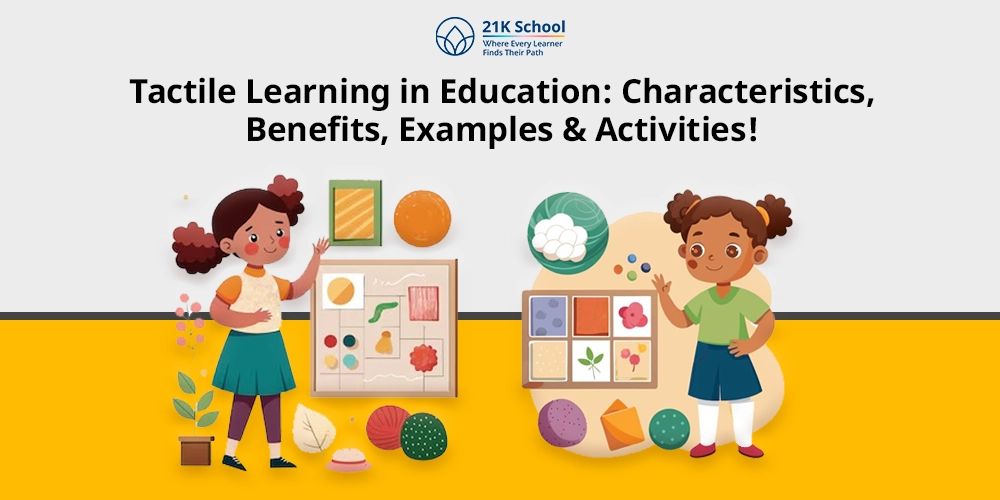
Tactile learning is a powerful approach through which students understand the information through touch, hands-on activities, and physical engagement.
Here, students physically explore everything to learn effectively. This can be done through moving, drawing, or manipulating objects.
Tactile Learning Style in the Classroom
Learners often feel traditional approaches are challenging especially during theory-based lectures in the classroom.
However, teachers can use tactile learning style in the classroom to make learning comfortable. Some commonly used learning style are:
- Experiments
- Manipulatives
- Interactive notebooks
- Field trips
- Art and craft-based learning
5 Characteristics of a Tactile Learner
Understand various characteristics of a tactile learner:
1. Learning Preferences
Some learners instead of fully lecture-based learning prefer hands-on activities, writing, drawing, real-world examples etc.
By touching, feeling, and creating, students can learn faster and better.
2. Multi-Sensory Engagement
Some learners become proficient in various senses such as touch, sight etc., embracing visual learning alongside tactile methods.
This often helps in enhancing the memory retention and learning experience.
3. Personalised Learning
Through personalised learning students can learn in their own way, adopting a student-centred learning approach tochoose desired hands-on learning methods and preferences.
4. Hands-On Experiences
Learners get the opportunity of physical interactions with different materials to learn better.
This increases students’ curiosity to learn with interest.
5. Development of Skills
Tactile learning activities are ideal ways to help students to develop various skills such as fine motor skills, hand-eye coordination, problem-solving and gross motor skills activities.
5 Benefits of Tactile Learning in Child Development
To understand how tactile learning help in child development, discover the 5 key benefits:
1. Enhances Memory Retention
Effective approach for child development because it improves memory power through touch and movement.
In this way, students connect with learning through strong sensory experience which helps them to retain information for a longer term.
2. Builds Motor Skills
Students who learn through touch and physical activity instant of continuous memorisation build fine and gross motor skills.
Various tactile learning activities such as science experiments, creating a model, drawing etc are ideal to enhance motor skills.
3. Improves Conceptual Understanding
Learners sometimes feel traditional learning is challenging to understand. But using physical materials and activity can improve their conceptual understanding.
For example, to learn geometry, use building blocks and to understand volcano eruption, making a model.
4. Encourages Exploration and Creativity
It is often seen that lecture-based learning often reduces student engagement.
However, through tactile learning teachers can introduce hands-on learning activities to promote:
- Build curiosity
- Invent new ideas
- Develop imagination
5. Supports Problem-Solving and Critical Thinking
Introducing tactile learning in the classroom supports effective problem-solving techniques and critical thinking skills by manipulating objects.
For example, students think how to build a stronger tower or complete a puzzle?
5 Best Tactile Learning Strategies for Parents and Teachers
To implement tactile learning parents and teachers can use popular strategies such as:
1. Encouraging Hands-on Activities
By providing needful tools and materials parents and teachers can promote tactile learning in real-life.
Some common examples are:
- Building blocks
- Science kits
- Art supplies
- Flashcards
2. Managing Distractions
As tactile learning is a physical activity, managing distractions is important.
- Allow movement breaks
- Use fidget tools appropriately
- Keep lessons short and interactive
3. Classroom Seating Arrangement
Make sure the classroom seating arrangement for learners is appropriate. For example, environment should be:
- Distraction free
- Close to materials
4. Group Activities
Encouraging different group activities through collaborative learning which helps them to work together with interest. Some common activities like:
- Group experiments
- Model-building competitions
- Role-play activities
- Field projects
5. Multi-Sensory Teaching Approaches
Multi-sensory teaching approaches are effective for all students, not just tactile learners.
Teachers and parents can combine visual, audio, and movement through experiential learning to make learning physical and interesting.
Tactile Learning Examples
Go through various examples of tactile learning in classroom:
1. Example 1: A Student in Science
Students making models, preparing for science experiments etc are some effective ways through which they can learn theoretical content.
2. Example 2: Using Hands-on Methods to Teach Languages
In language class, instead to rote learning, learners can use hands-on methods such as:
- Use flashcards
- Match words to objects
- Act out verbs
- Use clay to form letters
Popular Tactile Learning Activities
Tactile learning works because students can touch, move, and interact with objects in real-life. Some popular tactile learning activities include:
1. Maths Manipulatives
Learners often feel maths difficult but not now because through manipulatives and conceptual learning one can easily understand abstract concepts through touch.
Some simply example includes:
- Number rods
- Counting beads or abacuses
- Base-ten blocks
- Dice and counters
2. Science Experiments
Learning theory through lectures or memorising sometimes becomes challenging. But, hands-on experiments help students to understand by touching, observation, and participation.
Activity ideas:
- Growing plants
- Mixing vinegar and baking soda
- Creating simple circuits
3. Household Tasks
Day-to-day activities and household tasks can become tactile learning activities such as:
- Setting the table
- Watering plants
- Organising cupboards
4. Playdough, Blocks, Puzzles
Different tools and materials encourage students to think innovative ideas, boosting their creative activities. Playdough, blocks, puzzles activities boost creativity and engage students in learning.
5. Field Trips
Field trips, also known as educational tours, are all about connecting learning with real-life scenarios. Some popular field trips schools prefer are:
- Museums
- Farms
- Science centers
6. Tactile Activities for Autism
- Messy play:
Messy play is an ideal tactile activity for some students with autism supporting special education needs by activates the senses and helps in expressing themselves.
Examples:
- Finger painting
- Slime or foam play
- Kinetic sand
- Music and movement:
Music and movement activities like dancing to rhythms, playing drums or shakers also help some autistic children reduce anxiety and improve motor coordination.
- Outdoor Exploration:
Outdoor exploration such as visiting in the park, walking on grass, nature scavenger hunts etc often encourages independence and curiosity in autistic students.
4 Key Difference Between Tactile and Kinesthetic Learning
Explore the key difference between tactile and kinesthetic learning:
| S.No. | Perticular | Tactile Learning | Kinesthetic Learning |
| 1. | Primary sense | The primary sense of tactile learning is touch. | The primary sense of kinesthetic learning is whole-body movement and physical activity. |
| 2. | Type of movement | Types of movement are small, fine motor movements. | Types of movement are large, whole-body movements. |
| 3. | Characteristics | IIt includes hands-on approach, multi-sensory and trial-and-error learning. | On the other hand, characteristics of kinesthetic learning includes movement-oriented, good at practical skills etc. |
| 4. | Examples | Some common examples are using clay, flashcards, tracing letters etc. | Some common examples are role-playing, field trips, dancing etc. |
Conclusion
Using effective learning approaches ensures growth in education and lifelong learning. Parents and teachers often look for effective ways like tactile learning.
By understanding the benefits, examples, and effective strategies teachers and parents can plan tactile learning activities at school and home.
Achieve quality education to understand the true benefits of education and make the academic journey meaningful.

You may also want to read