

Do you have the technical skills that can make your classroom knowledge a success in the real world?
In the current world, technical skills are required by students who will be introduced to a competitive and technology-intensive world. These skills are practical knowledge and skills required to perform some tasks with regard to tools, software or techniques in a field of a study.
Beginning with simple computer literacy, transitioning to higher levels of digital literacy in terms of coding and data analysis, technical skills can help students improve academic success, become more marketable and satisfy the requirements of the modern work environment.
Learning some of the important examples of technical skills will enable the student to gain confidence and strategise their successful career paths.
Table of Contents
What are Technical Skills?
Technical skills are practical skills and expertise used to undertake tasks successfully. They are usually related to tools, technologies, software or processes that are used in a single field.
These are computer skills, data analysis, graphic design, machine operation and the use of lab equipment. These are the skills that are learned during the educational process, through training and experience.
Technical skills help an individual to solve problems, increase productivity, and meet academic and workplace demands; therefore, they play a pivotal role in ensuring that people become career-oriented in the present technological world.
They also favour innovation, flexibility and long-term career development in any industry.
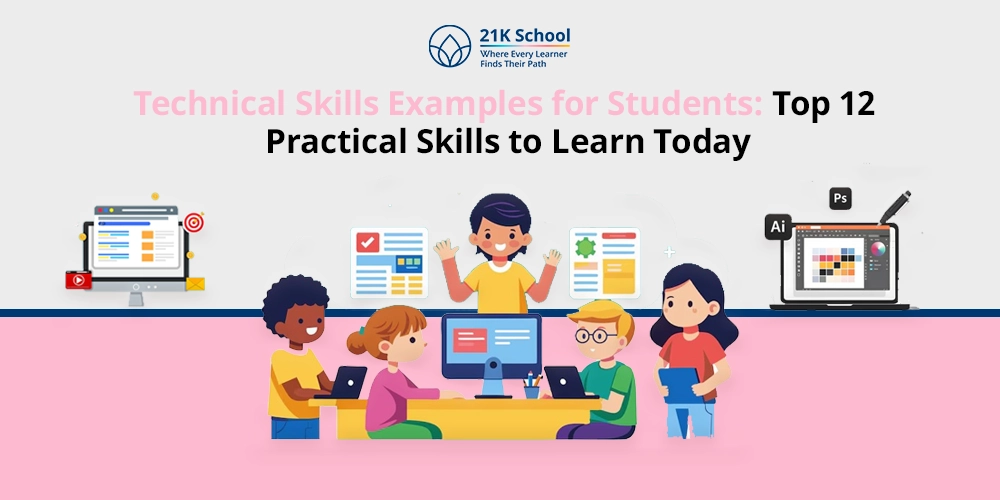
Examples of the Top 12 Technical Skills of Students
Technical skills refer to practical skills that help students to complete task using technology, software or tools. Learning such skills improves educational success, job and career success in the future. Here are the best 12 technical examples for the students.
1. Programming
Programming is the art of writing code that computers follow to accomplish something. Students utilise programming languages like Python, Java or C++ to create software applications and websites.
Programming improves logical reasoning, inventiveness as well as problem-solving. It also opens the possibility of fields such as software development, artificial intelligence, and game design.
2. Digital Design
Digital design is a visual art form that requires the use of software such as Adobe Photoshop, Illustrator or Canva. The students use this skill to develop graphics, logos, presentations, and user interfaces.
Digital design improves creativity and image communication. The field of application is in graphic design, advertising, web development and multimedia production.
3. Marketing Strategy
Marketing strategy refers to the skill of planning and promoting products or services. Students are taught to study audiences, set goals, and identify appropriate marketing channels.
This competence entails branding knowledge, consumer behaviour and competitive analysis. Marketing strategy can help students succeed in business, entrepreneurship and communication-based careers.
4. Copywriting
Copywriting is a field of art concerned with writing persuasive and appealing content to drive ideas, products or services. Students use the ads, websites, e-mail, and social media posts in copywriting.
It focuses on clarity, imagination and appeal to the audience. Communication can be improved through good copywriting, and it is also applied in marketing, media and content development.
5. Digital Marketing
Digital marketing is the marketing of a product or service through the use of online learning platforms, including websites, search engines and email. Such skills as SEO, Internet advertising, and analytics are gained by students.
Digital marketing can help businesses to reach out to larger masses. This competences is required in a profession in marketing, e-commerce and online brand management.
6. Social Media
Social media skills involve developing, handling and interpreting information on websites like Instagram, Facebook and LinkedIn. The students are equipped with the information to communicate with the audiences, be online, and learn trends.
The skills are useful in the sphere of personal branding, marketing and communication in the digital-first world as well.
7. Accounting
Accounting involves recording, evaluating, and controlling financial data is referred to as accounting. Students get to know how to create budgets, keep financial records, and the knowledge of financial statements.
The skills in accounting facilitate sound financial decisions. They are required in the fields of finance, business management, entrepreneurship and organisational administration.
8. Data Analysis
Data analysis is a process of gathering, sorting, and interpreting data so as to make informed decisions. Excel, Python or statistical software are some of the tools used by students to find patterns and trends.
The skill enhances critical thinking and problem-solving. The use of data in analysis can be useful in research, business, technology and economics.
9. Media Literacy
Media literacy refers to the ability to gain access, evaluate and interpret information contained in multiple media outlets. Students are taught how to recognise credible information, prejudice, as well as how to interpret messages.
This skill makes them informed digital citizens. Academic research, responsible use and communication of digital media all require media literacy.
10. Cybersecurity
Cybersecurity involves protecting computer systems, networks and data against digital threats. The students get familiar with online protection, data security and basic security protocols.
This competence gains more significance with the increasing cyber threats. Students with cybersecurity skills are ready to work in the IT, network security, and information protection fields.
11. Digital Communication Skills
Digital communication skills refer to the ability to communicate effectively through digital platforms (email, video conferencing, and collaboration software). Students also get to know professional online communication, clarity and proper etiquette.
These skills contribute to teamwork, distance learning, and workplace communication, which is why they are critical in the achievement of success in contemporary scholarly and professional settings.
12. Information Technology (IT)
Information Technology is defined as the use and management of computer systems, software and networks. Students acquire the skills to troubleshoot, maintain systems and basic networking skills.
Digital operations of organisations rely on IT skills. They are important in tech-based careers, support and systems management in any industry.
Ending Note
Technical skills play an important role in deciding the future career and school performance of students. These skills enable the students to possess practical knowledge and experience in the technologically-oriented world, be it in programming and data analysis or digital communication and cybersecurity.
The technical ability can also be employed in building problem-solving competency, employability, and self-confidence in tackling the real world challenges.
Through the acquisition and practical use of these skills at an early age, students are able to adjust to the evolving needs of the industry, are able to explore multiple career choices, and are well prepared to achieve professional growth and success in the long term.

You may also want to read