

What really makes us want to develop, become better, and be the best of what we can be?
The motivation of self-improvement and personal development is aimed at developing, changing, and living a more meaningful life. They are driven by self-awareness, motivation, learning experience and readiness to embrace change.
In the ever-changing world, people are willing to improve their skills, attitude, and emotional state to attain personal objectives and professional achievement.
Knowledge of what drives self-improvement can keep individuals motivated, challenge tough circumstances and keep transforming to become a better person.
Table of Contents
What is Self-Improvement and Personal Development?
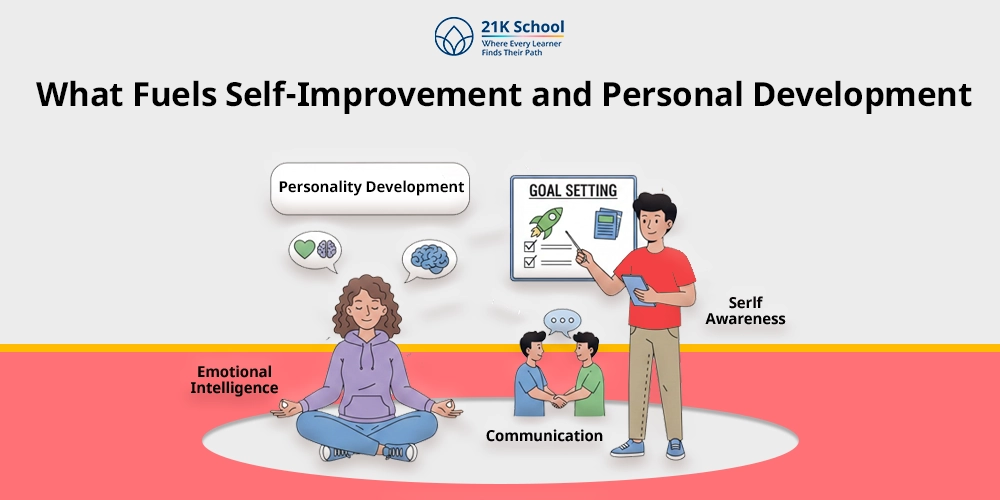
Self-improvement and personal development are the ongoing journey of enriching oneself in terms of abilities, attitude, behaviour and overall well-being. It is a process of self-awareness, goal setting, learning and personal development in terms of emotional intelligence, communication, productivity, as well as confidence.
With the help of conscious actions, people strive to better their lives, attain personal and professional ambitions, and get more competent, more resilient, and more satisfied in their daily activities.
What Fuels Self-Improvement and Personal Development: Top 12 Factors
Self-growth and inner development are motivated by diverse internal dispositions and external practices that influence development. The identification of these driving forces allows the development of meaningful and long-term self-development. The 12 best strategies may be checked below.
1. Intrinsic Motivation
Intrinsic motivation is the internal urge to become a better person, to be satisfied, as opposed to being rewarded. It drives personal development as it promotes curiosity, enthusiasm, and true zeal about self-development.
In the case of an intrinsically motivated person, he or she is committed, disciplined and eager to learn, which makes developing personally more sustainable and fulfilling in the long run.
2. Growth Mindset
Growth mindset is a perception that through effort and learning, one can acquire abilities, intelligence and skills. It facilitates individual development as it helps individuals deal with challenges and be ready to get feedback and not quit.
This philosophy encourages continuous improvement, dynamic education and perseverance that can make one see failures as learning opportunities and not as a limitation.
3. Goal Setting
Goal setting gives clarity, direction and purpose of self-improvement. It is obvious that clearly set objectives can assist people in setting their priorities, monitoring their progress, and being motivated.
Having specific short-term and long-term goals allows one to be disciplined and accountable and grow steadily. Goals serve as a guide, making what one wants to achieve come into reality in a measured and practical way.
4. Self-Awareness
Self-awareness means having the capability to understand their feelings, ideas, strengths, weaknesses, as well as behaviours. It improves personal development because it helps in the establishment of areas that require improvement, and also helps people in making good decisions.
Self-awareness helps them to manage their emotions better, have positive relationships and help them do what they believe in and strive to achieve.
5. Resilience
Resilience is identified as the ability to undergo difficulties, disappointments, and collapse without giving up. It stimulates self-development because it causes individuals to overcome the obstacles that come along the way, hence enabling them to move forward.
Resilient individuals learn from bad moments, open up to change and remain positive; hence, resilience is the main aspect of obtaining long-term personal and career growth.
6. Understanding Yourself
Self-knowledge involves the awareness of your values, interests, beliefs and strengths and weaknesses. It is this self-knowledge that will take you to a greater level since it ensures that you make decisions that will look back at who you are.
It creates confidence, clarity, and purpose, whereby people can invest in meaningful and realistic goals as well as meaningful and fulfilling goals rather than forced goals.
7. Learning from Mistakes
One of the main factors of self-improvement is to learn through errors. Errors are good sources of feedback and help in understanding what should be developed.
When people reflect on mistakes instead of being afraid to do so, they become problem solvers, strong, and wise. Such an attitude turns failures into choices for the future and long-term success.
8. Improving Emotional Intelligence
Emotional intelligence entails the ability to identify, comprehend and control emotions both in oneself and in other people. Emotional intelligence enhances personal growth by improving communication skills, feelings for one another and self-control.
It assists in coping with student stress, solving conflicts successfully, and establishing stronger relationships, which is a part of emotional well-being and personal development.
9. Increasing Accountability
Accountability refers to being responsible towards oneself and his or her actions, choices and results. It drives self-enhancement through the agencies of discipline, consistency and honesty.
Once people are accountable for themselves, they will have more chances to stick to their objectives, assess progress in a realistic manner and make the required alterations to keep them committed to personal development.
10. Strengthening Good Relationships
Good relations are important in the development of individuals as they make them supported, encouraged and receive constructive feedback. Good relations lead to development, increase confidence, and enhance emotional health.
One should always be surrounded by supportive and encouraging individuals to be accountable, to learn, and to have good habits in mind, which is key to self-improvement.
11. Following a Structured Routine
A routine is a systematic approach to bringing about order and balance to life. It stimulates self-enhancement by promoting productive practices, efficient time management, and fewer distractions.
Habits allow personal development practices to be sustained more easily and allow one to remain focused, disciplined, and dedicated to long-term development goals.
12. Respecting Others
Treating others with respect helps one to grow personally through empathy, understanding, and positive socialisation. It promotes tolerance and acceptance of different views.
Respecting people helps in strengthening relationships, creating trust, and developing emotional intelligence, which enables people to develop socially and emotionally and positively contribute to their surroundings.
Ending Note
Self-growth and self-development are lifelong learning processes that are influenced by attitude, behaviours and deliberate actions. Intrinsic motivation, self-awareness, resilience, and emotional intelligence are some of the factors which enable people to develop continuously as well as adjust to change.
With the establishment of clear objectives, experience-based learning, effective relationship management, and discipline, people are able to discover their potential capacity.
After all, knowing what drives individual development will help individuals to live more balanced, meaningful, and rewarding lives and to obtain both personal and work satisfaction.

You may also want to read