

One of the most popular education boards in India includes CISCE board too. But do most of you know what the CISCE board is?
When it was established, how it functions and what testing methods it uses, everything needs to be clear for someone thinking to choose this board of education.
This paper entails all about the CISCE board, its origin, curriculum, and advanced methods of holistic evaluations used in it.
Table of Contents
What is the CISCE Board?
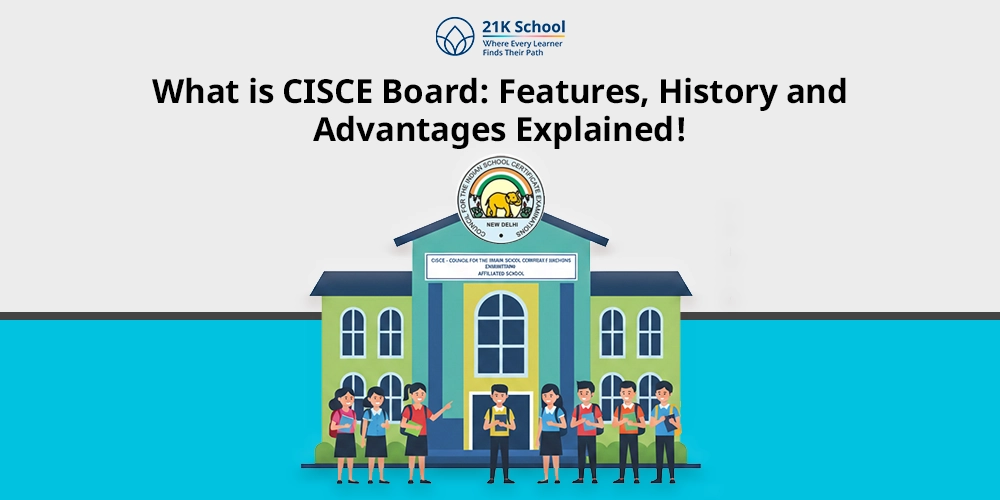
The CISCE (Council of the Indian School Certificate Examinations) is a privately organized board in India.
It is a premier national-level educational board that administers two major examinations:
- Indian Certificate of Secondary Education(ICSE) for Class 10, and
- Indian School Certificate(ISC) of Class 12
Its characteristic features include its well-designed curriculum, high-quality education, and attention to English language competence.
CISCE promotes conceptual education as opposed to memorization.
It is thus popular amongst those students seeking to pursue higher education in humanities, science, commerce, and other creative disciplines.
Presently, 2,600 schools are affiliated with CISCE in India. It also has its reach in International countries.
Key Features of CISCE board
The key characteristics of the CISCE board include:
- A private national board approved by the Government of India.
- Administers ICSE(class 10) and ISC (class 12) exams.
- The only compulsory language is English.
- The syllabus is elaborated and organized to attain conceptual clarity.
- Curriculum balance that gives equal importance to languages, sciences, humanities, and arts.
- Broad global approval for tertiary education.
- Pays attention to practice, skills, projects, and internal evaluation.
History and Background of CISCE board
The University of Cambridge Local Examinations Syndicate, along with the Inter-State Board for Anglo-Indian Education, founded CISCE in 1958 to offer standardized instruction and assessment in India.
With time it became an autonomous national board that designs its curriculum, administers exams, and also ensures the education quality in affiliated schools.
The overall intention of CISCE has always been to have thorough, balanced, and child-centered education.
As opposed to other boards that focus on theoretical studies, CISCE facilitates all-round knowledge application and analytical skills in learners.
CISCE today is known worldwide and in India has successfully been of high academic standards.
It also provides a strong curriculum and prepares students for future studies in any part of the world.
CISCE Board Examinations: ICSE and ISC
As mentioned above, CISCE takes exams on two different levels named as ICSE and ISC.
1. ICSE (Class 10)
At the end of Class 10, there is an examination called the ICSE examination. Considered to be a comprehensive curriculum, ICSE emphasizes on:
- Good skills in English language
- Competent skills in science, mathematics, humanities, and arts
- Project-based and internal evaluation
- Application-based questions
The subjects usually involve English, second language, mathematics, science (physics, chemistry, biology), history, civics, geography, computer applications, and so on.
2. ISC (Class 12)
Class 12 students give the ISC examination. There are three major streams available to the students including science, commerce, and humanities/arts, and choosing the right stream requires an understanding of the curriculum development process.
ISC curriculum provides freedom of subject choice, project-related assignments, practical tests, and questions in an essay format that enables critical and analytical thinking.
Similar to ICSE, English is still obligatory.
Curriculum and Teaching Approach in CISCE Board
The CISCE board generally has an advanced curriculum that supports overall-development of learners. These include:
1. Emphasis on English Proficiency
CISCE puts emphasis on English reading, writing, and comprehension.
The first and most widely used language is English and the language papers provided by the board are quite tough.
This forms a solid base, which helps students in acquisition of communication skills, higher education, and international applications.
2. Balanced Curriculum Across Subjects
CISCE is a well-rounded curriculum that does not just focus much on science and mathematics unlike boards.
It also encourages students to study humanities, languages, and creative arts subjects with a focus on their overall motivation in education.
This balance enables students to learn various subjects before specialization and decide their proficiency better.
3. Practical and Project-Based Learning
CISCE requires internal examinations and project work in various subjects such as science, maths, social sciences, and commerce.
Practice-based learning promotes research skills, hands-on learning, real-world application, and better conceptual knowledge, which is a key benefit of project-based learning.
4. Focus on Holistic Development
The board favors the holistic development of students by encouraging creative thinking.
The involvement in extracurricular activities and arts builds ethical and moral growth of your children, thus fostering their communication skills and leadership ability.
7 Top Advantages of CISCE Board
CISCE board has multiple qualities that can be called positive in terms of its curriculum, learning approach, english proficiency, etc.
1. Comprehensive and Detailed Syllabus
CISCE syllabus has a reputation of being conceptually apt and well-structured.
Students have a grasp on subjects and in-depth knowledge, which would help them in their studies later.
2. Strong English Foundation
With English as the official language of instruction, learning becomes very proficient.
As this is the language which will boost their communicative and global competitiveness.
3. Balanced Learning Approach
CISCE integrates both theoretical and practical studies, which provides a balance of both academic indulgence and creativity.
4. Excellent for Creative Fields
Much emphasis is placed on creative activities such as art, drama, design, writing skills, and humanities.
A large number of students studying ICSE and ISC, major in the areas of media, literature, psychology, and design.
5. Continuous Evaluation
Internal assessment has great weightage as it enables students to have less pressure of exams.
It additionally enhances the level of accountability in research-based learning through continuous evaluations.
6. International Recognition
The ISC and ICSE certificates are accepted in most foreign institutions like in the UK, USA, Australia, and Singapore.
A lot of organisations believe CISCE is in accordance with globally recognized boards like the IB curriculum.
7. Encourages Higher-Order Thinking
The CISCE board is application-based requiring analytical skills and higher-order thinking of learners.
The exam papers are also a bit more tough than other boards that can boost their advanced level of IQ. Students can learn how to avoid silly mistakes in exams to score better.
4 Common Challenges of the CISCE Board
The most common challenges in the CISCE board can be the following:
1. Heavy Syllabus Load
The syllabus of CISCE board is quite extensive and detailed, requiring effective study planning from the students’ side.
All other educational boards in India are way easier than this one.
2. Higher Expectations in English
Language requirements can be a barrier to students who have switched from non-English backgrounds or state boards.
3. Limited Availability of Schools
CISCE schools are fewer as compared to CBSE or state boards. Also understanding the key differences between ICSE, CBSE, and state boards can help parents make an informed choice.
These are predominantly located in urban areas only, thus restricting their access.
4. May Not Fully Align with Certain Competitive Exams
Examinations like NEET or JEE mostly focus on NCERT-based content which does not always match the CISCE curriculum.
But, even without advanced conceptualization, CISCE students may have a lead as soon as they start preparing for the board exams.
Key Takeaways
CISCE board and its curriculum is a private one in India.
It is recognised by national as well as international universities to support higher education of learners.
With the focus on English language proficiency and reading comprehension, CISCE board makes sure to provide an all-round developmental base for them.
The question papers and syllabus is tough, though it prepares students for real life challenges as well.

You may also want to read