
Coding: Turn Ideas into Working Systems
Age-banded programmes develop computational thinking through projects that become more complex and independent over time.
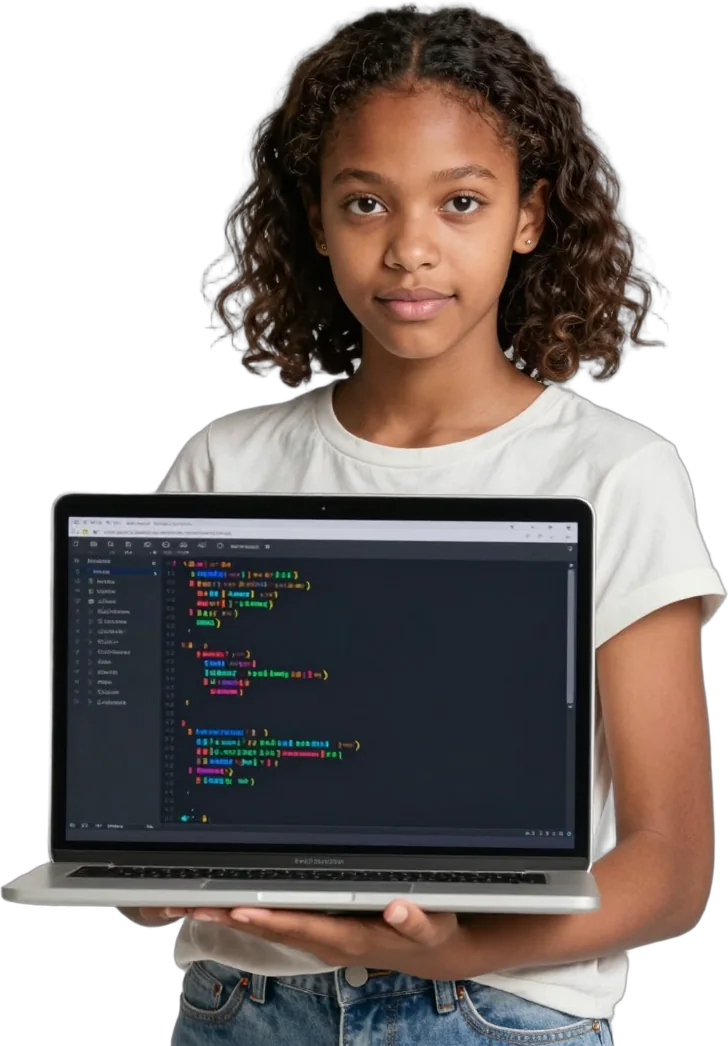



A progressive Grades 3–12 pathway
Coding is organised for elementary, middle and senior learners.
Grades 3–5 begin with visual logic, sequencing, events, coordinates, animation and games before an age-appropriate transition towards text-based programming and simple web creation. Grades 6–8 can deepen Python, data structures, interfaces, web applications and game development. Grades 9–12 may progress into advanced programming, data, systems, security, software architecture and deployment concepts.
The three-month FLOWW levels curate suitable outcomes from the wider 21K Coding curriculum. They do not promise completion of the entire 1,350-session framework.
Three levels
Level 1: Build logic
Learners understand how instructions create predictable outcomes.
Projects may use visual blocks, animation, game mechanics or introductory Python according to grade band. Learners practise sequencing, events, variables, conditions, loops and debugging.
Level 2: Build applications
Learners work with more structured programs and connected components.
Projects may involve Python, files and data, interfaces, web foundations, object-oriented thinking or software libraries. The exact environment depends on grade band and prerequisite skill.
Level 3: Build independently
Learners plan, construct, test and explain a more substantial system.
Projects may include games, responsive websites, API-based applications, data tools or advanced software concepts for senior learners. Deployment and public sharing occur only through approved platforms and privacy controls.
How learners work
Coding develops through making, testing and debugging.
Facilitators model a concept, guide practice and ask learners to explain choices. Errors become evidence about what the code is doing. Projects should reflect learner understanding rather than copied solutions or undisclosed AI-generated code.
Devices and accounts
A compatible laptop and stable internet are required.
The programme will confirm browser, software, account and specification requirements before enrolment. Any paid software requirement must be disclosed in advance.
Programme structure and fee
Coding serves Grades 3–12.
Each level runs for three months through 24 live sessions of 40 minutes. The fee is ₹9,000 plus GST for Grades 3–6, ₹11,000 plus GST for Grades 7–8 and ₹12,000 plus GST for Grades 9–12.
Free coding & AI taster for eligible 21K School learners
A one-month introduction is planned for selected new-school cohorts.
- 8Free Coding & AI Sessions
- 1 monthIntroduction
- Grades 3–12Eligible Learners
Eligible Grade 3–12 learners enrolling in the April or June 2027 21K School cohorts are planned to receive eight free Coding & AI sessions. The taster is separate from the paid Coding and Artificial Intelligence Capstones.
Questions parents ask
What families need before choosing Coding.
Does my child need previous coding experience?
Not for a suitable Level 1 cohort. Higher levels require demonstrated readiness.
Is this the Learning Garage Coding programme?
No. This is a fully online FLOWW Capstone with its own three-month structure.
Will learners use AI to write code?
AI assistance may be discussed in suitable cohorts, but work must follow the programme’s originality and responsible-use policy.
Will projects be published online?
Only where the project, platform, safeguarding requirements and permissions make publication appropriate.
Is a laptop required?
Yes. Exact specifications and software requirements depend on the grade band and level.