
Mathematics Mastery: Understand the Thinking Behind the Method
Learners begin at an appropriate skill level and build connected mathematical understanding through practice, reasoning and application.




What mathematics Mastery develops
Mathematics is a progression of ideas, not a list of isolated procedures.
The pathway may include number and operations, fractions, decimals and percentages, measurement, geometry, patterns and algebraic thinking, data handling, problem-solving and mathematical reasoning. Learners work towards understanding why a method works, when to use it and how to explain their thinking.
A diagnostic-led starting point
Every learner completes a diagnostic after registration and before placement.
The diagnostic identifies current strengths, prerequisite gaps and readiness for greater challenge. A learner may calculate accurately but struggle to interpret a problem, or understand a concept but need greater fluency. Placement responds to this profile instead of assuming that every skill sits at the learner’s school grade.
How learning works
Live sessions make mathematical thinking visible.
Learners may use worked examples, discussion, visual representations, practice, reasoning tasks and real-world applications. Facilitators ask learners to explain choices, compare approaches and reflect on errors. AI-assisted personalised practice and adaptive progression help focus practice on the next relevant skill.
The programme balances conceptual understanding, fluency, reasoning and application. It does not promise faster grade completion or examination results.
Curriculum by age band
The curriculum revisits important ideas through a spiral pathway, increasing the complexity of reasoning, application and explanation over time.
Elementary
Ages 6–8Learners strengthen number sense, place value, operations, shapes, patterns and measurement. They apply ideas through time, money, schedules, sharing, simple coordinates and practical construction or design tasks. The aim is to move from concrete understanding towards accurate calculation and clear explanation.
Intermediate
Ages 9–11Learners extend factors and multiples, fractions, geometry, area and volume, data, probability, sequences and logical reasoning. Tasks may introduce flowcharts, Boolean logic, optimisation, cryptography or route planning to show how mathematical thinking operates in real systems. A real-world investigation brings several strands together.
Advanced
Ages 12–13Learners develop algebraic reasoning, linear and visual quadratic relationships, ratios, rates, data analysis and multi-step measurement. Financial applications can include profit and loss, simple and compound interest, discounts and tax. Modelling tasks may connect mathematics with travel, business, engineering or scale design.
Explorer, Navigator and Pioneer tiers adjust the support, complexity and independence expected within each age band. A learner may be at different points across number, geometry, data or reasoning, so progression follows demonstrated understanding rather than one overall grade label.
Progression
Learners progress when they can apply a skill with sufficient understanding and independence.
Evidence may include practice performance, reasoning explanations, problem-solving tasks, formative assessments, reflection and facilitator observations. A learner can spend longer consolidating one strand while moving more quickly in another.
Who it can support
Mathematics Mastery is designed for ages 6–13 with different starting points.
It can support a learner rebuilding an important foundation, seeking deeper understanding or ready for work beyond the present school level. Difficulty is not treated as a fixed label; it identifies where learning should begin.
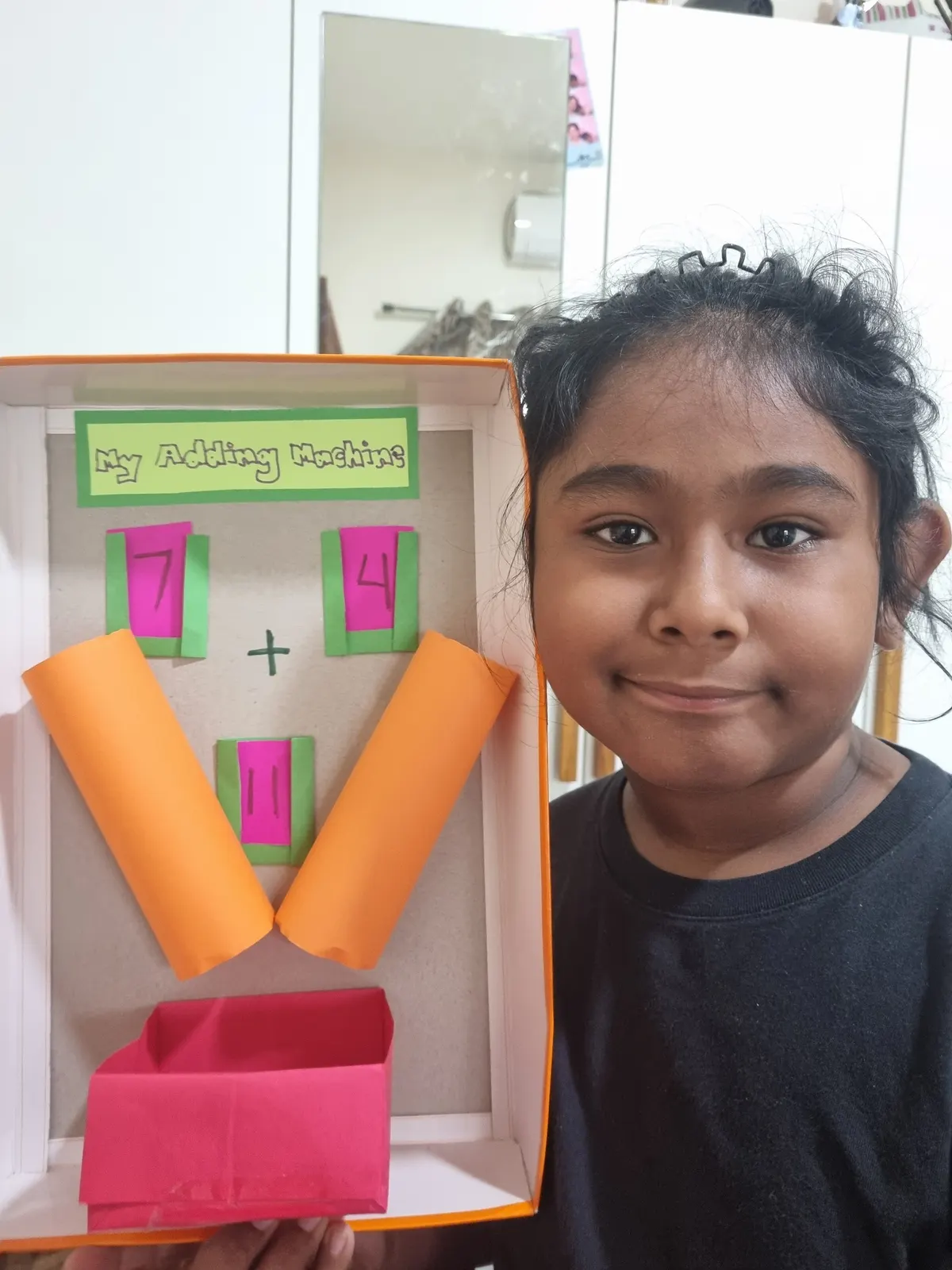
Visible progress
Parents should be able to see how mathematical understanding changes.
Useful evidence includes changes in strategy, accuracy, fluency, explanation and application—not only the number of questions completed.
Programme duration and fee
Mathematics Mastery runs for ten months with two live 40-minute classes per week in a planned cohort of 24–26 learners.
Mastery fee
₹18,000
ten months
Learners
24–26
per planned cohort
The current listed Mastery fee is ₹18,000. Final GST, invoicing and payment terms depend on learner type.
Questions parents ask
Practical answers about Mathematics Mastery.
Is this the same as Maths tuition?
No. It is a diagnostic-led skills pathway focused on connected understanding, targeted practice and progression.
Can my child work above school grade?
Yes, where diagnostic evidence and ongoing readiness support more advanced work.
Are school homework and examination preparation included?
The programme strengthens underlying mathematical capability. It is not positioned as school-homework completion or guaranteed examination coaching.
How is progress shared?
Progress may be shared through feedback, parent connects, reports and learner work. The final reporting format must be confirmed for the current cohort.
Will my child receive a certificate?
Eligible learners receive a 21K completion certificate subject to attendance and programme requirements.