4 Pillars of Education for Students Overall Growth!
 Written byAnkita SinghaContent Specialist
Last modified: Sep 8, 2026 5 min read
Change becomes part of life as people improve themselves through time and education, and it now goes beyond grades and marks, meaning learning from textbooks alone is not the best way to become efficient.
True learning starts when people go beyond and understand the foundation of development, which allows schools, teachers and parents to make students more capable, curious, and compassionate in their journey.
And this can be recognised through some common pillars which we will discuss further.
What is education?
Education can be easily represented as a procedure in which people gain:
- Knowledge
- Skills
- Values
- Habits
- Developing Reasoning
- Preparing for lifelong learning
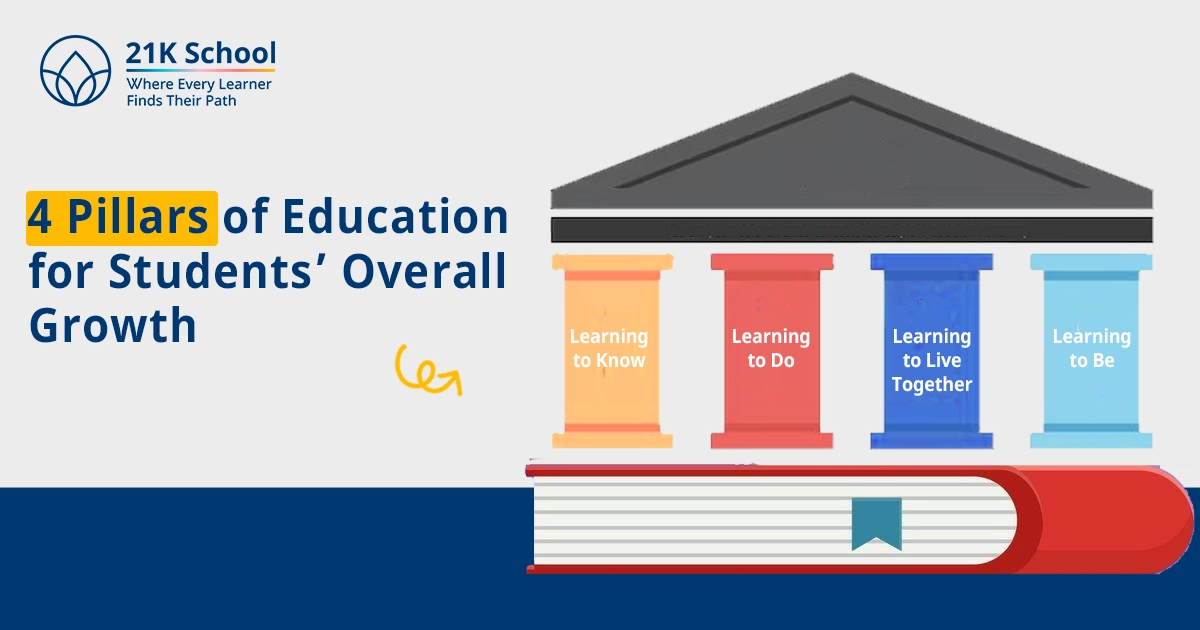
According to UNESCO's Education: The Treasure within (1996), chaired by Jacques Delors, education throughout life is based on four pillars:
- Learning to Know
- Learning to Do
- Learning to Live Together
- Learning to Be
4 pillars of education for students growth
The upcoming four pillars of education remain relevant from the start to today because they prepare people for different situations, from making the right decisions to forming good relationships.
Let's go deeper to measure them accurately:
1. Learning to know
This pillar is all about knowledge, but not in a traditional way in which people learn by memorising and repeating. Knowledge here is more deeply used, which includes curiosity, inquiry and finding application in the real world.
This showcases how a particular piece of knowledge can be used in multiple areas to bring something new and innovative.
Applying this pillar in school classrooms and in day-to-day life pushes students to learn in an analytical and creative way.
For example, a student, instead of memorising different dates in History subjects, understands the causes and consequences of events.
2. Learning to do
From learning to application, both knowledge and skills must be used or applied practically, which is what the next pillar showcases. The pillar believes that practical skill application in real life is important to deal with challenges.
Some of the key strategies to implement are:
- Implementing experiential learning
- Focus on soft skills.
- Skill-based training of students
For example, a group of students learns about experiments in the classroom and performs them in a science lab to see the results.
Here, a student goes beyond technical knowledge and learns real-life abilities to become more proficient in future scenarios like a job, internship, etc. It prepares students to understand and implement effectively everything they have learned.
3. Learning to live together
Diversity is what makes the environment more energetic and effective, where individuals become a part of a large community where they learn to live together.
This pillar is all about becoming stronger and improving potential in this modern world where one must learn to:
- Appreciate each other
- Connect and cooperate
- Except diversity
- Bring harmony
However, classrooms and schools achieve this pillar through simple projects, assignments, culture exchange, debates, and other common activities that students love to participate in and come together to contribute positivity.
4. Learning to be
This pillar of education helps students to become skilful and useful individuals; instead, it helps in making a complete human being, which means students look at themselves and understand who they are and what their objectives are.
It can be easily promoted in several ways; some examples and elements schools can consider.
For example:
- Leadership opportunities to work in a team.
- Personal goal-setting for future success.
Key Elements of Learning to Be:
- Self-awareness
- Self-confidence
- Creativity and imagination
- Independent thinking
Four pillars for a holistic education
Holistic education simply means the development of a child's intellectual, emotional, social, physical, and spiritual areas. It is used to improve academics, promote creativity, and support the mental health of an individual.
The 4 pillars of holistic education go beyond books and shape the lives of students. It helps in both academic and personal growth of a student.
It includes:
- Intellectual growth (Learning to Know)
- Practical competence (Learning to Do)
- Social development (Learning to Live Together)
- Personal growth (Learning to Be)
Interconnection of the four pillars
For better holistic development, the above-mentioned four pillars should be effectively implemented in the curriculum to make learning more impactful for students.
All the pillars are interconnected with each other to support and strengthen the education system to ensure students become professionally successful and personally responsible human beings.
For example:
- A child cannot truly be without learning to live together.
- Practical skills of a child are incomplete without ethical values.
- Any kind of knowledge is meaningless without application.
Conclusion
In the 21st century, students face various challenges related to technology, competition, social diversity, mental health, etc, and traditional approaches lack the ability to fulfil students' overall needs.
For overall growth and development, implementation of the four pillars of education is important. Each pillar is interconnected and together helps in achieving desired goals.
Students need to discover all four pillars to become professionally and personally successful in life.
Frequently asked questions
6 questions
How to integrate the four pillars for a holistic education?
To integrate the four pillars for a holistic education, one should use key strategies including: Using project-based learning Fostering teamwork for social skills Incorporating mindfulness
What are the types of education?
Three different types of education include: Formal education Informal education Non-formal education
What are the stages of education?
The 4 stages of education are: Early childhood/pre-primary education Primary education Secondary education Higher education (postsecondary) education
What are the 4 pillars of NEP 2020?
The 4 fundamental pillars of NEP 2020 are: Access Equity Quality Accountability
What are the 4 pillars of life skills education?
The 4 pillars of life skills education include: Learning to Know Learning to Do Learning to Live Together Learning to Be
What are the 4 pillars of learning?
According to UNESCO's Learning: The Treasure within (1996), chaired by Jacques Delors, education throughout life is based on four pillars: Learning to Know Learning to Do Learning to Live Together Learning to Be
About the author
Ankita Singha
Content Specialist
Ankita Singha is an Education Content Specialist at 21K School, India’s first accredited fully online K-12 School. She focuses on the in-depth research and creation of the well-drafted guides on early childhood education, school admission processes, and CBSE/ICSE curriculum guidance. With more than 2 years of experience at 21K School, a fully accredited institute- Cambridge International (IA702) and Pearson Edexcel (94883), Ankita works closely with the school’s curriculum heads and academic coordinators. Ankita’s every article reflects on the official board guidelines, practical realities, and current policies of online education in 78+ countries. Ankita’s content has helped thousands of parents in understanding the topics like RTE eligibility, NIOS pathways, and age-appropriate admission criteria.
Every 21K School guide is written by our education team and reviewed by a subject facilitator before publishing.
Exploring a CBSE-pathway online school?
Talk to an advisor about 2026–27 admissions — no obligation.
Talk to an advisorComments
No comments yet — be the first to share your thoughts or ask a question.