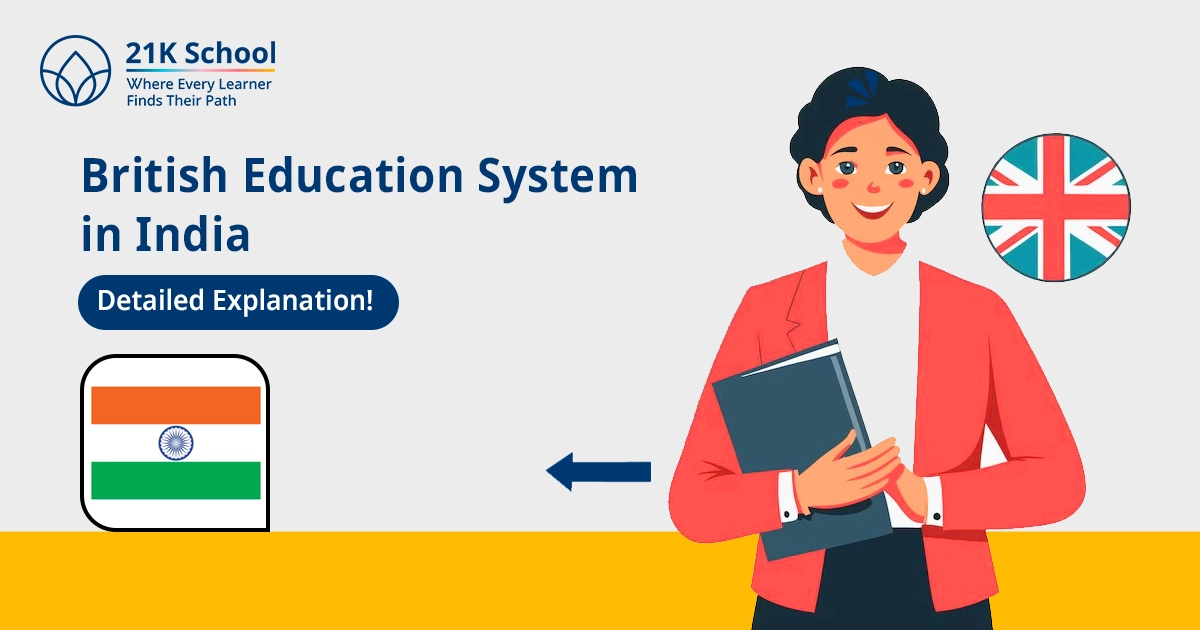
British Education System in India: Detailed Explanation!
 Written byAnkita SinghaContent Specialist
Last modified: Sep 4, 2026 11 min read
People are curious to know who introduced modern education in India, because traditional approaches were used prior to British rule. To know the key change, we need to go into the past.
Have you ever wondered how it evolved?
If not, then don't worry. This blog is all about various education policies introducing objectives, features, merits, demerits, and key differences in Indian society.
What is the British education system in India?
In simple words, the British Education System in India is Western-style, English-medium education for students in India.
It was introduced by the British colonial government during the 19th and early 20th centuries with the objective of creating a class of English-educated Indians.
The system was highly focused on:
- English-medium instruction
- Western curriculum and scientific subjects
- Structured examinations
- Teacher training institutions
- Establishment of universities
The structure and policies made by the British Education System in India helped Indians become literate and improve the standard of living.
How does the British education system work?
The British model of education is one of the popular systems that follows a hierarchy and structure. The key stages and structure are:
- Early Years (Ages 3 to 5)
At this stage, young children reach their first milestone in learning, laying a foundation for their future academic journey via foundational literacy and numeracy.
- Primary (Ages 5 to 11)
It includes key stages 1 and 2.
- Secondary (Ages 11 to 16)
It includes key stages 3 and 4. Students take GCSE examinations in Year 11 (ages 15-16).
- Further Education (Ages 16 to 18)
For non-compulsory but standard education, students learn further, which generally involves A-levels. This is for university or vocational qualifications.
- Higher Education (Ages 18+)
3-year bachelor's degrees are designed for higher education.
Historical background of the British education system in India
The details given below are a sequence of time frames and events of the British education system in India:
1. 1781: First Madarasa at Calcutta
The Calcutta Madarasa, also known as "Aliah Madrasah", was established by Warren Hastings in 1781. The objective was:
- Study Muslim law and related subjects.
- Also, provide trained Indians to assist in administering justice through the Company's courts.
2. 1784: Asiatic society
The Asiatic Society was founded in Calcutta by Sir William Jones to inquire into the:
- History
- Antiquities
- Arts
- Sciences
- Literature of Asia.
3. 1791: Benaras Sanskrit College
Benaras Sanskrit College was founded in 1791 by Jonathan Duncan.
4. 1792: Charles grant recommendation
Charles Grant's) Recommendation focused on:
- Promotion of Western education and Christian values
- English education will be introduced in India.
5. 1800: Fort William College
Fort William College is one of the first colleges for Western education that was set up by Lord Wellesley. It was created to train British civil servants in Indian languages and administration.
6. 1813: Sanction of Rs 1 lakh per annum
The Charter Act of 1813 was introduced in 1813, under which 1 lakh rupees per year was allocated to education in India. It was the first commitment by the British government.
7. 1817: The Hindu College
The Hindu College in Calcutta was established. It promoted Western education in India.
8. 1835: Macaulay's minute on English
Macaulay's minute on English in 1835 was presented by Thomas Babington Macaulay to support the Western curriculum. It is one of the major shifts in the Indian education system.
English was formally adopted as the language of higher courts and administration following the English Education Act of 1835.
9. 1835: Adam's report on education in Bengal and Bihar
Adam's report on education in Bengal and Bihar declared the condition of indigenous education.
10. 1844: Preference for Indians who knew English
In this period, the demand for English increased because the British government stated that Indians educated in English would receive preference in government jobs.
11. 1854: Charles wood's dispatch
Charles Wood introduced "The Wood's Dispatch of 1854" or "Magna Carta of English Education in India". The purpose was to create a class of educated Indians to assist in colonial administration.
It laid the foundation of modern education in India.
12. 1857: Universities of Calcutta, Bombay and Madras
The three major universities were established in 1857:
13. 1882: Hunter Commission
The Hunter Commission was appointed under William Hunter. It was established to improve the quality of primary education in India.
14. 1885: Punjab university
Punjab University, established in 1885, expanded higher education in the country. It mainly focused on literature, teaching, and examinations.
15. 1887: Allahabad university
In 1887, Allahabad University was established and soon became well-known in India.
16. 1904: Indian universities act
Indian Universities Act of 1904 helped control universities to offer high-quality education in India.
17. 1929: Hartog committee
To evaluate the education system in India, the Hartog Committee was introduced. It highlighted the problem of low literacy rates and poor education quality and suggested taking necessary steps to improve it.
18. 1937: Wardha scheme
Under the influence of Mahatma Gandhi, the Wardha Scheme in 1937 was proposed. It focused on self-supporting education.
19. 1944: Sergeant plan
The Sargent Plan, or Sargent Report of 1944, proposed that children aged between 6 and 14 could avail free, compulsory, and universal primary education. It aimed to eradicate illiteracy by 1984.
However, due to various factors, it was not fully implemented before independence.
Features of the British education system in India
Introduction of British education changed a lot of things, and some of the primary ones are:
1. English medium instruction
Introduction of the English language is one of the decisions. Soon, they made it the primary medium of instruction.
This helped the Britishers to get assistance in administration and to act as intermediaries.
2. Formal education structure
The formal education structure in India is promoted by the British education system. It impacted the Indian structure and replaced Gurukuls and Madrasas with structured and hierarchical systems of schooling.
The British education system in India focuses on:
- Age-based classes
- Prescribed curriculum
- Standardised textbooks
- Written examinations
3. Western curriculum
The introduction of the Western curriculum by replacing Indian traditional subjects and approaches is another feature of the British education system in India.
Western curriculum mainly focuses on:
- English literature
- Western philosophy
- Modern science
- Mathematics
- Political science and economics
4. University system
The university system is shared by British education. The three major universities were established in 1857:
- University of Calcutta
- University of Bombay
- University of Madras
5. Initiatives for reform
Multiple reforms were introduced by them.
- Hunter Commission (1882)
- Indian Universities Act (1904)
5 objectives of the British education system in India
There are multiple motives of the British Education System in India which highly impacted learning.
1. Administrative efficiency
Implementation of Western education for administrative efficiency.
In simple words, educating Indian students to get assistance in colonial administration helps in producing clerks, translators, teachers, and lower-level officers.
2. Cultural imperialism
Instead of understanding Indian culture and values, they implemented Western style and dominated the country's education system and languages.
They also promoted Western habits in Indians for the long run.
3. Creating consumers
To make consumers, due to the large Indian population, the British saw an opportunity and introduced Western products that succeeded in creating habits in India, which benefited them significantly in business.
4. Disseminating Western knowledge
Spreading Western knowledge like theories and ideas is another aim of the British.
Various subjects were introduced, like Modern science, Political theory, etc.
5. UK education system levels
The UK education system is structured into 5 main stages:
Early years, Primary, Secondary, Further education, Higher education.
Key qualifications include GCSE at 16.
A-levels at 18, and university degrees.
Note:
In certain areas, a three-tier system is used.
- Elementary
- Secondary
- Higher education
Merits of the British education system in India
The British education system was introduced in India for various reasons.
The objective was to get assistance in colonial administration to disseminate Western knowledge.
Various merits to the country such as:
1. Introduction of modern subjects and scientific thoughts
Introduction of modern subjects and scientific thoughts helped Indian traditional education.
British Curriculum is the main focus, and various institutions are formed.
2. English as a link language
Traditional education promoted the cultural unity of its locality and its value systems. The introduction of the British education system in India produced English as a link language.
This later helped in connecting with vast communities all over the world.
3. Exposure to Western ideas
The British education system in India helped to introduce various concepts like democracy, equality, justice, and human rights.
This created a class of thinkers, intellectuals, political leaders, and nationalists.
Demerits of British education system in India
The British education system in India offered modern education; it also created a few imbalances. Demerits include:
1. Reduce indigenous systems
Several changes were made to dismantle Indian structures and instil Western-style habits, which had a negative impact.
2. Loss of languages
Not only education and standard of living but languages have also vanished due to the English language. Local and other languages have also vanished.
3. Focus on clerical skills
To get proper assistance, British individuals created a structure where Indians were limited to practice clerical skills instead of acquiring knowledge of other domains.
4. Low literacy
Education in this period was not for all. They prioritised urban areas and upper- and middle-class people only.
This created an educational gap which led to low literacy rates in India.
British education policy in India
To understand the British education policy in India, go through the below-mentioned key aspects:
- Initially, they wanted to create "interpreters" between the British and Indians.
- Some of the key educational reforms are: Charter Act of 1813 - Macaulay's Minute (1835) - Wood's Despatch (1854) - Hunter Commission (1882)
- The policy reduced the functions of Indian traditional education such as gurukuls and madrasas.
American vs British education system
The following are the differences between the American and British education systems.
| Number | Particular | American Education System | British Education System |
|---|---|---|---|
| 1. | Governing Authority | Managed by federal, state, and local governments. | The British Education System is set by the UK government. |
| 2. | Standardized Exams | SAT and ACT for college admissions | GCSE at 16, A-Levels at 18 |
| 3. | Grading System | GPA (Grade Point Average), Letter Grades (A-F) | Percentage grades and letter grades (A*-U) |
| 4. | Curriculum Structure | Flexible | Structured |
| 5. | Assessments | GPA, SAT/ACT scores, extracurricular activities | A-Level results (final exams) for specific subject mastery. |
Indian education system vs British education system
The following are the differences between the Indian Education System and the British Education System.
| Number | Particular | Indian Education System | British Education System |
|---|---|---|---|
| 1. | Curriculum Boards | CBSE, ICSE, State Boards, IB, Cambridge | National Curriculum of England, GCSE, A-Levels, IB |
| 2. | Medium | English + Regional Languages | Primarily English |
| 3. | Key Qualification at 16 | Class 10 Board Examination | GCSE |
| 4. | Key Qualification at 18 | Class 12 Board Examination | GCE A Level |
| 5. | Grading System | Percentage-based grading | Letter grades (A*, A, B, etc.) |
Conclusion
Choose the ideal pathway of today's education. It opened new doors of learning.
On the other hand, it marginalised indigenous knowledge systems and negatively impacted the traditional education system.
However, understanding the features, merits, demerits, differences and opportunities helps individuals to build an inclusive and meaningful system.
Frequently asked questions
7 questions
Who started the British education system in India?
It had contributions from Charles Grant (1792) and the Charter Act of 1813. Some popular names are: Thomas Babington Macaulay Lord William Bentinck
What was Mahatma Gandhi's teaching?
Mahatma Gandhi's teachings include: truth non-violence passive resistance education unity self-discipline self-reliance
What is the Charter Act of 1813?
The Charter Act of 1813 (the East India Company Act) was an act of the Parliament of the United Kingdom. It renewed the charter issued to the British East India Company and continued the Company's rule in India.
What is ancient education?
The existence of education in early civilisations to shape responsibility discipline ethics For example, the Gurukul system, in which children live with the gurus to learn life skills, philosophy and many more.
How did British rule affect the education system in India?
British rule affected the education system in India in both good and bad ways, where modern institutions were established, and history and culture were neglected.
What were the drawbacks of the British Education System in India?
Common drawbacks are: Promotion of Western culture Neglect of technical and vocational education Highly dependent on rote learning
Describe the education system in pre-British India?
The pre-British Indian education system was a: Decentralised Indigenous Widespread network
About the author
Ankita Singha
Content Specialist
Ankita Singha is an Education Content Specialist at 21K School, India’s first accredited fully online K-12 School. She focuses on the in-depth research and creation of the well-drafted guides on early childhood education, school admission processes, and CBSE/ICSE curriculum guidance. With more than 2 years of experience at 21K School, a fully accredited institute- Cambridge International (IA702) and Pearson Edexcel (94883), Ankita works closely with the school’s curriculum heads and academic coordinators. Ankita’s every article reflects on the official board guidelines, practical realities, and current policies of online education in 78+ countries. Ankita’s content has helped thousands of parents in understanding the topics like RTE eligibility, NIOS pathways, and age-appropriate admission criteria.
Every 21K School guide is written by our education team and reviewed by a subject facilitator before publishing.
Exploring a CBSE-pathway online school?
Talk to an advisor about 2026–27 admissions — no obligation.
Talk to an advisorComments
No comments yet — be the first to share your thoughts or ask a question.