What Is STEM Education: Turning Ideas into Real-World Solutions
 Written byAnshu KumariContent Specialist
Last modified: Sep 9, 2026 18 min read
Have you ever heard of STEM education or its approach in general classrooms?
A few decades ago, education administrators realised that learning came through the practical use of subjects taught in the class, instead of just theoretical knowledge. This encouraged the introduction of STEM education, which represented Science, Technology, Engineering, and Mathematics.
Later on, it also added Arts and became the STEAM educational approach.
STEM learning welcomes learners to excel in today's workforce and day-to-day challenges through analytical understanding. To know more about STEM education, you will have to read the following piece from here to the end.
You will also come to learn about some common example activities of STEM education in schools.
What is STEM education?
STEM education is a multidisciplinary approach of learning and teaching that teaches the essence of Science, Technology, Engineering, and Mathematics.
Learners get to know that real learning comes from critical thinking of the subjects and their hands-on application in real-world problems.
Unlike earlier times, present-era employers search for practical applicability of education and skills acquired by a learner. And STEM education satisfies those demands.
Whoever wants to succeed as a job employee or an entrepreneur will normally be chasing STEM education instead of a conventional theory-based approach of studying.
What does STEM stand for?
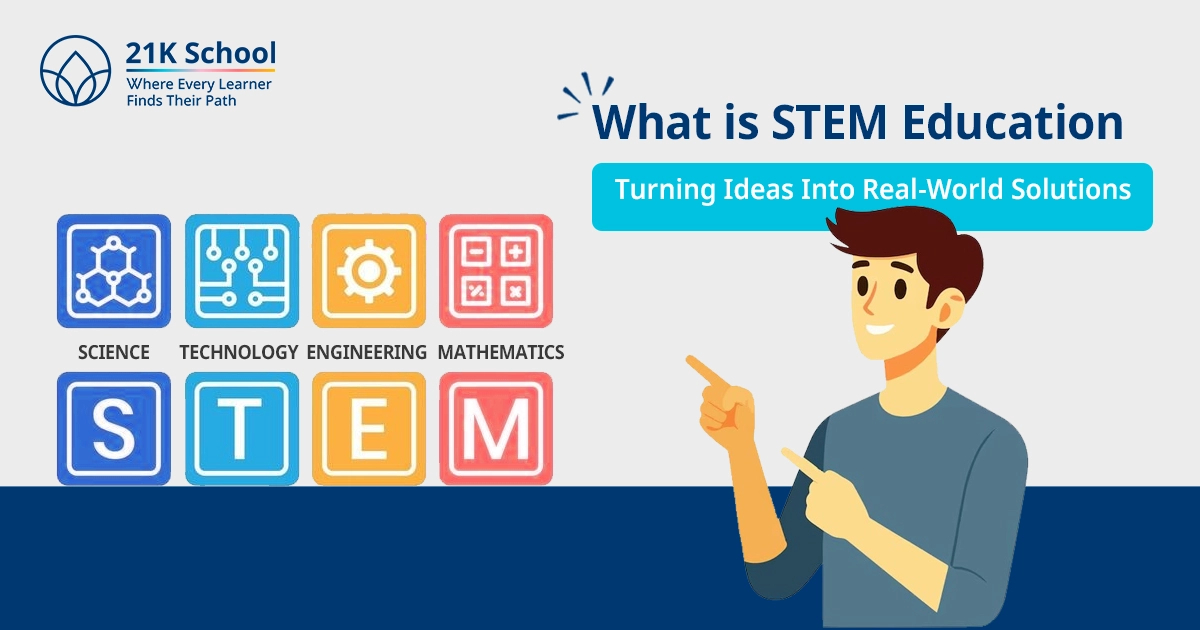
STEM is an acronym for Science, Technology, Engineering and Mathematics. In this, every area is important in providing knowledge and skills; however, the power of STEM education lies in its ability to integrate these.
1. Science
Science is the study of the natural world in an organised manner. It contains topics like biology, chemistry, physics, environmental science, astronomy and earth science.
Students study scientific concepts and acquire skills in making observations, conducting experiments, taking measurements, gathering evidence and reasoning, and analysing.
2. Technology
Technology is defined as tools, systems, techniques and processes that people use to solve problems and to carry out tasks. Technology can refer to computers, computer software, digital tools, sensors, programming languages, platforms and robotics, as well as communication technologies in modern STEM education.
With the use of technology, students learn how tools and systems can be adapted to achieve a purpose and solve problems.
3. Engineering
Engineering is the process of designing, making, testing and refining solutions to problems. Engineers apply science and maths knowledge and practical design principles to develop products, structures, systems and processes.
Engineering has a significant role in STEM education because it provides opportunities for students to apply theoretical knowledge.
4. Mathematics
Mathematics is the language and tools to measure, calculate, model, analyse and interpret information.
The STEM curriculum incorporates some concepts from Maths, including arithmetic, algebra, geometry, statistics, probability, calculus and data analysis.
Students can use mathematics to make calculations about measuring, analyse experimental data, look for patterns, represent data in graphs, estimate costs or model situations.
7 key features of STEM education
Let's see the prominent characteristics of STEM education and how it stands out:
1. Interdisciplinary learning
Interdisciplinary learning is one of the key attributes of STEM education. Instead of subjects being strictly isolated fields, STEM relates knowledge of different subjects.
Students may need to build a project that uses science, math, technology and engineering in combination.
2. Hands-on learning
Learning by doing is a key component of STEM learning. Students can run experiments, build models, program devices, gather measurements, build prototypes and test their ideas.
Experiential learning activities can provide students with the opportunity to learn something abstract in a more concrete manner.
3. Problem-solving
Problem-solving is at the heart of STEM learning. Pupils are often given questions or problems which involve them in applying knowledge, rather than just recalling it.
There can be many different solutions to a STEM problem. This allows students to think systemically, thus becoming confident in tackling problems they are not familiar with.
4. Inquiry-based learning
Inquiry-based learning is a favourite approach for the STEM disciplines where students are taught by engaging in the research and investigation of the questions they have.
A lesson might start with an observation or a problem, rather than the teacher's complete explanation. Students may ask a question, formulate a hypothesis, carry out investigations and draw conclusions based on the evidence.
5. Creativity and innovation
STEM is not the only thing about being accurate. Creativity and innovation also have a great deal of importance.
Students are asked to consider alternative solutions to the same problem, create new products, improve existing systems or consider alternative solutions.
6. Collaboration
A large number of STEM projects require collaboration. Students are encouraged to work in teams to explore a problem, delegate tasks, share ideas, develop prototypes, interpret data and report results.
Cooperation fosters communication, leadership, listening, negotiation and teamwork skills.
7. Real-world application
STEM education links school learning with the application of learning in the real world.
The student can choose to have research problems about climate change, transportation, healthcare, agriculture, energy, water, communication, construction or space exploration.
This enables the students to see the importance of subjects like math and science in the real world beyond exams.
5 objectives of STEM education
STEM education consists of 5 main objectives to build learners' academic and overall potential for the future. These are as follows:
1. Critical thinking
A prominent goal of STEM education is to encourage critical thinking. Students develop skills in assessing evidence, detecting patterns, challenging assumptions, comparing alternatives, and deciding on the evidence.
Rather than simply taking everything on faith, students are encouraged to question or pose questions of the form: “What evidence supports this conclusion?; What other factors might have caused this?; What are the credentials of the data? Is there any way to improve the solution?"
These thought patterns are beneficial not just in STEM-related courses but in real life as well.
2. Career readiness
One of the key aims is to support students in their future learning and/or working.
There are a variety of STEM careers, such as engineering, medicine, information technology, data analysis, scientific research, architecture, environmental science, manufacturing, telecommunications and more.
In the field of educational science, STEM education enables students to acquire technical knowledge and to transfer these skills into other skills of problem-solving, communication, teamwork, adaptation, and analysis.
3. Digital literacy
Digital literacy requires knowing how to effectively, responsibly, and safely use digital tools.
Digital skills can be developed in STEM education by programming, data processing, digital investigation, simulation, robotics, design software and other technologies.
Digital Literacy is becoming more significant as students are exposed to digital technology in learning, working, communicating, finance, health and life.
4. Lifelong learning
Students can be motivated towards lifelong learning through STEM education. The field of science and technology is dynamic and fast evolving. New discoveries, tools, methods and occupations continue to be found. Students should be able to learn new information and adjust to new circumstances, therefore.
5. Equal access
A key goal of STEM education is to offer all students, regardless of background, chances to gain scientific, mathematical, technological and engineering competence. The importance of equal access is that students' academic and career decisions could be affected by their educational opportunities.
To promote inclusive STEM education, schools should make learning resources accessible, invite all students to participate in STEM, and accommodate students with various learning barriers and break up stereotypes of who is successful in STEM.
7 importance of STEM education
STEM education was introduced to serve learners and their ability to deal with the challenges of the world. The main key points that reflect the importance of STEM education are mentioned below:
1. Prepares students for future careers
STEM education plays a role in supporting students to be career-ready since they are made aware of the ways technical knowledge is applied in today's workplaces.
There is a need for students to be prepared to deal with the recent worldly changes, and that is where STEM education will play a role in providing them with the knowledge and skills.
Students don't have to be scientists, engineers or programmers, but being familiar with technology, data, analysis and problem solving can have a benefit in a variety of professions.
2. Develops critical thinking
Students are invited to consider evidence and solutions when participating in STEM activities. Students will have to watch what happens, make notes, investigate what has happened, and think of explanations. This activity builds logical and analytical skills.
Critical thinking is so important beyond STEM subjects because people are constantly inundated with information. It is crucial for life to be able to weigh evidence and differentiate reliable information from unproven information.
3. Encourages problem-solving
Everyday life is full of problems to be solved in a practical way. STEM education provides students with multiple chances to engage in problem-solving.
When designing a bridge, a student might find that the bridge might collapse. When an activity doesn't work, STEM learning invites the student to ask themselves, “Why did it fail? What can I do differently to make it work? This process helps to build persistence and educates students that sometimes difficult problems can be solved systematically.
4. Promotes innovation
Innovation is the process of creating new or better ideas, products, processes and/or solutions. Innovation can be fostered through opportunities in STEM education to experiment and design.
Students do not necessarily have to locate a single “right” answer. They can be prompted to compare and contrast solutions and decide which one is best under specific circumstances.
This instils a creative attitude in students to experiment, accept failure and refine ideas.
5. Improves technological literacy
Technological literacy, in STEM education, enables students to be more confident users and creators of technology.
It can also enable them to comprehend topics like digital security, responsible use of technology, data, automation, as well as the social implications of technological change.
Today, technology plays a role in virtually all aspects of life. Students must be aware of the use of technological devices and the impact that technology has on individuals and society.
6. Connects learning with real life
One of the strengths of STEM education is the ability to bring concepts in the classroom to real-life situations.
Students can truly grasp the meaning of math when they use it to figure out how much materials cost or to analyse data. When students look into the environment around them, science is more meaningful. Students will know what engineering is when they either create something that solves a real-life problem.
These relationships can assist in students' interpretations of why they are learning what they are learning.
7. Encourages collaboration
Working collaboratively is frequently a part of STEM education. A large project could be challenging for a single individual to do. Students may split the work up, discuss concepts, compare, give feedback, etc., and put their skills together.
Additionally, working collaboratively equips students for later careers. Group STEM-related activities can help students learn the skills of communicating clearly, listening to others, dealing with conflict, cooperating with others, and achieving a shared objective.
STEM education in schools
STEM opportunities can be integrated at all levels of education, from early childhood and primary to secondary and higher education. It's not always a requirement that every child become a scientist, engineer, mathematician or programmer. Rather, schools employ STEM strategies to foster student skills in curiosity, logical thinking, creativity, problem-solving, working cooperatively, and technological literacy.
In primary schools, it is possible to introduce STEM education with simple and fun activities. Children could use blocks to make constructions, watch plants grow, measure things, make simple machines or explore the movement of water. These activities give students the chance to learn about scientific and mathematical concepts from first-hand experience.
Advanced ideas of STEM education can be introduced at the secondary and tertiary levels of academic learning. Students can perform robotics, coding, lab experiments, engineering design challenges, research into the environment, data analysis, and projects using technology. They can also employ mathematical models and digital tools to explore real-life situations.
A good STEM class should encourage students to seek out questions, rather than waiting for answers. The teacher can pose a problem and give students an opportunity to explore a variety of methods for solving a problem. Students are able to make a design, try it, evaluate the outcomes, recognise flaws, and refine their design.
5 examples of STEM education activities
Learners are told to experience STEM education by performing different activities that foster reasoning and multifaceted learning. Some of the example activities of STEM education include:
1. Building a bridge
The design of a bridge is an easy but effective STEM activity that can help students get started in the fields of science, engineering, and math.
Paper, cardboard, wooden sticks, straws, or classroom materials can be provided to students, and they will be required to build a bridge that will support a certain weight.
Students can discuss the properties of good bridges before they construct their own, and look at various bridge designs. They can then make a plan, build a model, see how strong it is and record the outcome.
Numbers can be used to measure length, to work out weight, to compare designs and to analyse results. Science can be used to educate students about concepts of forces and stability. Engineering is used for designing and improving the structure, and technology can be used for research, digital modelling, or documenting the projects.
Students can determine the cause of bridge failure and redesign the bridge if it fails. This demonstrates a valuable STEM learning principle: It's okay to test and fail, and it can be useful for making improvements.
2. Water filtration project
The water filtration project helps students understand environmental science, engineering, materials, and data analysis. It also enables them to apply the concepts they learn to real-world situations.
Students can explore the effect of various materials, including sand, gravel, cloth or other safe filtering materials, on the clarity of water. They can experiment to create a basic filtration system and see the outcomes.
The teacher may present ideas of filtration, contamination, water quality and clean water. Students will be able to make observations and compare the various designs.
The project can also be the basis for discussions on real-life water treatment systems and the problems of communities which have an unreliable source of clean water.
3. Robotics
Robotics is an engaging STEM activity as it brings together multiple skills from varied areas of learning in a project.
The students will be able to create and program easy robots to accomplish a certain task. They may design a robot to follow a line, move objects, or avoid obstacles or react to sensors depending on their age and resources.
Students can learn engineering design, programming, mathematics, electronics, and logic by using robotics.
Children frequently have to run their robots several times. If a robot is not operating as it should, it should be determined where the problem lies, and either the robot's structure or its program should be changed.
This allows for experimentation, persistence and systematic problem solving.
4. Coding projects
The coding projects can allow students to learn about computational thinking and digital problem-solving.
Students will be able to develop simple games, animations, websites, calculators, simulations or interactive stories. For younger students, use a visual programming language and for older students, work with text-based programming languages.
By learning to solve a problem in different ways, students learn to break a problem down into smaller steps, find patterns, develop instructions, test solutions, and correct problems.
Errors in a program are not necessarily a cause for failure. Rather, it is a chance for students to analyse their code, discover the problem and solve it.
Coding can thus foster technical skills as well as general patterns of logical thinking.
5. Environmental data analysis
Environmental data analysis is an approach that students can use to integrate science, mathematics, and technology, as well as critical thinking.
Students can gather data on temperature, precipitation, air quality, water quality, plant growth or consumption of energy. They can arrange the information in a table, make a graph, look for patterns and explain them.
For instance, students can take the temperature over a few weeks and observe the change in temperature with the passage of time. They could then explore how temperature, rain or plant growth might be related.
Top 5 challenges of STEM education
There are many challenges that come across the implementation of STEM education in schools for children and educators. These include:
1. Lack of resources
A lack of resources is one of the most prevalent issues. A well-designed STEM program might need equipment, computers, Internet, robotics kits, software, building materials, measuring tools, or other specialised materials or tools. It may be difficult for schools with limited funds to offer these resources.
The main problem that needs to be addressed is the teacher's lack of resources for meaningful practical experiences for students.
2. Teacher training
Teacher training is a necessity. Teachers should be provided opportunities for building their content knowledge and effective practices for teaching STEM.
Teachers in STEM subjects may be asked to employ other teaching methods that deviate from their traditional ways for STEM education.
Project-based learning, inquiry-based learning, engineering design, technology, coding, data analysis, and interdisciplinary teaching are among the areas that may require teachers to have knowledge of.
Teachers might feel unsure when starting to plan STEM activities or when combining several subjects in a single project if they do not have proper professional development.
3. Time constraints
One of the challenges of STEM projects is that they require a longer period of time than regular lessons.
It may take a teacher more than one class to help students grasp a challenge, devise a solution, create a model, make some tests, analyse the test results, and then present their solution.
This may be challenging in a school with a rigid curriculum to be completed within a short school year. This can be overcome by embedding STEM projects within subjects instead of using them as an extra strand of work.
4. Unequal access
There is a disparity in access to STEM education for all students. The funding gap, location of schools, family income, access to the Internet and technology, and educational support can result in great inequities.
Students in well-resourced schools can learn in the laboratory, with a teacher of robotics, with computers, etc., and students in under-resourced schools may not be able to learn in these ways.
It is crucial to make sure that everyone has access to the same opportunities, as STEM skills may impact future education and career options.
5. Examination-oriented learning
Implementation of STEM can be a challenge in an examination-based education system. In cases where most of the success in school is judged by the students' written examination results, teachers may feel compelled to concentrate on memorising rather than practical investigation and project-based learning.
The outcomes of STEM activities may not be easily assessed in the traditional examination setting and can be time-consuming.
Concluding comments
STEM education brings together Science, Technology, Engineering, and Mathematics to create learning experiences that connect to real-world problems.
With great implementation of STEM education in schools, it is applicable through multiple activities that render critical analysis as a developmental feature of young learners.
STEM education also fosters creativity in problem-solving. But due to a lack of adequate professional training of educators, learners struggle to grasp concepts through the STEM approach of learning.
Frequently asked questions
5 questions
What are the four components of STEM education?
Science, Technology, Engineering and Mathematics are the four pillars of STEM education. The points listed above are linked by STEM education, enabling students to apply knowledge, explore problems and create solutions.
What are the benefits of STEM education?
STEM education can build skills of critical thinking, problem solving, creativity, collaboration, digital literacy, and technological skills. It can also enable students to relate what they learn in class to real-life situations and be ready for postsecondary education and a variety of possible careers.
What are some examples of STEM activities?
Some examples of STEM activities include making a bridge, designing a water filtration system, designing a robot, coding projects, analysing environmental data, simple machine design, scientific experiments and engineering prototypes.
How does STEM education help students?
STEM learning enables pupils to be active learners and problem-solvers. It gets them to ask questions, examine evidence, test ideas, collaborate with others, utilise technology, and solve real-world problems. These skills can be relevant to study and/or work
What careers are related to STEM education?
A STEM education can equip students with skills and knowledge that are applicable in many careers, including biomedical, engineering, medicine, computer science, software development, data science, scientific research, architecture, biotechnology, environmental science, robotics, the mathematical sciences, information technology, and renewable energy. Many careers outside the traditional STEM professions also include the use of STEM skills.
About the author
Anshu Kumari
Content Specialist
Anshu Kumari is an Education Content Specialist at 21K School- a fully accredited institute- Cambridge International (IA702) and Pearson Edexcel (94883). She focuses on the in-depth research and creation of the well-drafted guides on NIOS admission, Indian Education Policy, and competitive exam preparation. With around 2 years of experience at 21K School, her psychology background informs her approach to the education content and hence focuses on creating guides to address the real anxieties of the guardians. She writes well-researched articles on competitive exam timelines, stream selection, and board choices by referring to the official resources. All Anshu’s content pieces are fact-checked against the board and primary government official resources and is dedicatedly reviewed by the school’s academic team.
Every 21K School guide is written by our education team and reviewed by a subject facilitator before publishing.
Exploring a CBSE-pathway online school?
Talk to an advisor about 2026–27 admissions — no obligation.
Talk to an advisorComments
No comments yet — be the first to share your thoughts or ask a question.