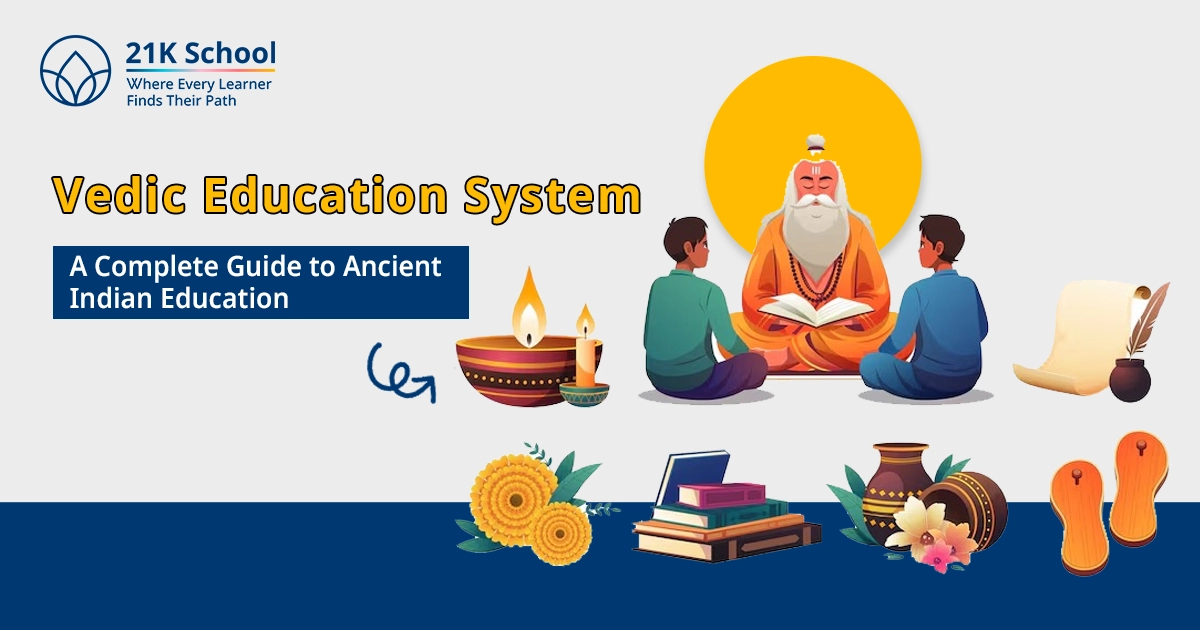
Vedic Education System: A Complete Guide to Ancient Indian Education
 Written byRahul PalContent Specialist
Last modified: Sep 1, 2026 14 min read
Have you ever thought about the Vedic Education System, which has made it one of the oldest and finest systems of education respected in the world?
The basis of any good and progressive community is education, and the Vedic education system left much behind in the intellectual and cultural heritage of ancient India.
It was dedicated to the production of a balanced person whose education, discipline and experience were grounded in values.
This system provided the student with a chance to both receive academic education and moral, physical and spiritual growth, enabling them to lead a responsible life and become useful citizens of society.
What is the Vedic education system?
The Vedic Education System was the old Indian education system that developed during the Vedic era (c. 1500 BCE-500 BCE).
It was mainly taught in Gurukuls, where students (Shishyas) used to live with their teacher (guru) so that they could have an education based on the background of austerity and value orientation.
The purpose of the system was intellectual, moral, physical and spiritual growth through the study of the Vedas, philosophy, sciences, arts and artistry of practical living.
It emphasised building character, discipline, respect towards the guru and learning through observation, discussion and practice and developed the students into responsible and knowledgeable citizens of society.
History of the Vedic education system
Vedic education system was created during the Vedic period (c.1500 BCE-500 BCE) in ancient India. It was based on the Guru-Shishya (teacher-disciple) tradition, where the students lived in Gurukuls under the guardianship of their Gurus so as to be educated and life-trained.
Discipline, morality, self-reliance, spiritual and character development were the focus of the system, which prepared learners to fulfil their social and personal duties.
In the early years, education was aimed at the maintenance and passing down of the Vedas by means of oral recitation and memorisation.
The curriculum was slowly expanded to include Upanishads, Vedic philosophy, Ganita Shastra (Mathematics), Jyotisha Vedanga (Astronomy), Anvikshiki (Philosophy), Ayurveda (Medicine), Yoga Shastra and Adhyatma Vidya (Meditation), both informing the students and providing them with practical skills.
Salient features of the Vedic education system
The Vedic Education System had a number of unique characteristics which facilitated disciplined education, holistic development, independence and values of lifelong learning within students.
1. Upanayana Sanskar (Admission ceremony)
The start of formal education was with the Upanayana Sanskar, a religious initiation rite. After this ceremony, the students entered the Gurukul and started their educational journey under the guidance of a guru.
2. Residential education
During their studies, students spent time in the Gurukul, which was not with their families. This system of home-based education encouraged self-reliance, responsibility, simplicity and lifelong learning under the guardianship of the teacher.
3. Free education
Education was normally free of charge. Gurus never levied students with Guru Dakshina unless they had completed school, since they would be appreciative but not as a binding element.
4. Self-sufficient lifestyle
Vedic Education System prompted students to be independent and work on family chores on their own. They learnt some of the most important life skills that prepared them to have a responsible and productive life.
5. Close connection with nature
This study was conducted in a calm natural environment as opposed to regular classes. A natural environment promoted attention, observation, good health and good learning.
5 core principles of the Vedic education system
The Vedic Education System was conditioned by the primary principles which shaped the character of students, the way they acquire their knowledge, and personality development.
1. Self-discipline
Self-discipline was one of the most important principles of Vedic education. A set timetable to adhere to on a daily basis was put in place; pupils were self-disciplined and took their responsibilities seriously, and created routines that enhanced moral character and responsible living.
2. Respect for the guru
Students viewed the guru as a teacher, guide and an expert. The Guru-Shishya bond was carried out with respect, obedience and appreciation for the teacher, and this led to the creation of a positive learning environment.
3. Learning through practice
Vedic education was focused on how to apply knowledge in daily life and not merely memorising knowledge.
Real-life experiences, practical activities and observation assisted students in grasping subjects and other vital skills in life.
4. Spiritual knowledge
This kind of system was able to vitalise students to learn moral values, themselves and the purpose of existence through the study of the Vedas, Upanishads, meditation, and ethics in addition to the education.
5. Harmony with nature
Education and nature were closely related, and students would be educated to lead simple lives and be grateful to nature.
Learning in the natural world stimulated observation, physical well-being, and a peaceful interaction with nature.
5 teaching methods of the Vedic education system
The Vedic Education System had efficient instructional strategies that facilitated intellectual knowledge, critical thinking, practical learning and the lifelong acquisition of knowledge.
1. Oral teaching method
Vedic education was basically based on the oral mode of teaching. Gurus taught by talking and students by listening, asking questions and making frequent discussions.
2. Memorisation and recitation
The students had to memorise and recite Vedic texts numerous times in order to maintain accuracy and correct pronunciation.
This technique enhanced memory, focus, and proficiency in the language and was able to pass on the knowledge to the next generation.
3. Discussion and debate
Students were involved in arguments and discussions of concepts in order to decode ideologies and explanations of concepts.
This plan resulted in rational thinking, critical thinking, communication skills and promoted knowledge sharing.
4. Nature learning
It was learnt in the natural environment where the students would observe the natural environment, plants and animals.
Nature provided a method of learning which promoted practical knowledge, environmental knowledge, and healthy living.
5. Observation method
Students learned through watching their guru, day-to-day activities and natural phenomena.
Independent study, experiential knowledge, and the learners' ability to implement knowledge in real life were some of the aspects that were aided by observation.
5 importance of the Vedic education system
Vedic Education System has been instrumental in creating knowledgeable, disciplined and responsible citizens and has provided holistic and value-oriented education.
1. Preserves Indian cultural heritage
Vedic Education has been in place to preserve knowledge, practices, language and philosophy of India in ancient times.
It guaranteed that the cultural values and sacred books were correctly transferred through the generations.
2. Develops strong moral values
The system emphasised honesty, truth, compassion, respect and self-discipline. These values allowed students to be ethical in behaviour, responsible and have great moral character in life.
3. Promotes holistic development
The Vedic education was based on intellectual, physical, emotional and spiritual development. This reserve allowed the students to be ready to confront issues in life and to also help bring about changes in society.
4. Encourages lifelong learning
Students were advised to pursue knowledge as opposed to studying to pass exams. This value fostered curiosity, learning, critical thinking and lifelong enthusiasm for learning.
5. Builds responsible citizens
Vedic Education System equipped the students to take their social, family and national obligations. It instilled discipline, leadership and a sense of duty and guided people to make a big contribution to society.
Subjects taught in the Vedic education system
The Vedic Education System put in place a comprehensive curriculum that covered spiritual knowledge, scientific knowledge, skills and physical education.
1. Vedas and Upanishads
Vedic education was based on the Vedas and Upanishads. The students read religious hymns, religious practices, philosophy, religious ethics, and religious teachings to gain knowledge, moral values and understanding of themselves.
2. Ganita Shastra (Mathematics)
Arithmetic, geometry, algebra, and daily computations were to be found in Ganita Shastra along with astronomy, architecture, as well as business. It inculcated logical thinking, analysis and problem-solving in the students.
3. Jyotisha Vedanga (Astronomy)
Jyotisha Vedanga was focused on astronomy, heavenly bodies, movements of the planets, astronomical calendar and computations of time.
Learners learnt to read the sky and understand astronomical ideas that are used in religious and agricultural activities.
4. Anvikshiki (Philosophy)
Anvikshiki was a discipline that taught philosophy, logic, logical reasoning and critical thinking. It also forced the learners to reason, to find the truth and use their mental abilities to question, debate and think rationally.
5. Ayurveda (Medicine)
Students were introduced to health, prevention of diseases, natural medicine, nutrition and natural healing through Ayurveda.
It enhanced physical health and a healthy lifestyle by observing good lifestyle habits.
6. Yoga Shastra, Adhyatma Vidya (Yoga and meditation)
In order to enhance overall personality development, students engage in Yoga, meditation practices, breathing and spiritual practices in Yoga Shastra and Adhyatma Vidya.
As a way of enhancing their physical fitness, mental concentration, emotional balance and self-control.
7. Shastra-vidya and astra-Shastra (Military science)
Military education was a part of Shastra-vidya and Astra-Shastra and consisted of archery, swordsmanship, war tactics, self-defence and physical exercise.
It indoctrinated the students, particularly Kshatriyas, to defend society and to undertake their duties fearlessly and with control.
8. Gandharva Veda and kala (Arts and music)
Gandharva Veda and Kala taught the fine arts of music, singing, dance, painting, drama and so on. These subjects assisted in being creative, appreciating cultures, expressing art, as well as developing emotions.
Difference between the early Vedic age and the later Vedic age
Early Vedic Age and the Later Vedic Age were different in various circumstances, which reveals how the traditional education system differed in culture, system, and region.
| Basis | Early Vedic Age | Later Vedic Age |
|---|---|---|
| Time Period | Vedic civilisation in ancient India started in 1500 BCE-1000 BCE. | The subsequent phase of the Vedic civilisation and growth occurred around 1000 BCE-600 BCE. |
| Region | It was confined primarily to the Sapta Sindhu region of the north-western part of India. | Spread eastwards to the fertile Gangetic Plains of northern India. |
| Varna System | Varna was based on occupation and personal talents to a great extent and not birth. | The Varna system was hereditary and stern, and the free movement of occupations was curtailed. |
| Education | One of the concerns of learning was the preservation of the knowledge of the Vedas by informal learning and oral tradition. | Gurukuls, which included a wider curriculum and systematic learning, became more organised in terms of education. |
| Literature | This was also the time when the Rigveda was written, which preserved the ancient Vedic hymns and practices. | The compositions of Samaveda, Brahmanas, and Upanishads were in the era of Yajurveda. |
| Status of Women | Women were learned; they were involved in religion and enjoyed some freedom and respect in society. | The female status in society was lowered, and educational and religious opportunities were reduced. |
Difference between Vedic and Buddhist system of education
Both the Vedic and Buddhist Education systems follow different pathways in their teaching methodologies, learning styles, language and philosophies.
| Basis | Vedic Education System | Buddhist Education System |
|---|---|---|
| Origin | Developed in the Vedic era (1500 500 BCE). | Originated by Gautama Buddha in the 6th century BCE. |
| Primary Objective | Devoted to religious growth, moral development and Vedic knowledge. | Giving forth wisdom, leading upright lives, equality and enlightenment. |
| Place of Learning | Gurukuls were learning centres, and education was imparted under the Guru-Shishya system. | They were taught in monasteries (Viharas) and Universities like Nalanda. |
| Teacher | The Guru was the teacher who was the centre of power. | Teachers and guides were Buddhist monks (Bhikshus). |
| Language | The main medium of instruction was Sanskrit. | Pali and Prakrit were some of the popular languages of teaching. |
| Access to Education | Caste and social status were the main factors that determined access to education. | People were free to receive education without consideration of caste or background. |
Top 5 benefits of the Vedic education system
The long-term advantages of the Vedic Education System were that it produced knowledgeable, disciplined and responsible individuals who were prepared to take up personal and social life.
1. Builds strong character
Honesty, discipline, humility, truth, and responsibility were the key issues that were highlighted in the Vedic Education System.
The values have enabled students to acquire a good moral character, ethical behaviour and make responsible decisions in life.
2. Improves critical thinking
Debates and philosophical discussions were suggested to students to challenge, discuss and analyse concepts. This would enhance critical thinking, creative thought and problem-solving skills.
3. Develops leadership skills
Students were taught responsibility, decision-making, teamwork, and self-reliance in life. All these provided them with leadership qualities and equipped them to be accountable to serve and guide society.
4. Promotes lifelong learning
Students in the system engaged in knowledge-seeking ventures around the clock, unlike learning to pass examinations.
This gave rise to the desire to learn, intellectual development and the desire to self-evolve and gain knowledge in life.
5. Encourages physical and mental well-being
Yoga, meditation, physical exercises and rigid living styles were done on a daily basis, thereby promoting physical fitness, mental concentration, emotional stability and well-being in the students to lead a healthy and balanced life.
5 limitations of the Vedic education system
Although it possessed its strengths, the Vedic Education System had some limitations which impacted accessibility, inclusiveness and development of education over the years.
1. Caste-based education
The caste system had a greater impact on education. Formal education was allowed to further castes as compared to the lower castes, where they had very limited knowledge opportunities, leading to inequality in their knowledge and social development.
2. Gender inequality
Education, in most instances, remained the prerogative of boys, and the opportunities of girls were few. Despite a few exceptions of women who were eminent scholars, women were still mostly limited in terms of formal Vedic education.
3. Limited scientific and technical education
Written knowledge transmission was not the main method; instead, oral recitation and memorisation were the main methods.
It was through this that the likelihood of information being lost was increased and the pervasive knowledge level was diminished.
4. Dependence on oral tradition
Written knowledge transmission was not the main method of knowledge transmission; instead, oral recitation and memorisation were the main methods.
It was through this that the likelihood of information being lost was increased and the pervasive knowledge level was diminished.
5. Social restrictions
Factors that influenced educational opportunities were social customs, traditions, and hierarchical forms. Such obstacles were not conducive to equal access to education, and not all sections of society had a chance to obtain formal education.
Conclusion
Among the earliest education systems in pre-Indian society was the Vedic Education System, in which emphasis was put on knowledge, discipline, moral values and multipurpose development.
It not only developed students intellectually, physically and spiritually but also prepared them to be good citizens based on Guru-Shishya.
Although it had some shortcomings, its emphasis on character building, lifelong learning and value-based education has still been influential on the current system of education and practices, and it is not outdated in modern education practices.
Frequently asked questions
7 questions
What is the Vedic Education System?
Vedic Education System was an early Indian education system which existed in the Vedic period. It adhered to the Guru- Shishya tradition, and it was geared towards academic education, moral discipline, pragmatic education and spiritual development.
What are the main features of the Vedic Education System?
The key aspects include: a system of gurukul, guru-shishya, whole-person development, value-based education, oral education, practical education and disciplined lifestyle.
What were the objectives of the Vedic Education System?
These were aimed at the formation of moral character, spiritual development, the introduction of practical knowledge, self-control and the creation of responsible citizens who can be useful in society.
What was the Gurukul system in Vedic education?
The Gurukul system was a personalised system of education, in which students resided with their guru. They were subjected to, taught, trained and given moral counsel in a strict daily routine that was coupled with academic study.
What subjects were taught in the Vedic Education System?
The Vedas, the Upanishads, mathematics (Ganita Shastra), astronomy (Jyotisha), philosophy (Anvikshiki), Ayurveda, yoga, military science, music, arts, grammar and others useful to them were the subjects taught to students.
What are the Vedic methods of teaching?
Oral education, memorisation and recitation, argument and discussion, observation and learning were, in nature, the foundation of the Vedic Education System in formulating knowledge, critical thinking and practical knowledge.
What are the three pillars of Vedic education?
Vedic education has three main pillars: Guru (teacher), Shishya (student) and Gurukul (place of learning).
About the author
Rahul Pal
Content Specialist
Rahul Pal is an Education Content Specialist at 21K School- India’s fully accredited online school recognised by the Cambridge International (IA702) and Pearson Edexcel (94883). His graduation from Journalism and Mass Communication from Swami Vivekananda University gives him a strong foundation in factual reporting, source verification, and investigative research. With around 2 years of experience at 21K School, he has written extensively for the CGPA conversion guides, marking schemes, and Indian and International boards (IGCSE, GCSE, and A-Levels). His articles are highly relevant for the guardians looking to guide their learners for board exam preparation across 78+ countries. All Rahul’s content is reviewed by the school’s academic team to ensure alignment with the latest board guidelines and latest notifications from the official resources
Every 21K School guide is written by our education team and reviewed by a subject facilitator before publishing.
Exploring a CBSE-pathway online school?
Talk to an advisor about 2026–27 admissions — no obligation.
Talk to an advisorComments
No comments yet — be the first to share your thoughts or ask a question.