What Is Kindergarten? Meaning, Importance, Stages, Admission
 Written byAnkita SinghaContent Specialist
Last modified: Sep 16, 2026 7 min read
Conversations around knowledge of kindergarten are helpful for students and their parents to understand the early stage of development in children, which helps them make the right decision.
One of the crucial aspects of kindergarten is an educational step. Children take this step to explore and learn several skills which are offered in a formal setting.
It has a great influence on children by improving their several abilities, including cognitive, social, and spiritual. Consider the information for a better understanding of kindergarten.
What is kindergarten?
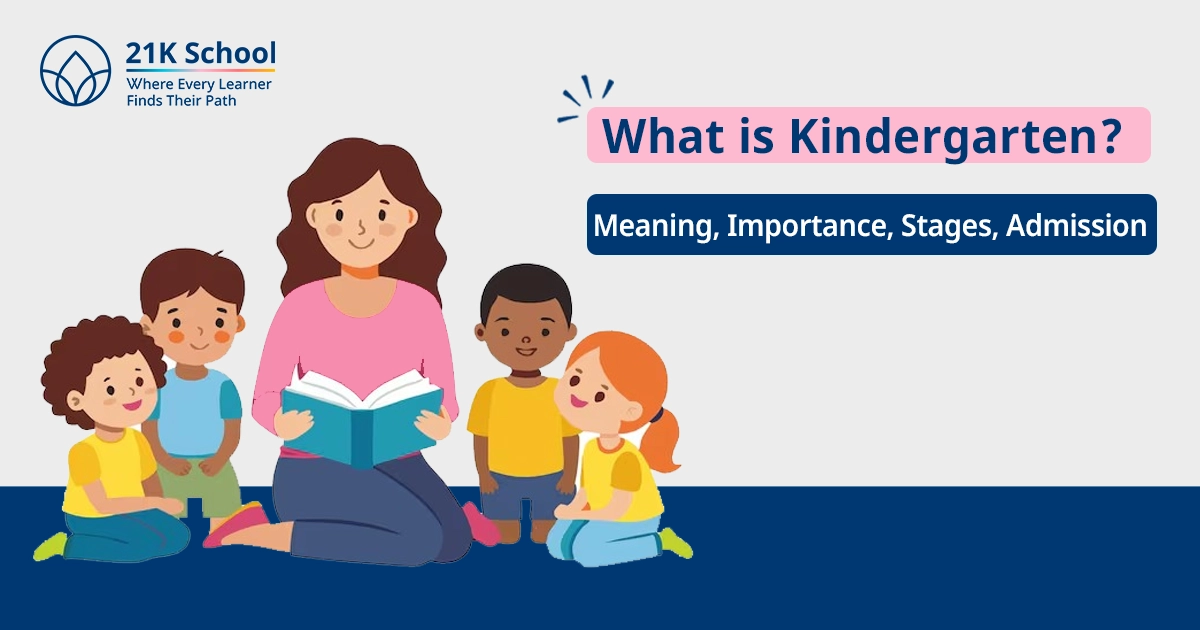
Kindergarten is an early childhood education and formal program for children; it is normally offered in a structured manner in which young children can acquire knowledge by playing and learning.
Parents also get informed about the right ways early learning works for their children. It provides an environment to access basics and get assistance in different languages, social, emotional, motor, and physical skills.
Right age for kindergarten admission in India
By rule, for children of 4-6 years of age, depending on the school and the system of education where they learn early literacy, numeracy, communication and systematic learning.
They learn how to become more organised, work under schedules and have time to learn with play by engaging in activities.
Children form early literacy and numeracy habits, communication, social and learning habits. The journey helps in adjusting from preschool and primary education.
Stages of kindergarten in India
Under our latest education structure, kindergarten is divided into two parts. Both parts must essentially be completed for the children's educational growth.
It is essential to understand these stages so that parents can comprehend their children's needs and enrol them, and facilitators can guide them in the right direction.
1. Lower kindergarten (LKG)
Those who are between the ages of 4 and 5 years belong to this stage, where parents enrol children to give them enough time to develop pre-literacy and pre-numeracy abilities and get motivated to learn.
During the process of learning to communicate, fine-motor coordination and school-readiness, students are trained to identify letters and numbers.
Facilitators take care that students are introduced to:
- Alphabets
- Basic numbers
- Class routine
2. Upper kindergarten (UKG)
It is for children aged 5 to 6 years, which equips children for primary school. This includes reading and writing preparedness, number sense, simple problem-solving, communication and on-task classroom activities.
- Word formation
- Writing practice
- Basic math
Why is kindergarten important?
Parents should not avoid kindergarten, which includes pre-reading, pre-writing, counting, vocabulary development and basic concepts. It helps in the development of early stages so that children can learn, play and practice age-appropriate activities:
1. Improved school readiness
Starting school is tough; not every child is ready for their first day, but confidence comes when, instead of struggling to meet people and become friends, they become free to meet and interact with everyone.
2. Enhanced communication skill
Avoiding skills in early education is a drawback for children. They need space to understand their ability and better ways to express questions, connect with individuals, start a conversation, take part in discussion, and be free to connect and collaborate.
3. Play-based curriculum
Kindergarten is a combination of learning and playing via activities, games and story experiences. Children become interested and encouraged to love learning. Multiple activities are pre-designed through which children are able to learn and play effectively.
4. Early literacy
In early learning, the foundations of literacy and numeracy must be developed. It ensures further learning in:
- Reading
- Writing
- Language
- Number
5. Cognitive growth
Cognitive means mental health development, which ensures that a child should become mentally strong in every situation, from learning to playing.
6. Motor skills
Kindergarten must aid in the development of children physically, cognitively, socially, emotionally and creatively. In this way, children are not only introduced but also participate and play to improve early motor skills.
7. Academic foundation
Kindergarten enables children to know basic information related to numbers, letter understanding, phonics, shapes and reading in a structured classroom to get a hint of future learning.
They are more inclined to hands-on and interactive approaches instead of depending on memorisation.
How to choose a school for kindergarten?
Schools play a major role in the kindergarten journey of a student, and parents are responsible for selecting the right school to make the process smoother and prepare them for the future.
1. Whether teaching is good
Rather than checking the popularity, make sure that the teaching and the learning structure of learning used in the school you have selected are ideal for kindergarten to make students' education effortless.
2. Environment is ideal
Don't avoid the environment because, by spending a lot of time in school, children understand what they are seeing in the particular environment.
As per the guidelines, the kindergarten should follow the official rules with respect to age, admission, and implementation of teaching style.
Through the right activities, children learn routines of learning to prepare them for first formal schooling.
3. Seeking public or private
Kindergarten is a phase that is more inclined toward education than preschool, and that's why parents seek the best option for their children, and choosing between public and private school needs deep insights.
You must know:
- Student-teacher ratio
- Classroom environment
- Safety and security
- Emotional support
- Teacher quality
- Learning approach
Kindergarten admission process
Parents concerned about their children's admission in UKG or LKG need to acquire enough information to apply on time:
1. Find right school
Finding the right school for your child needs searching and shortlisting. Parents generally choose 2 to 3 schools that are near their residence.
2. Fill out admission
Go to the school websites or speak to the admission team to fill out the application form without delay. Remember to check the last date of the form.
3. Prepare the documents
Documents are a part of the application; without verifying them, the school can reject the admission. Prepare the required documents of both parents and children.
4. Submit and attend the interaction
Submit the form; it requires accuracy and fee payment. Attend the interaction in which teachers observe every move of the child.
Difference between preschool and kindergarten
Quick information about preschool and kindergarten to know the real comparison analysis:
| Aspects | Preschool | Kindergarten |
|---|---|---|
| Age | 2-4 years | 4-6 years |
| Structure | Flexible play-based learning | Structured with formal lessons and tasks |
| Teacher credentials | Can be a teacher or an assistant | Qualified teachers |
| Duration | May be half-day or even full-day | Generally a full-day program |
| Curriculum | Social and emotional skills with play | Start of reading, writing, maths, and formal chapters |
Final thoughts
For better learning opportunities and improvements in daily life, kindergarten involves languages, reading, physical and mental skills. However, it is different from preschool because kindergarten promotes structured and formal learning.
However, make sure to choose the right kindergarten because it may vary as per learning style, curriculum, teaching and the environment where they are learning with protection and qualified individuals.
Frequently asked questions
8 questions
Is kindergarten and LKG the same?
Both of them are not the same because LKG is part of kindergarten.
What are the 5 methods of teaching for kindergarten?
Teaching methods of kindergarten are play-based learning, Montessori method, storytelling, hands-on approach, and music and movement.
What are 4-year-olds called?
A 4-year-old is called a preschooler.
Is 2.5 years too early for nursery?
Yes, 2.5 years is too early for nursery. At this age, children can take admission in pre-nursery (playgroup).
Is nursery mandatory for LKG?
No, it is not mandatory for LKG
Can a 4-year-old be in nursery school?
A 4-year-old can be in nursery school.
What comes after LKG?
UKG or Upper Kindergarten is next.
What is pre-kindergarten?
Children aged 2.5 to 3.5 years old can enrol in pre-kindergarten before regular kindergarten.
About the author
Ankita Singha
Content Specialist
Ankita Singha is an Education Content Specialist at 21K School, India’s first accredited fully online K-12 School. She focuses on the in-depth research and creation of the well-drafted guides on early childhood education, school admission processes, and CBSE/ICSE curriculum guidance. With more than 2 years of experience at 21K School, a fully accredited institute- Cambridge International (IA702) and Pearson Edexcel (94883), Ankita works closely with the school’s curriculum heads and academic coordinators. Ankita’s every article reflects on the official board guidelines, practical realities, and current policies of online education in 78+ countries. Ankita’s content has helped thousands of parents in understanding the topics like RTE eligibility, NIOS pathways, and age-appropriate admission criteria.
Every 21K School guide is written by our education team and reviewed by a subject facilitator before publishing.
Exploring a CBSE-pathway online school?
Talk to an advisor about 2026–27 admissions — no obligation.
Talk to an advisorComments
No comments yet — be the first to share your thoughts or ask a question.