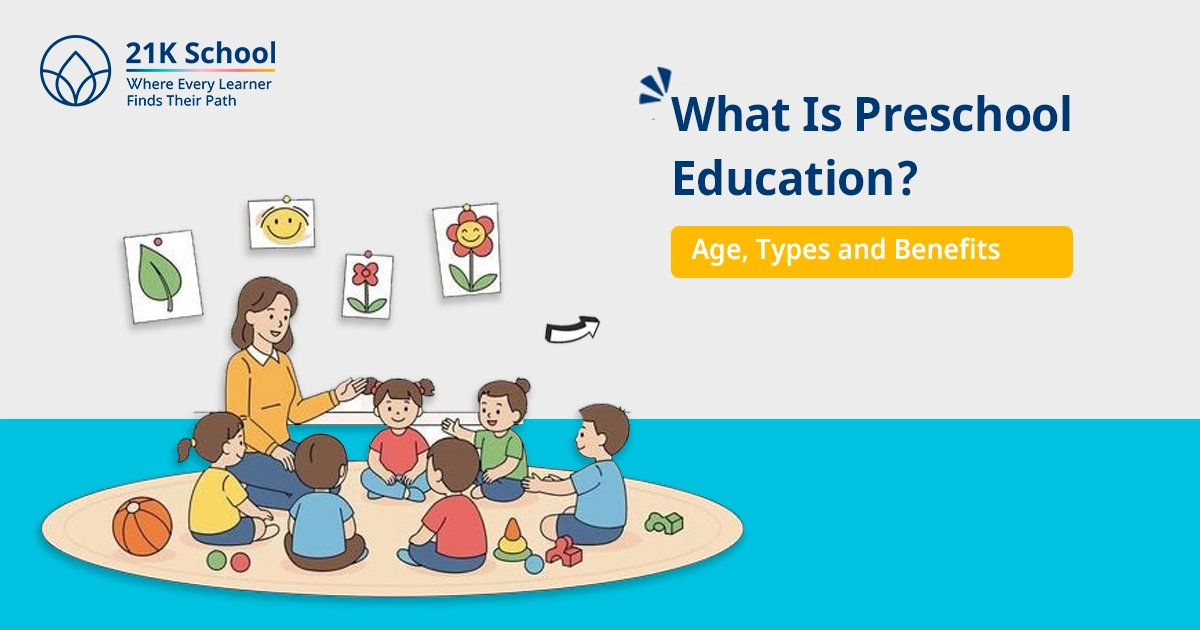
What Is Preschool Education? Age, Types and Benefits
 Written byRahul PalContent Specialist
Last modified: Sep 15, 2026 17 min read
Have you ever thought about what makes preschool an essential initial step before formal schooling?
One of the crucial aspects of this transition is preschool. Through stories, games, creative activities, conversations and interaction with other children, preschool offers the young learner the chance to explore and learn important skills.
It also assists children in getting accustomed to routines, communication, self-contained activities and sharing.
Knowledge of how preschool should be carried out, what the children learn and how it is helpful in the early stage of development of the children will help parents make a more informed decision on what early learning their child receives.
What is preschool?
Preschool is an early childhood education level where young children who are of delicate ages start to learn by playing, exploring, storytelling activities and interaction with one another.
It exposes the children to the basics and assists them in acquiring language, communication, motor, cognitive and social skills.
Children also get used to the ways of the classroom, group work and individual work through the use of preschool before the children begin to receive formal education.
It creates a supportive environment where children can do what they love doing, mingle with other children and learn the skills needed at their own pace.
Preschool programs age group
The preschool programs too are widely classified into various stages as far as age group and child development is concerned. Depending on the schools, age may differ, but the normal arrangement in India is made up of:
1. Playgroup - 2 to 3 years
Playgroup introduces children to a learning environment that is based on play, music, stories, movement and direct simple group activities. The emphasis is on social contact, communication and building up of early motor skills.
2. Nursery - 3 to 4 years
Nursery children are introduced to their first language, counting, shapes, colours, drawing and creativity. Children also get to play around, learn how to participate in group activities, follow simple instructions and get more accustomed to the routines in the classroom.
3. LKG - 4 to 5 years
LKG additionally includes pre-reading, pre-writing, counting, vocabulary and basic concepts. During the process of learning to communicate, fine-motor coordination and school-readiness, children are trained to identify letters and numbers.
4. UKG - 5 to 6 years
UKG equips children for primary school. This includes reading and writing preparedness, number sense, simple problem-solving, communication and on-task classroom activities.
Top 6 importance of preschool
Preschool helps in the early development of children by providing them with a chance to learn, socialise, experiment and practice age-related abilities within a well-structured environment.
1. Foundational development
Preschool enables children to learn early skills, which can be used in later lessons. Activities based on language, number, shape, colours, movement and creative expression promote key concepts as they are age-relevant.
2. Cognitive development
The preschool activities also enhance cognitive development as this requires the children to observe, memorise, compare, classify and solve simple problems. Activities that develop early thinking and reasoning are puzzles, storytelling, matching activities and directed exploration.
3. Physical development
Movement activities aid the child to learn gross and fine motor skills. Coordination, balance, and control are enhanced by running, jumping, drawing, colouring, cutting, building and manipulating objects.
4. Social and emotional development
Preschool is the time when children become conscious of emotions, their expression, and overcoming some simple frustrations and realise the role of their actions on other people. The experiences will help them gradually develop confidence and sensitivity.
5. Peer interaction
Playing with other children will help the preschooler to practise sharing, taking turns, collaborating and listening, as well as doing group work.
The high level of interaction with children their age also provides the children with the chances to acquire early friendship and communication skills.
6. School readiness
Preschool teaches the children to get used to routines such as listening to the teacher, performing activities, making sure that their possessions are clean and moving around the different activities. These experiences can help ease the transition to formal schooling.
7 types of preschool programs
Preschool programs can differ with regard to their age of teaching, the way of teaching, the day structure and the aim of learning. Both are more play-oriented and socially oriented, and one arranges the primary school preparation in a more holistic manner.
1. Playgroup
The Playgroup is usually created to target younger children and is aimed towards play, communication, movement and socialisation.
Kids participate in songs, narratives, sensory activities, as well as simple games because they are comfortable in a group.
2. Nursery
Nursery introduces children to more formal education, and activities undertaken in the nursery are age-friendly and interesting.
Early language, number, motor, creative and social development of children is nurtured by stories, drawing, games, rhymes and classroom activities.
3. Pre-kindergarten
Pre-kindergarten, also referred to as pre-K, equips children to enter school by the end of kindergarten with the help of the interactional approach of learning.
Activities can include early reading, writing, mathematics, problem-solving, communication and daily classroom activities.
4. Kindergarten
A more organised early-learning experience is available in Kindergarten, and is more likely to provide a transition between preschool and primary education.
Children form early literacy and numeracy habits, communication, social and learning habits.
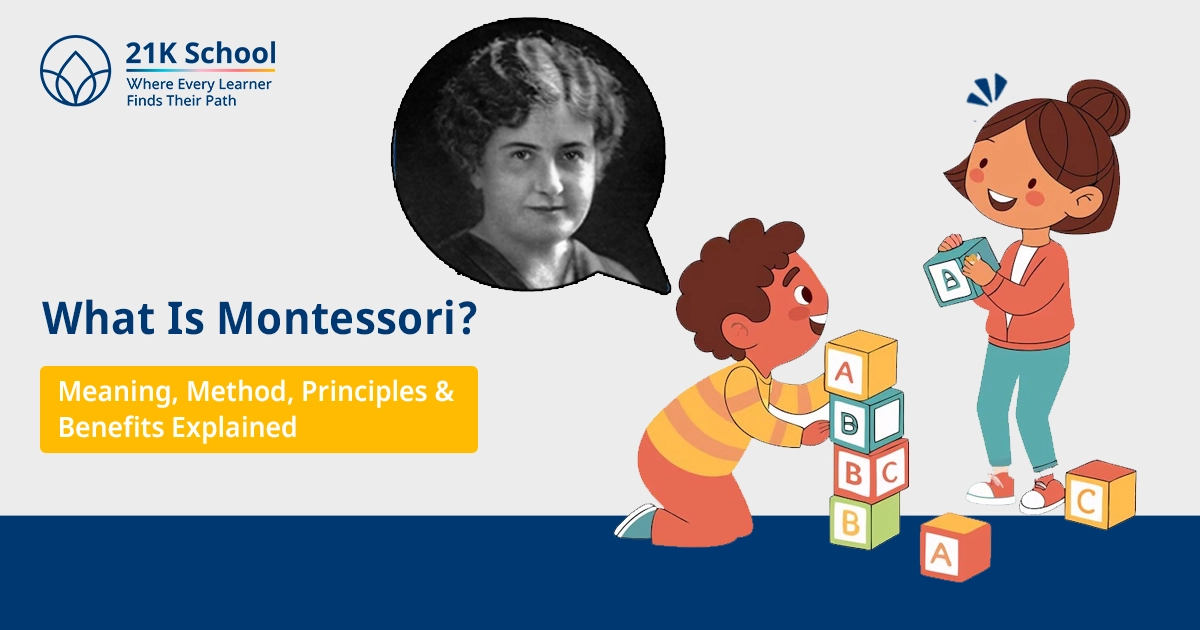
5. Montessori preschool
The Montessori preschool revolves around the Montessori education system; the children are taught through working with materials and deliberate tasks.
Children are encouraged to think and make their own decisions and learn practical, sensory, language and mathematical skills.
6. Daycare with preschool education
Daycare centres are combined childcare and early learning centres. Children are also monitored and attended to and engaged in activities based on age, such as storytelling, art, music, games and simple learning activities.
7. Play-based preschool
Play-based preschool is a learning style that utilises play as an important technique. Pretend play, construction activities, games, storytelling, exploration and guided activities assist children in learning language, thinking, social, physical and creative skills.
Subjects taught in preschool
Preschool is not typically subject-laden in its academic curriculum. Instead, children learn the required information when they play, tell stories, engage in activities, discuss and experience.
1. Early language and vocabulary
Children learn language by making use of new words, listening to tales, singing rhymes, answering questions and talking.
The exercises are not only useful in transferring their ideas but also in recognising the speech of other people.
2. Pre-reading and pre-writing skills
In preschool, the concepts of reading and writing are introduced to the children.
They are taught to identify letters, sounds and how to work with books, trace shapes and letters and work on drawing or making simple marks.
3. Early numeracy
Simple mathematical concepts are introduced to the children through the use of simple games and activities.
They enumerate, count, compare, sort, and possess the conceptual understanding (simply) of more, less, big and small.
4. Shapes, colours, and patterns
Simple patterns are learnt as children learn to define and to categorise familiar shapes and colours. They learn similarly about differences, sequences and visual relationships.
Matching games, blocks, drawing, puzzles and classroom objects can assist them to be aware of similarity, differences, sequences and visual relationships.
5. Environmental awareness
Environmental education assists children to comprehend the world. They can see, read stories, do experiments and undertake outdoor activities to understand animals, plants, weather, family, people who help in the community, seasons, food, cleanliness, and safety.
Difference between preschool and kindergarten
Preschool and kindergarten assist in early education, and the distinction between the two is gauged by the age of the child, the teaching method, the classroom set-up and the transition to primary school.
| Aspect | Preschool | Kindergarten |
|---|---|---|
| Age Group | This is normally with children who are 2-5 years old, based on school and programme. | By rule, for children of 4-6 years of age, depending on the school and the system of education. |
| Learning Focus | Familiar with the ability to move, communicate, be creative and play, and simple concepts. | Increased school preparedness, early literacy, numeracy, communication and systematic learning. |
| Teaching Approach | More often than not, it deals with play-based and activity-based learning through stories, games, art, music and exploration. | Integrates teaching/learning with learning activities, hands-on activities and classroom-based learning. |
| Daily Routine | Usually, it does not have a strict schedule and is more concentrated on free play and exploration. | More organised schedule and has time to learn and to engage in activities. |
| Purpose | Conditioning even permanent children on fundamentals and making them comfortable in a group and classes. | Equips children to start going to primary school by developing their initial academic and in-class skills. |
Top 6 benefits of preschool education
Preschool education offers children experiences that will help them to grow and, in turn, equip them gradually with the routines, anticipation of interaction and learning of formal school education.
1. Develops classroom readiness
Preschool also introduces the children to classroom routines which involve listening to instructions, performing tasks, moving on tasks and group sessions. This eases the transition to primary school with this familiarity.
2. Builds communication skills
Children experience a lot of speaking and hearing through storytelling, conversations, songs, role plays and group activities. The experiences help them to express their needs, share ideas, learn about others and expand their vocabulary.
3. Encourages peer interaction
Preschool will provide the children with an abundance of contact with children. Sharing materials, turns, participating in activities and in simple conflicts will promote the growth of young relationships and social building skills.
4. Enhances motor coordination
Fine and gross motor skills are practised with drawing, cutting, piling blocks, threading, running and jumping and outdoor games. Hand-eye coordination, body and balance, control and physical confidence can be established with training.
5. Develops early learning habits
Preschool aids children in getting acquainted with routines like paying attention, obeying instructions, doing simple chores, posing questions, organising materials, and also engaging in activities.
6. Encourages independence
Age-appropriate preschool activities can help children train in some simple tasks on their own, including sorting belongings, choosing activities, cleaning up materials and satisfying their own primary needs. This builds up a feeling of responsibility, self-reliance and confidence.
Is my child ready for preschool?
Preschool preparedness is not the same for every child. Instead of making assumptions about some academic skills, parents can observe how children talk, how they can make routines, how they interact with others and how they manage simple daily tasks.
These simple indications enable them to know when their children are prepared to join preschool or not.
1. Emotional readiness
Once able to spend a certain minimum of time without parents, able to cope with minimal frustrations and integrate increasingly with new individuals or the environment, it is possible to offer emotional preparedness.
2. Starts communicating
Kids start communicating basic needs in word-based, gesture-based, facial expression-based, or simple sentence-based ways, which allow the children to communicate with the teachers and other children in day-to-day interaction in the preschool.
3. Ability to follow basic routine
Some simple rules, such as creating a routine of washing hands, eating, cleaning, sitting and changing things and tasks, can help preschoolers to adjust to the new setting.
4. Basic independence
The most basic tasks of eating, washing toys, carrying items, and washing hands or even basic efforts towards taking care of oneself, are a lot more autonomous.
5. Ready to socialise with others
Being interested in other children and learning to share gradually, to take turns, to play with others, to listen and to be involved in group activities can be signs of social readiness.
Preschool teaching methods in India
Various methods of education can be used in preschools in India depending on their curriculum, school philosophy and developmental needs of the children. Some of the common methods include:
1. Montessori method
Montessori method utilises learning tools, real-life activities and independent learning. Children are given a choice of activities at their level, allowing them to learn through first-hand experience with the learning materials.
2. Playway method
The playway approach entails play as the learning environment. Children are not necessarily taught a lot of formal instruction in concepts, but instead they learn them through games, stories, songs, role-play, art, movement and other fun things.
3. Reggio Emilia approach
The Reggio Emilia approach teaches children to think, ask questions, communicate and learn via projects. Teachers can monitor, based on their inquisitions and observations, what children care about, on which they build learning experiences.
4. Waldorf approach
The Waldorf method emphasises imaginative play, story-telling, art, music, movement, and experience with the natural world.
Learning is normally introduced in small bits, where their levels of development are taken into account and not stressed academically at such a tender age.
5. Integrated/thematic learning
This style relates all the learning fields to one theme, and through the related activities and experiences, the children can indulge in language, numbers, art, science and social concepts.
7. Technology-enabling and gamified learning
This approach includes the use of education applications, digital games, animation, and interactive activities to bring out ideas of letters, numbers, colours, sound and patterns of the preschool context in a manner that is engaging.
Types of preschool in India
Preschool child education in India takes a number of forms, and in this case, the child can be taught by means of government-sponsored centres, school-based programmes, as well as childcare centres.
1. Anganwadi centres
Anganwadi centres are early childhood care and education centres for young children which are run by the local community.
They also provide healthy, nutritional, growth-monitoring, and development-friendly meals. Such centres have a great role to play in the provision of early childhood services, particularly in areas that have not been well served.
2. Balvatikas
Balvatikas are classes that are aimed at assisting young children to acquire the basic learning and school-readiness skills.
Activities involving play-based learning where children are exposed to language, numeracy, creativity and social development are included. They help facilitate the easier assimilation of early childhood learning to formal learning.
3. Daycare and crèches
The most prevalent services provided by daycare centres and crèches in the absence of the parents include childcare and supervision.
Most centres also have activities related to learning age like play, telling stories and other creative activities. These are mostly immersed in the act of addressing the needs of children who have an early developmental perspective, in terms of their care needs.
4. Balwadis
Balwadis are community-based centres where children at tender ages are allowed to learn. They largely use play, stories, songs and simple elements to assist the children in developing at an early age.
They can provide a local community-based early learning environment, especially in local communities.
Early Childhood Care and Education (ECCE) and NEP 2020 on preschool education
ECCE deals with the development of children between the ages of birth and 8 years as a whole and their cognitive, linguistic, physical, social, emotional and creative development. It involves cultivating and teaching, not merely schoolwork.
ECCE helps in encouraging play, activity and inquiry-based learning in children at the preschool stage. Children do not need to be pressed to undergo any serious academic practices when they are young; they read a story, play, draw, dance, explore and interact.
NEP 2020 recommends the pre-school program to be the Foundational Stage and age group (3-8 years).
The policy suggests that the learning at this stage should be flexible, multidisciplinary and play-based.
Key focus of NEP 2020 for preschool
- Play-Based Learning: Children will learn via play, activities, stories, games and practical experiences.
- Early Literacy and Numeracy: During early learning, the foundations of literacy and numeracy must be developed to ensure further learning in reading, writing, language and number.
- Whole Child Development: Preschool education must aid in the development of children physically, cognitively, socially, emotionally and creatively.
- School Readiness: ECCE needs to prepare the children for the learning processes and experiences that they will be experiencing in primary school.
- Regional Languages: NEP 2020 proposes to use home language (children) or a common language in the region as a medium of instruction in the lower years, where possible.
How to choose the right preschool?
The selection of a preschool is not made based on academics, but on the environment that is suitable to the age, development, comfort and the learning requirements of the child.
1. Teaching approach
Start with understanding the teaching approach of the preschool and its activities. Check to see whether it embraces age-based methods such as play-based, activity-based or hands-on learning, instead of excessive academic pressure.
2. Safety and hygiene
Always look at whether the classroom, toilet, playground, and eating area are well-hygienic. Ask about the procedure for entry and exit, children supervising procedures, emergency procedures, first-aid installation and campus safety as well.
3. Classroom environment
The classroom environment should be welcoming, clean, well-ventilated and appropriate to young children. Search for age-related learning resources, adequate space to move around, as well as individual and group activities.
4. Location and schedule
Think about how it would be more convenient to access the preschool at home, and its timetables with regard to the daily life of the child. Consistency can also be attained as it is an accessible location and has manageable time.
5. Budget
Compare tuition fees with other expenditures like admission fees, transportation fees, food, uniform, books, activities and other services. Select an alternative that offers the appropriate facilities without stressing the finances.
Conclusion
Preschool provides a learning opportunity that enables a child to learn the necessary language, cognitive, physical, social, emotional and self-help skills.
Through play, exploration, stories, creative work and interaction, children learn routines of learning and gradually become prepared to be initiated into formal schooling.
Preschool programmes may vary, in respect of age group being taught, learning strategies and curriculum; this is why parents must be in a position to consider their child's development needs, the learning environment, security and how the school addresses them when they are choosing preschool.
Frequently asked questions
9 questions
What is preschool in simple words?
An early childhood education program is known as Preschool that educates young children through play, activities, telling stories, interacting with them and so on.
What age is preschool for?
Preschool is usually offered to children aged 2-5 years in relation to the schools and education systems of the different countries.
What is the difference between preschool and kindergarten?
Preschool correlates to a previous level of education prior to primary school, but kindergarten is more of a phase with a more school-influenced orientation.
What do children learn in preschool?
Children acquire early language, pre-reading, pre-writing, numeracy, shapes, colours, patterns, communication, social skills, motor skills, as well as basic self-help.
Is preschool necessary for children?
Preschool is not the sole way that a child can get early skills, but a good preschool might provide a systematic way of learning, playing, socialisation, and school preparation.
What ages are preschool and kindergarten?
The preschool usually includes children between 2-5 years, and kindergarten usually includes children between 4-6 years. The age restriction, however, varies with school and region.
What are the key differences between preschool and pre-K?
Preschool is a broad term which is used to refer to the education of early childhood, and pre-K is a programme which is more commonly used in a bid to prepare children to join kindergarten or formal education.
What is preschool development?
The process of language, thinking, physical, social, emotional, creative and self-help development in preschool years is known as preschool development.
Is preschool kindergarten?
No. Although kindergarten and preschool may involve the same age range, they are not necessarily the same. Preschool is a wider period of early education, and kindergarten is a narrower period of early childhood education.
About the author
Rahul Pal
Content Specialist
Rahul Pal is an Education Content Specialist at 21K School- India’s fully accredited online school recognised by the Cambridge International (IA702) and Pearson Edexcel (94883). His graduation from Journalism and Mass Communication from Swami Vivekananda University gives him a strong foundation in factual reporting, source verification, and investigative research. With around 2 years of experience at 21K School, he has written extensively for the CGPA conversion guides, marking schemes, and Indian and International boards (IGCSE, GCSE, and A-Levels). His articles are highly relevant for the guardians looking to guide their learners for board exam preparation across 78+ countries. All Rahul’s content is reviewed by the school’s academic team to ensure alignment with the latest board guidelines and latest notifications from the official resources
Every 21K School guide is written by our education team and reviewed by a subject facilitator before publishing.
Exploring a CBSE-pathway online school?
Talk to an advisor about 2026–27 admissions — no obligation.
Talk to an advisorComments
No comments yet — be the first to share your thoughts or ask a question.