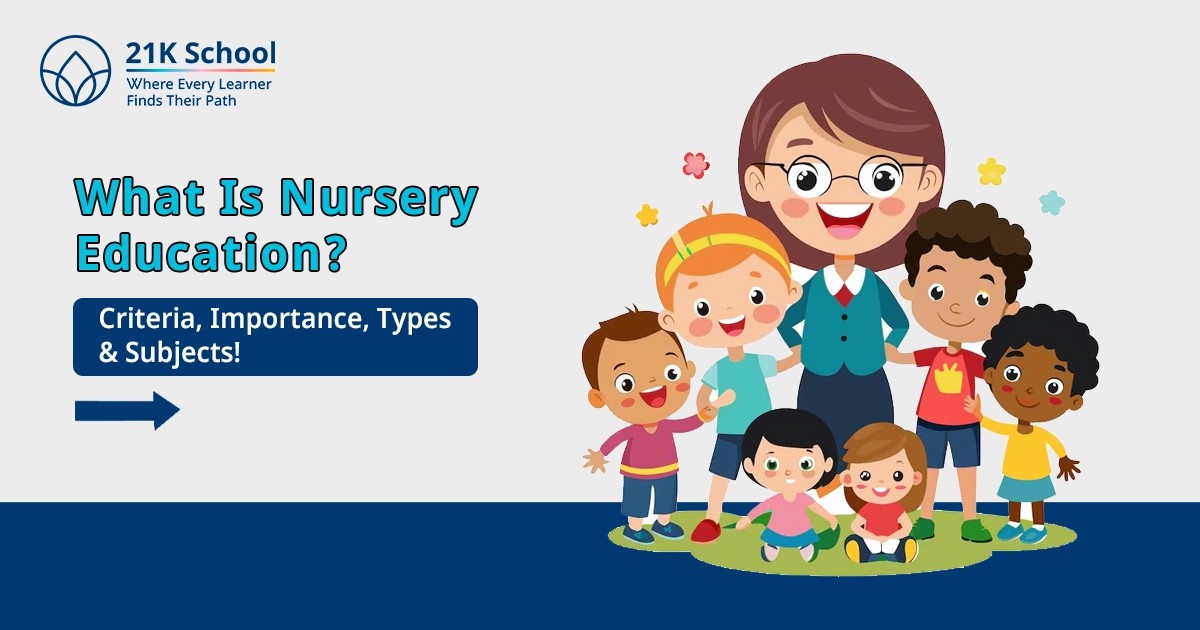
What Is Nursery Education: Criteria, Importance, Types & Subjects!
 Written byRahul PalContent Specialist
Last modified: Sep 15, 2026 12 min read
What would the first formal learning experience of a child entail?
Nursery subjects young children to a systematic learning experience through play, storytelling, conversation, artistic activity and simple classroom routines.
It concentrates on building early language, a sense of numbers, motor skills, social skills and autonomy instead of academic schoolwork.
Nursery normally falls into the age group of approximately 3-4 years, and it helps children familiarise themselves with group activities and helps them transition towards the next stage of early education, i.e. LKG.
What is a nursery?
A nursery is a period of early childhood learning (usually for children around the age of 3-4 years), and during this time they get introduced to a more structured learning process. Stories, rhymes, games, art, movement, talks and practice are all taken part in by children.
The development of language, early numeracy, motor coordination, social skills, communication and independence are achieved through these experiences.
Most of the Indian schools have a nursery before the LKG, which enables the children to familiarise themselves with the classroom routine and work in a group prior to the next phase.
Nursery age criteria: 3-4 years
The average age of children enrolled in nursery school is 3 years old, and the majority of children enrolled under the programme are 3 years to 4 years old.
Nevertheless, the age of admission may be different in different schools with regard to age-cutoff policies and the school year. Most of the schools have a transfer of children to LKG after one year of nursery school.
Before applying to a specific school, parents need to ensure the actual admission policies of the school to guarantee the age and cutoff date of the school.
Top 6 importance of nursery education
Nursery education assists in various aspects of development during the early childhood stages as well as initiating the children into formal education, teamwork and classroom experiences up to the age.
1. Cognitive development
The nursery activities assist the children to observe, compare, sort, remember and solve simple problems.
Puzzles, counting games, matching activities, and hands-on activities reinforce early thinking and reasoning and help in the cognitive development of children.
2. Social development
Children are never out of touch with teachers and fellow children. Group activities enable them to practice sharing, taking turns, cooperation, listening to others, and playing along with their peers.
3. Language development
Stories, conversations, rhymes, songs and picture activities introduce children to new words and sentence patterns.
The constant communication is helpful in the development of vocabulary, listening abilities, articulation and confidence in conveying thoughts.
4. Physical development
Physical development is supported by drawing, colouring, building, threading, running and jumping, amongst others.
Fine-motor activities improve the ability to control hands; however, the advantage of outdoor play is that it improves balance, coordination and greater motions of the body.
5. Emotional development
Nursery helps children to show feelings, discuss, solve minor disappointments and feel at ease in a new situation. Emotional awareness and self-confidence can be attained through positive relationships with the teachers in the long run.
6. Early learning habits
The daily nursery practice helps the children to develop habits such as listening during activities, instructions, simple activities, keeping materials clean and movement activities between activities.
The practices give a background of what is to be learned in the classroom.
Types of nursery
The nursery programmes will vary in their approach to teaching, daily activities, learning and childcare facilities, which will provide alternatives to the parents to suit the needs and preferences of their children.
1. Traditional nursery
The conventional nursery classroom routine is based on teacher-led classroom activities.
Premeditated lessons and group work introduced children to language, numbers, drawing, rhymes, and easy ideas.
2. Montessori nursery
The Montessori nursery was based on specialised learning materials and hands-on activities to promote independent exploration.
Children learn at their own pace without rushing to learn, but to develop practical and sensory, language, mathematical and coordination skills.
3. Play-based nursery
Play-based nursery entails utilising games, pretend play, stories, music, puzzles and creativity to introduce ideas.
The children learn communication, thinking, social, physical and emotional skills through fun learning activities.
4. Daycare nursery
Daycare nursery is a blend of early childhood education, child care and child supervision.
In addition to education activities, the children can also be provided with meals, rest, personal care, outdoor play and opportunities to socialise.
5. International nursery
International nursery programmes mostly adhere to international curriculum or instruction methods and might adopt English as the medium of instruction.
They are oriented at communication, imagination, discovery and international consciousness.
Nursery teaching methods
The approaches used in teaching nursery are orientation-based and involve making the learning process an active one whereby the learning process engages and occupies the young children as compared to the usual classroom learning process.
1. Play-based learning
Games, pretend play, puzzles, blocks and simple playful activities are ways in which children learn.
This process not only ensures that learning is fun but also aids communication, creativity, thinking, social interaction and problem-solving.
2. Activity-based learning
Children learn through activities such as drawing, counting, sorting, matching, singing and movement.
Such activities assist them in practising concepts, enhance attention, coordination, communication and participation.
3. Story-based learning
Stories, picture books, rhymes and storytelling are used to present new words and ideas as well as situations.
They ensure children listen, think and answer questions, build imagination and learn early language skills.
4. Thematic learning
The various learning areas are connected with one theme such as animals, family or seasons.
The children familiarise themselves with the theme using stories, art, counting, songs, conversations and simple activities.
5. Hands-on learning
Children engage in exploration of concepts using real objects, blocks, clay, puzzles and sensory materials.
The process encourages active involvement and building up of coordination, observation, creativity and practical knowledge.
Subjects taught in nursery
Even simple things are learnt in nursery through age-friendly activities, rather than formal instruction.
This is based on early skill development through play, practice, interaction, and exploration.
1. Language
Children develop their communication skills and vocabulary in the form of conversations, rhymes, songs, stories and picture and image-based activities.
They listen, talk, use familiar words and are able to communicate their thoughts in simple sentences.
2. Letter and sound recognition
Children are introduced to the letters and simplest sounds through the use of songs, picture cards, tracing, matching and games.
The focus is on learning to be familiar with letters and not on fluent reading.
3. Basic numeracy
Early numeracy includes counting, recognising numbers, sorting, matching and comparing amounts.
It is through toys, objects, games and real-life situations where children are taught to have an elementary number sense and a simple thought process with regard to mathematics.
4. Shapes, colours, and patterns
The drawing, matching, sorting, puzzles and objects in the classroom allow the children to learn the skills of recognising common shapes and colours, sizes and simple patterns. Exercises enhance observing, classifying and recognising.
5. Environmental awareness
Children are able to feel their immediate environment, which includes family, animals, plants, food, weather, cleanliness and community assistants.
Learning and the normal experiences can be linked to stories, discussions, outdoor observation and basic activities.
Advantages of nursery
In nursery, children are helped to grow at this tender age through play and day-to-day activities in the classroom, which assist the children to learn, communicate, develop social skills, motor skills as well as independence skills.
1. Builds early learning skills
At nursery, the children are exposed to various activities that are related to their age on the basics of language, numbers, shapes, colours and patterns, among other things.
It is these initial experiences that can help in the delivery of a base on which additional formal teaching in the next classes can be given.
2. Encourages social interaction
The unending interaction with their peers provides the children with the chance of sharing, taking turns, cooperating, listening and performing group activities.
The experiences help them to feel comfortable in communicating with and working with others.
3. Develops motor skills
Drawing, colouring, building blocks, clay work, threading, running and others help in fine and gross motor skills development.
Practice enhances hand control, balance, coordination and movement.
4. Builds independence
The nursery routines assist children in carrying out such simple activities as organising, washing hands, eating and putting away materials.
These activities may be resolved step-by-step and instil confidence and self-reliance.
5. Improves communication
Children are exposed to new words and alternative methods of expressing themselves through stories, rhymes, conversations, songs and classroom conversations.
Vocabulary, listening, speaking, and confidence will develop as well due to constant communication.
How to know if the child is ready for nursery?
Children do not become ready to go to nursery at the same time, and as such nursery preparedness cannot be based on academic ability.
Simple signs of communication, interest, interaction and early learning may be of interest to parents.
1. Starts basic communication
During day-to-day communication, the child is able to express simple needs either using verbal communication or non-verbal communication, using simple sentences or simple responses to common questions or instructions.
2. Starts counting
A desire to count things, see a few numbers or repeat a series of numbers can be indicators of emerging numeracy skills, which can be utilised in nursery education.
3. Recognition of objects
The vocabulary, perception of the surrounding world, observation and memory development are happening as the ability to see familiar objects, animals, colours, toys or everyday objects.
4. Increases curiosity
Questions, mishandling of objects which he has not encountered and watching the world and exploring the new are the cues that the child is captivated with exploration and experience as a means of learning.
5. Shows interest in books
Early literacy experiences through reading picture books, telling stories, pointing out pictures or posing questions about characters all show an interest in language and early literacy experiences.
6. Tries to socialise
Taking an interest in other children, playing with them, sharing with them toys, taking turns or engaging in simple group activities are signs of a growing readiness for a nursery environment.
How to prepare kids for nursery
The nursery preparation process essentially involves preparing children to get comfortable with the rudimentary routine, communication, independence and interrelationships in their lives prior to being exposed to a new learning environment.
1. Establish daily routines
Establish a basic morning wake-up, breakfast, play, sleep and rest routine. The routine also helps the children get used to a routine that is close to the one they used during a nursery day.
2. Encourage independent tasks
Give children the opportunity to independently engage in simple activities such as eating, cleaning, washing hands, putting on shoes or carrying around small objects.
3. Practise communication
Get children to talk or make gestures to tell about their needs, feelings and preferences.
To develop vocabulary and confidence regarding communication, read stories, pose simple questions, and talk about simple conversations.
4. Encourage social interaction
Give an opportunity to play with other kids, such as play dates, family get-together, group activities.
Promote sharing, turn-taking, listening and collaboration so that the children might be more at ease with each other.
5. Practise separation
Begin with short absences with the child and increase the duration as the child gets used to it.
Gradually use a goodbye ritual, and promise them that you will come back when they have completed the activity.
Conclusion
Nursery gives the kids a formative learning experience whereby language, numeracy, motor, social and communication skills are developed in play and age-specific activities.
It also familiarises the children with the routine in the classroom and prepares them to make the next leap in further education, in this instance, LKG.
Different schools might differ in age, standard of curriculum and admissions and thus the parents should enquire about the nursery programme when sending children to nursery in advance.
Frequently asked questions
10 questions
What is a nursery in school?
Nursery is a type of early childhood learning which generally involves kids aged around 3-4 years, where they are taught simple skills which they acquire via play, activities, tales and their interactions with the classroom.
What age is nursery for?
Generally, a nursery will target children within the age group of 3-4. At what age admission occurs, and the cutoff dates might, however, vary in schools.
Is nursery the same as preschool?
Preschool education may be considered as a part of nursery school. Depending on the school, playgroup, nursery, LKG and UKG can be subsumed under a larger school term, preschool.
What is taught in nursery?
The board, letter and sound recognition, simple numeracy, shapes, colours, patterns, environmental recognition, creative works and social skills are becoming a norm in nursery schools.
Is nursery compulsory before LKG?
Pre-LKG nursery is optional. We have schools where children can attend LKG provided they meet the age criteria as well as the admission criteria.
What are nursery art and craft activities?
Nursery art and craft activities include drawing, colouring, finger painting, tearing sheets of paper, pasting papers, clay modelling, collage-making and other simple craft projects which are child-friendly.
How to start with the nursery class syllabus?
Provide starting topics for the age group which incorporate language, pre-writing, counting, colours, shapes, patterns and environmental concepts. Present them in the form of stories, games, songs, practicals and repetition as opposed to formal lessons in schools.
What activities are done in nursery?
Some activities at nursery are storytelling, rhymes, drawing, colouring, counting games, puzzles, sorting, matching, clay work, role-play, music and movement and outdoor games.
What should a child know before joining nursery?
No formal knowledge is required in a child, but he should ideally begin to converse about the most fundamental needs, follow simple instructions, identify recognisable objects and simple activities.
How can parents prepare a child for nursery?
The parents can prepare children by establishing a daily routine, promoting independent functioning, promoting communication, reading picture books, social play, and experiencing brief intermittent periods of separation in a gradual manner.
About the author
Rahul Pal
Content Specialist
Rahul Pal is an Education Content Specialist at 21K School- India’s fully accredited online school recognised by the Cambridge International (IA702) and Pearson Edexcel (94883). His graduation from Journalism and Mass Communication from Swami Vivekananda University gives him a strong foundation in factual reporting, source verification, and investigative research. With around 2 years of experience at 21K School, he has written extensively for the CGPA conversion guides, marking schemes, and Indian and International boards (IGCSE, GCSE, and A-Levels). His articles are highly relevant for the guardians looking to guide their learners for board exam preparation across 78+ countries. All Rahul’s content is reviewed by the school’s academic team to ensure alignment with the latest board guidelines and latest notifications from the official resources
Every 21K School guide is written by our education team and reviewed by a subject facilitator before publishing.
Exploring a CBSE-pathway online school?
Talk to an advisor about 2026–27 admissions — no obligation.
Talk to an advisorComments
No comments yet — be the first to share your thoughts or ask a question.