


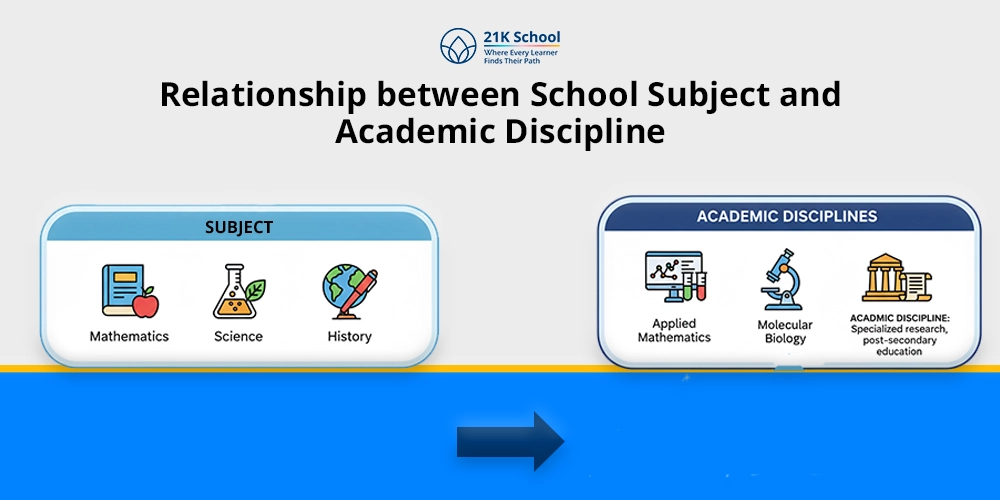
Have you ever thought of how things taught in school relate to academic disciplines?
Academic learning subjects and disciplines will be crucial bridges between the world of knowledge and the development of learners. The two concepts, though closely related, are different.
An academic area taught in the school curriculum, e.g. mathematics, history, or science,is formed or founded on educational goals and aligned to the level of development of the students.
On the other hand, an academic discipline is a broader field of systematic inquiry and research practised by educated persons and scholars, such as Physics, Sociology or Linguistics.
The relationship between school subjects and academic disciplines needs to be comprehended, as school subjects often base their foundations, content, and style on academic disciplines, and also often reorganise them according to pedagogical needs.
Table of Contents
What is a School Subject?

A school subject is a particular field of study, which is taught in school as one of the curriculum. It is a designed pool of behaviours, knowledge and skills that are expected to assist the students to gain knowledge and experience in specific areas of specialisation.
Those include Mathematics, English, Science, History, Language and Geography. School subjects are usually grounded on broader knowledge fields, known as academic disciplines are simplified and made more accessible to the age, hobbies and learning methods of students.
Every subject has its objectives, material and how it is taught and examined. The main purpose of the school curriculum is to instruct, impart critical thinking and provide the learner with more studies and career opportunities after school.
What is an Academic Discipline?

Academic discipline in post-secondary education refers to a special study and a specialised field of research in any field. It is defined by its unique theories and concepts and practices and is utilised in the field of study to regulate the knowledge creation and interpretation process in the field.
Unlike school subjects that are geared towards the classroom-based learning process, academic subjects help in creating insights as well as constructing new knowledge.
To put it in simple terms, academic disciplines are the baseline on which subjects covered in schools are based, which means that they give the content and the outline that can be simplified and made by teachers to be taught in various levels of education.
What is the Relationship Between School Subject and Academic Discipline?
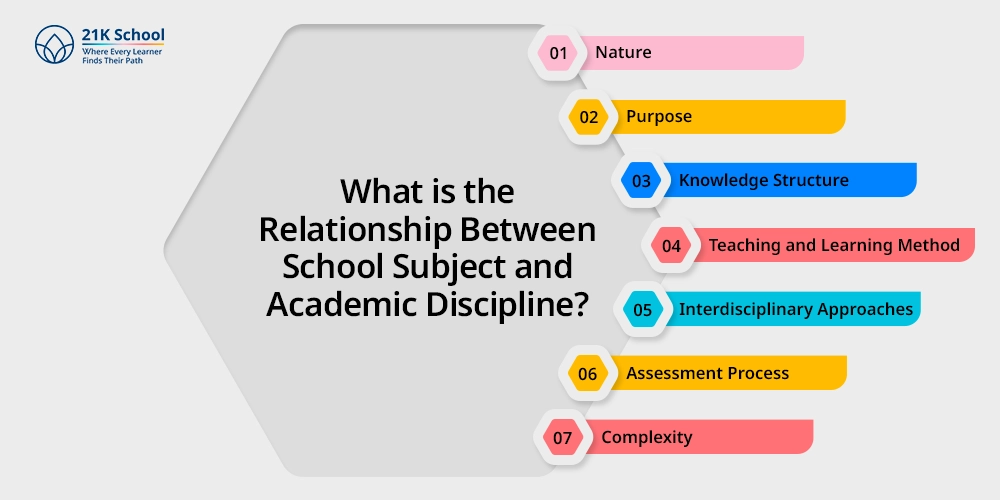
School subjects are simplifications of the academic disciplines, and are specifically meant to provide the students with an introduction to the subject, whilst the academic disciplines refers to the specialised research-oriented subjects of higher education.
The classes covered in school are typically supposed to provide the rudimentary information and skills, and the academic classes are supposed to widen the knowledge, develop expertise, and make professionals. The correlation between school subjects and academic disciplines is as illustrated below.
1. Nature
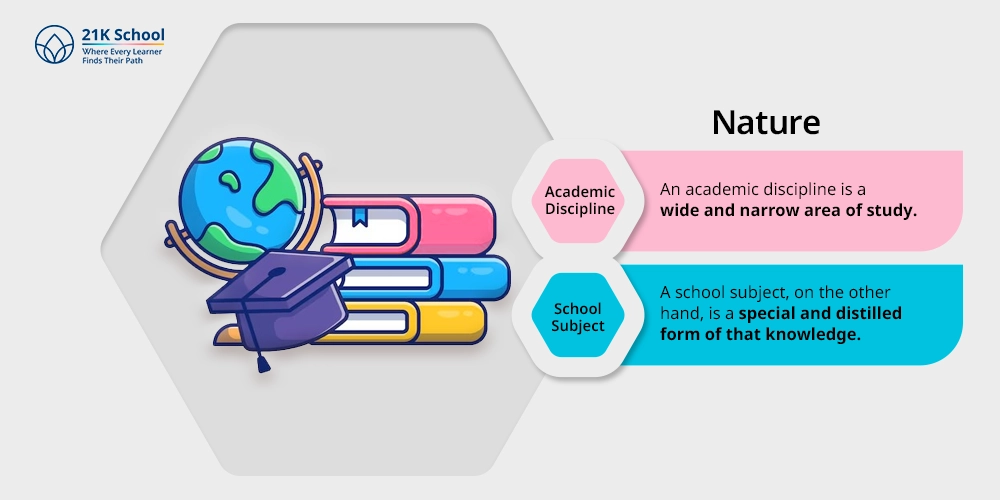
The essence of a subject in school and an academic subject varies primarily in scope and detail. An academic discipline is a wide and narrow area of study which deals with producing and developing knowledge on the basis of research and academic investigation. It is conceptual, technical and usually targeted at specialists and scholars.
A school subject, on the other hand, is a special and distilled form of that knowledge, made classroom teachable and appropriate to the age, interests, and learning abilities of the students.
2. Purpose

Academic discipline is supposed to spread knowledge, produce theories and enhance human understanding in a given discipline. Researchers in a given field are in the quest to answer new questions, resolve issues, and publish their findings to add value to their field of study.
Conversely, a school subject should be educational and developmental, enabling the learner to gain basic knowledge, skills and attitudes that will be a preparation for further studies and real life.
3. Knowledge Structure

The knowledge structure of an academic field is an advanced network of theories, concepts, principles and methodologies, which constitute the field of study. Such fields as Physics, History, or Economics are oriented to the production of new knowledge in the form of research and academic inquiry.
A school subject, in contrast, is a simplified and structured form of this knowledge of discipline, but adapted to the knowledge of students at various learning stages.
4. Teaching and Learning Method
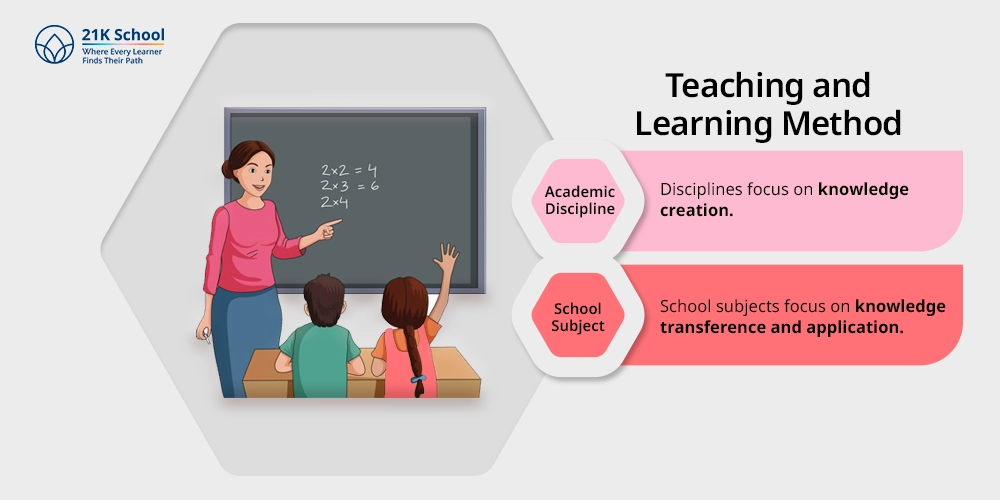
There is a relation and difference between the teaching method and learning techniques in the academic field as well as in the school subjects. Teaching in academic subjects becomes inquiring, exploring and learning through research, with the learner taking matters independently and making investigations and critically interpreting evidence.
Whereas disciplines focus on knowledge creation, school subjects focus on knowledge transference and application.
5. Interdisciplinary Approaches
Interdisciplinary learning methods bridges the school subject and academic discipline by creating a pedagogical connection, integration and context, curriculum development, real-world application, and simplifying the complexity.
In the pedagogical connection, the subjects are taught in a pedagogical environment offering more holistic view of the knowledge. The integration and context used in interdisciplinary approach allows school to combine different subjects and make learning relevant.
The curriculum development based on the interdisciplinary approach combines different subjects for best knowledge-sharing. In interdisciplinary approach, learners are encouraged to use and evaluate the real-world applications, helps in the creation of knowledge through real-world research, and hence simplifies the complexities.
6. Assessment Process
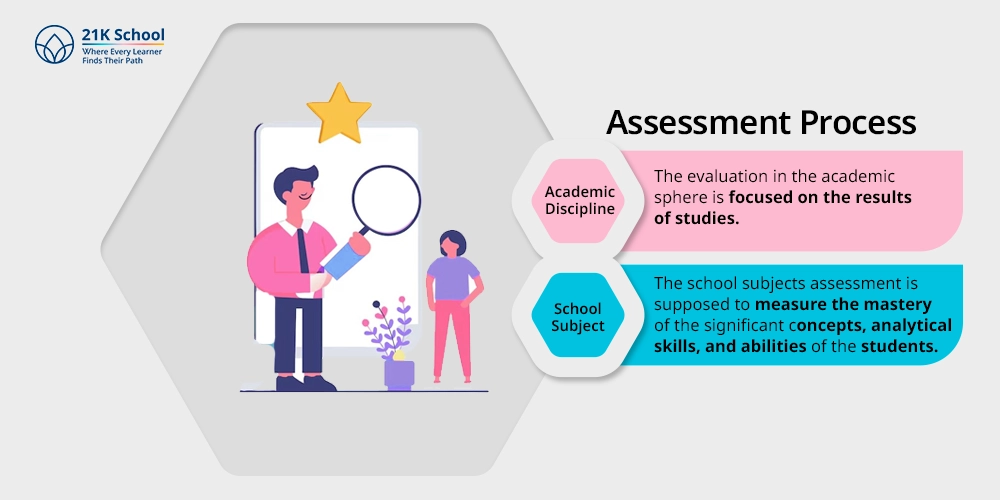
In the field of education and school-related studies, evaluation must serve different purposes. The evaluation in the academic sphere is focused on the results of studies, the ability to analyse, and the contribution to the knowledge itself and typically through research papers, theses, or peer-reviewed journal articles.
The school subjects assessment is supposed to measure the mastery of the significant concepts, analytical skills, and abilities of the students on tests, assignments, projects, assessments, and practical activities.
7. Complexity
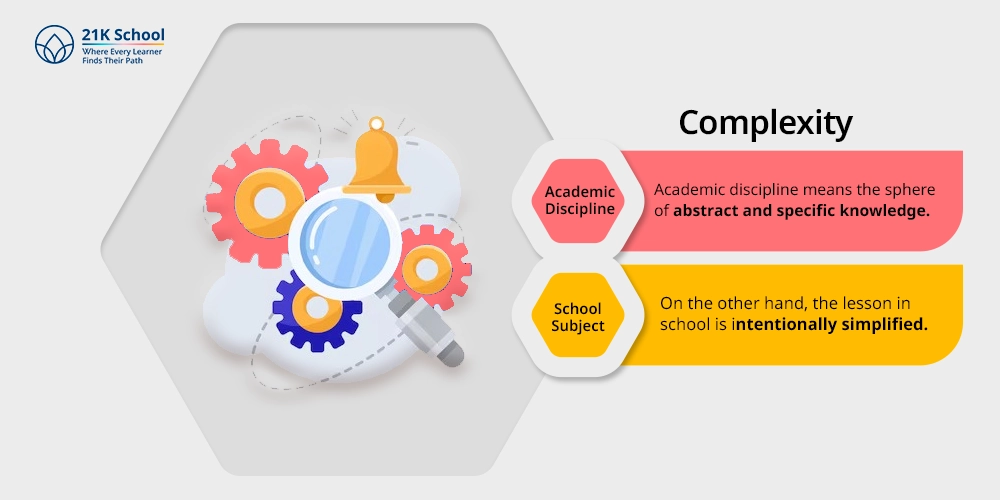
A professional field and a school course have a great difference in the level of sophistication. Academic discipline means the sphere of abstract and specific knowledge which requires higher-order thinking, critical analysis and deep theoretical knowledge.
On the other hand, the lesson in school is intentionally simplified; it is structured in accordance with the level of development among the students and their awareness of the simple principles, facts and self-management skills.
Conclusion
Academic and school subjects are closely related, however, they have another application in the school process. The academic disciplines are the roots of knowledge that is determined by research and scholarly investigation and it is the school subjects that are based on this knowledge and are more adaptable and easier to educate and acquire at school.
Approaches in course subjects will simplify the learning of harder concepts in disciplinary studies and formulate lessons through which the students can acquire knowledge, skills and curiosity.
In doing so, the relationship between the two would ensure that the education is not based on academic knowledge only, but rather based on the developmental needs of the learners.

You may also want to read