

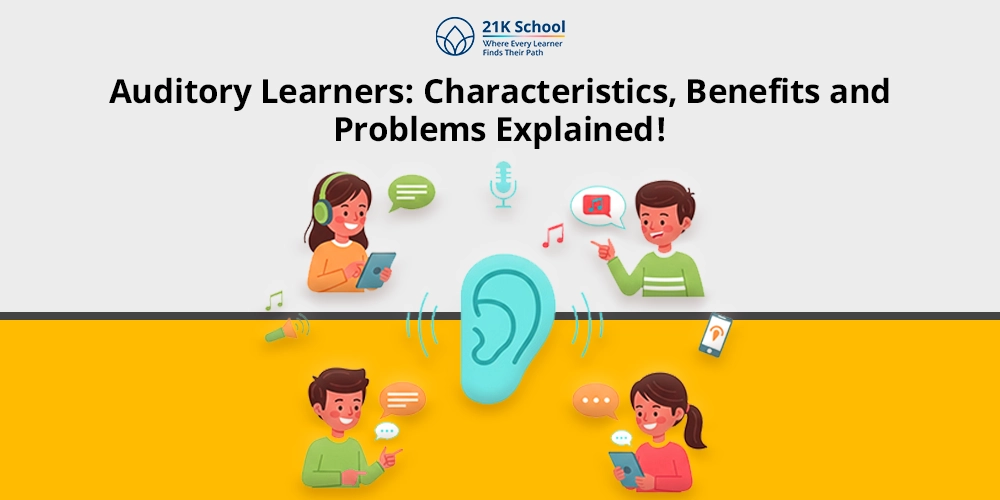
Have you ever wondered what is different about auditory learners other than other learners?
Auditory learners are the students who learn and retain information through sound. It is either listening to lectures, engaging in conversations or listening to instructions read out aloud; either way, these learners use their hearing sense to process and internalise new ideas.
When it comes to the learning method in a learning institution, knowing the strengths and weaknesses of auditory learning can help a teacher design a lesson that can be easily understood and comprehended.
Understanding the ways auditory learners think and learn, teachers and parents can work out the ways that will enable improving learners’ academic performance and make the learning process seem more entertaining.
Table of Contents
Who is an Auditory Learner?
Auditory learners are those people who learn through listening to words and sounds. They remember and comprehend information better when it is spoken as opposed to when it is written or illustrated in a visual learning format.
These learners prefer lectures, discussions, and audiobooks. They are likely to be good listeners and speakers, like in group discussions and verbal repetitions.
Auditory learning is a form of learning in which individuals best learn by listening. Those who will adore this taste will be able to grasp information better when it is presented orally rather than in a graphical or interactive form.
Verbal communication, discussions, audio-recordings, verbal learning, reading out loud, and storytelling are also enjoyed by them. Auditory learners tend to work effectively in an environment where they have the opportunity to listen, speak, pose questions, and process information through hearing.
How to Identify Auditory Learners – 5 Ways
It is important to identify auditory learners in order to adapt their methods of teaching to their strong sides. Such learners receive information better by listening and talking.
Their listening habits and their involvement in discussions will allow the teachers and parents to know which learning style they prefer and guide them to achieve academic success.
1. Better at Oral Assessment
Oral assessment suits auditory learners better since they learn better when it is spoken. They are articulate in their speech and answer questions asked verbally with confidence.
They are better able to perform in their presentations, interviews, and discussions because their capabilities of processing spoken information are more effective than when taking written exams.
2. Better Listening Skills
Auditory learners are good listeners, and they can best receive instructions in the form of lectures, conversations and spoken instructions. They can see the tone, emphasis, and other details that other people might miss.
They listen attentively and thus, they absorb lessons faster, they follow instructions whenever they are given, and they remain active when it comes to discussions or storytelling.
3. Easily Distracted by Noise
Auditory learners are very sensitive to noise and require a proper study environment, hence are easily distracted by noise around them.
Their attention is soon disrupted by conversations, traffic, or disturbances in the classroom. They are also influenced by a noisy environment in terms of information processing. Giving them a silent environment will enable them to remain on course and enhance their learning effectiveness.
4. Memory for Sound
Auditory learners possess vigorous memory by sound, and they can easily memorise lectures, conversations and other directions that are spoken.
They recall orally presented information a long time before they forget, when it is written. This skill makes them perfect for learning languages, discussions, verbal recall or listening to tasks.
5. Enjoy Discussion
Auditory learners engage in discussions as they are able to learn by speaking and listening. Discussing allows them to simplify the ideas, ask questions, and express their ideas.
Discussion-based classroom learning makes them more comfortable and effective in learning and classroom discussions, as well as group work, which helps to improve their learning.
Characteristics of Auditory Learners
Auditory learners have strange features that determine their approach towards sound and speech-based learning.
These attributes can be utilised to comprehend the strong points of the teachers and parents to ensure that they modify their parenting and teaching methods. The auditory learners have the following characteristics.
1. Strong Memory
Auditory learners possess a strong sound memory, which enables them to memorise what has been spoken to them, lectures and when talking to other people with ease. They tend to recollect tone, rhythm and words more than written information.
This good auditory memory makes them find it easy to follow instructions, engage in discussions and retain lessons given through speech over a long time.
2. Verbal Skills
Learners with the auditory style tend to be good verbal learners since they think and communicate using language. They express themselves well, love discussing issues, and interact with their colleagues and educators.
Their fluency in language skills makes them better storytellers, presenters, debaters, and classroom participants, and verbal expression is one of their strengths both academically and socially.
3. Active Listening
Auditory learners are characterised by active listening. They listen to verbal explanations, tone and accent given keenly, and therefore they will be able to get concepts at a deeper level.
They can listen attentively, and this makes them grasp lessons more quickly; and they are also able to participate actively in a discussion. The skill also contributes to enhanced understanding, reduced misunderstandings, and enhanced group discussion or classroom participation.
4. Active Participation
Auditory learners are usually very active throughout the lesson because oral communication enhances their learning process. They also pose questions and interrelate with the ideas, and discuss how to handle the information more effectively.
They love to talk, and that is why they will associate with the lesson, clarify their doubts and enhance the learning. They are also more empowered and strengthened in their communication and social competencies within a teamwork environment.
5. Distractibility
As auditory learners are reliant on the sound, a distraction caused by noise might be easy. Background talking or traffic, or noise can interrupt them in the classroom. They are also sensitive to sounds, and hence it becomes hard to concentrate in a noisy place.
Such distraction can undermine the understanding and performance, except when they study in isolated environments or put mechanisms to deal with the distraction-based noise.
6. Emotional Awareness
The auditory type of learners may exhibit a great sense of emotion since they easily catch the tone, the pitch, and the voice variations. Such signals make them know how others feel in a better way.
Their acoustic sensitivity enables them to read emotions in a conversation, and thus they are sensitive listeners who make them good communicators. This emotional intelligence makes them relate better and become capable of responding intelligently in any social or learning context.
7. Confident Speaking Skills
Auditory learners normally have good speaking abilities, which they usually have as they find it easy to speak. They also communicate well, talk and feel at ease speaking to a crowd.
They become more confident by discussing, presenting and arguing. This strength makes them express themselves properly, make others talk, and excel in oral tests or other tasks when speaking in front of an audience.
8. Improved Comprehension Skills
Auditory learners normally demonstrate good reading comprehension skills, whereby the information flow is facilitated through the auditory means. They perceive complicated concepts better through the use of explanations, narrations and discussions.
The tone and emphasis that they can read can help in better comprehension. Listening and learning help them to learn fast, pose relevant questions, and retain. Thus, verbal teaching is particularly relevant to their academic achievement.
Benefits of Auditory Learning
Auditory learning has many benefits for students who learn information best by listening. With the use of oral instructions, conversations, and audio messages, such learners will be able to develop memory, communication, and confidence. Auditory learning has the following advantages.
1. Interactivity
Auditory learning promotes interactive learning where the students engage in speaking, listening and asking questions. This dialogue reinforces the learning process since the learners are not mere consumers of information.
Auditory learners also remain engaged in their minds, acquire concepts better and forge better relationships with the material and peers by discussion, dialogue and oral activities, thus creating a more dynamic learning and participatory learning atmosphere.
2. Enhances Memory
Auditory learning plays a significant role in enhancing memory since learners can memorise spoken words, tone and rhythm than written messages. Lectures, stories or discussions allow them to remember things longer.
Their good memory in auditory enables them to recall explanations, instructions and talks vividly. This is an improved memory, which contributes to academic achievement and increases confidence in activities involving verbal knowledge or remembrance.
3. Brainstorming
Auditory learners are effective in the process of brainstorming since they understand ideas better in oral communication. Listening to what other people think triggers their ideas and enables them to develop creative thinking abilities.
The verbal communication enables them to discuss possibilities, exchange ideas, and develop ideas. Such teamwork of minds will foster innovativeness, enhance problem-solving skills, and allow auditory learners to learn hard topics.
4. Encourages Critical Thinking
Auditory learning stimulates critical thinking as it encourages the learner to critically analyse what they hear, by asking relevant questions and interpreting tone or context.
They discuss and argue others out, thus considering various opinions and coming up with well-grounded opinions. The active listening to different views enhances their reasoning skills, ability to compare and make inferences.
5. Boost Confidence
Spoken and listening activities tend to give auditory students confidence and suit their innate abilities. The involvement in the discussion and presentation of classes, as well as verbal assignments, will help them demonstrate their skills.
Their self-esteem increases as they communicate effectively and answer questions. This is carried into social life and in school work, where they are encouraged to actively participate in learning processes.
6. Enhances Communication Skills
Auditory learning improves the power of communication skills, since the learners frequently share ideas, as well as listen to others and talk to them. They become clear in speech, articulate, and converse well.
Discussions, group work, and oral activities can be adjusted to constant practising, which will allow them to perfect the use of language. They will ultimately be better speakers in both academic and real life.
7. Engagement
Auditory learning enhances the student’s engagement through a dynamic learning approach, as the lessons are more interactive and based on speech. When information is given in the form of a story, discussions, audio clips or through verbal explanations, learners remain alert.
This would keep them busy in the head and eliminate boredom. When their main learning style is involved, they become interested in the process of learning, and they get motivated to learn the concepts in detail.
8. Enhance Listening Skills
Auditory learning is the one that develops the listening skills naturally, since listening learners depend on the sound to take up the information. They train themselves on listening to details, tone and context.
This continual exposure enhances the power of listening to their surroundings and speaking as well as reading speedily. Good listening competencies help them at school, in relationships, and in their day-to-day communication, and they are better learners and communicators.
Common Problems of Auditory Learning
Auditory learning has many advantages, but it also has its problems; it can be experienced that learners who mostly learn through auditory means may undergo this problem.
Their performance can be influenced by issues such as distraction, problems with reading or writing activities, as well as problems with visual or hands-on activities. The following are the issues related to auditory learners.
1. Distractions
The auditory learners are so sensitive to sound, and hence distractions become a significant problem. They can be distracted by some background noise, conversations, or some minor sounds, making stress management essential to their learning effectiveness.
They are very dependent on hearing; they are easily distracted by any unwanted sounds, hence they struggle to receive information. They need a calm, positive learning environment that will make them remain focused and productive.
2. Difficulties in Individual Work
Working alone may be a challenge to auditory learners as it may be achieved without verbal interaction with most of them, i.e., through reading, writing and especially paying attention to the silent tasks.
Their study preferences are discussion and listening, and therefore, studying alone may not be interesting and easy to digest.
In the event of these not being explained or talked about in discussions, they may not be interested or may not understand the concepts in a proper manner when they do it independently.
3. Lack of Motivation
Auditory learners may become demotivated in case there is no verbal explanation and discussion of the lesson. Activities that require much reading or writing are either tedious or rigorous, and they might not be of interest.
They will not be able to maintain interest when they fail to receive the kind of learning style they prefer. Verbal guidelines and collaborative learning effort, or audio materials, may be delivered to make them and attend to them.
4. Environmental Disruption
As sound is essential to auditory learners, it can be easily disturbed by such environmental problems as noisy classes, traffic, or conversations around. These sounds interfere with their concentration, and they cannot process the information with ease.
Even the smallest inconveniences will make them lose track. The kind of learning environments that may be noisy or unpredictable may greatly impair their performance and general learning experience.
5. Difficulties in Reading and Writing
Reading and writing activities are usually more difficult for auditory learners since they are not as sound-intensive as they are visually intensive. They might not be able to concentrate, comprehend written instructions or communicate effectively on paper.
Unless there is verbal reinforcement, written content may become less stimulating, and literacy-based assignments would be more difficult and possibly have an impact on their academic results in reading-intensive courses.
6. Challenges in Visual and Kinesthetic Work
Auditory learners can also encounter problems with what time and space learning is, visual or physical, like charts, diagrams, experiments, or physical activities. Their best way of learning does not coincide with these approaches, which makes them understand slowly.
They might be lost or even detached without verbal explanations. They need guidance frequently in the form of words and visual or physical exercises to comprehend with ease and be effective.
8 Strategies for Auditory Learners
Where learning involves listening and talking, auditory learners excel. Certain strategies, including reading aloud, discussions, audio materials, and storytelling, could help them internalise information better, retain more and be interested in the learning process.
The following are the strategies for auditory learners.
1. Read Aloud
Auditory learning is also improved through reading out loud, where the written information is changed into sound. Recording their voice helps them to understand better, retain their memory and makes them attentive.
This is a powerful technique that is particularly effective in learning challenging ideas, memorising narratives, and revising notes. It is also through reading aloud that they can recognise tone, rhythm and emphasis, which in turn enhances learning and retention.
2. Audiobooks
Audiobooks enable the learning process to be very effective for auditory learners since they enable them to take in information through listening as opposed to reading. Listening to the material also enables them to comprehend complicated concepts, narratives more easily and be more attentive.
Audiobooks are also flexible, and one can learn anywhere in case whether travelling or wasting time. By making the study enjoyable and reinforcing understanding and memory with clear verbal explanations, they make it more enjoyable to study.
3. Group Discussions
Group discussions are very effective for auditors since they are good for interactive learning, where they share ideas orally. Discussing ideas, posing questions and listening to divergent ideas solidify knowledge.
Discussions also assist them in clearing doubts, remaining motivated, and gaining a deeper information processing. This interactive approach boosts communication as well as makes learning more fun, interesting and valuable.
4. Songs and Rhymes
Songs and rhymes are advantageous because they help auditory learners to remember information more easily with the help of rhythm and melody. Learning vocabulary, formulas, or concepts, the elements of music help them memorise it longer and remember it faster.
This process makes the process of learning enjoyable and enhances memory networks. Songs and rhymes can be most useful with younger learners or those learning repetitive content.
5. Promotes Active Listening
Active listening should be encouraged to enable the auditory learner to remain concentrated and enhance understanding. Such strategies as making notes during listening, summarising what is being said, and using effective revision tips help them become more involved.
Listening also helps them become more astute to details, tone, and points. This approach enhances the overall learning performance, particularly in the lecture, presentation or discussion where the audio processing is critical.
6. Audiotape and Podcast
The audio recordings and podcasts also offer a good learning experience to auditory learners as they get information through spoken words. They are able to listen at the pace they want, replay problems and discuss subjects in a format that is comfortable to them.
Learning is made accessible and enjoyable because the topics in the podcasts are varied. These tools facilitate memory, enhance understanding and enable learning to be conducted outside the normal classrooms.
7. Repetition
Repetition is very important to auditory learners since they learn to hear information more than once, and this helps them remember. Restatement of instructions, rechecking of recorded notes, or rehearsing of oral ideas aids in cognitive learning and long-term retention.
Repetition is made via verbal means to enhance comprehensibility and to memorise important points. The method works particularly well with learner’s vocabulary development, retention of definitions or in situations where the oral examinations are important, and the use of sound-based memory is essential.
8. Storytelling
Storytelling involves the use of auditory learning, whereby information is given in an organised and memorable manner. Listening using stories allows them to visualise concepts, perceive ideas better and have long-lasting memories.
Storeys render the lessons familiar and easier to learn, particularly in the case of complicated or abstract studies. This plan makes the understanding better, improves listening skills, and increases the general interest in the learning process.
Ending Note
The auditory learners have their own manner of processing information, and they are good in an atmosphere where verbal communication, speaking and listening are given importance.
Having knowledge about their strengths, traits and weaknesses, teachers and parents can devise personalized learning strategies that will enable them to memorize and gain interest.
Their learning, communication, and academic performance in general are also improved by the use of such tools as discussions, audiobooks, storytelling, and repetition.
Auditory learning could be understood to make the education of such learners more inclusive and effective to enable them to achieve their potential.

You may also want to read